Key takeaways
- 20–30 L: one traveler, drinks and simple meals, or a removable weekend setup.
- 35–45 L: the best compromise for two people in most camper vans.
- 50–60 L: longer trips, more fresh food, or a family using the van.
- 60–75 L dual-zone: separate refrigerator and freezer compartments, but higher power use and greater installation demands.
Best 12V Portable Refrigerators for Camper Vans
The best 12V portable refrigerator for most camper vans is a 35–45-liter compressor model such as the Dometic CFX5 35/45, ARB Zero 36/47, or ICECO VL45, while compact vans and weekend campers are better served by a 20–30-liter unit.
Unlike thermoelectric coolers, these refrigerators use a compressor and can hold a stable refrigerator temperature even when the van interior is warm. The right choice depends less on the advertised maximum capacity than on four practical questions: how much food you carry, how much battery capacity you have, where the refrigerator will sit, and whether you need a freezer compartment.
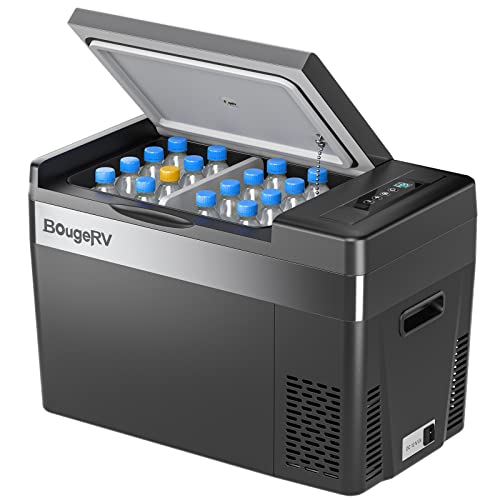
BougeRV 12v refrigerator 30 Quart, -8℉~50℉ Portable Freezer for Car, Black
Included for 'Best 12V Portable Refrigerators for Camper Vans' because the listing specifies 8℉~50℉ Portable Freezer for Car and Black, details this guide uses to compare options.
View on Amazon
BODEGACOOLER 12 Volt Refrigerator, 2.94cu.ft RV Fridge with APP Control
Included for 'Best 12V Portable Refrigerators for Camper Vans' because the listing specifies 2.94cu.ft RV Fridge with APP Control, details this guide uses to compare options.
View on Amazon
VEVOR 12 Volt Refrigerator, 42.3 QT/ 40L Car Fridge, Portable Ultra-Light EPP Freezer, APP Control Electric Compressor, 12V/24V DC, 14℉ to 50℉, for Truck Van RV SUV Boat Travel Camping ASIN B0GZB65DNP
Included for 'Best 12V Portable Refrigerators for Camper Vans' because the listing specifies 42.3 QT/ 40L Car Fridge and Portable Ultra-Light EPP Freezer, details this guide uses to compare options.
View on Amazon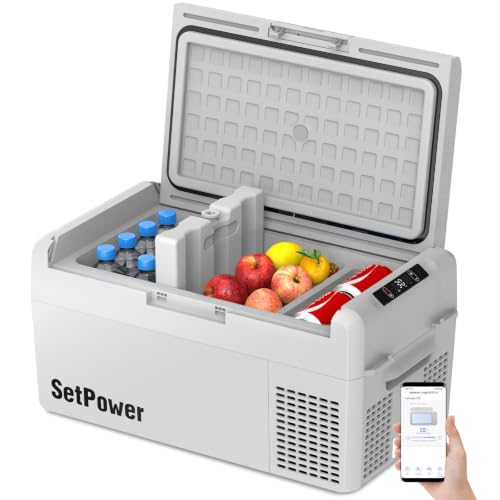
Setpower 12V Refrigerator 21QT Car Refrigerator 12V Fridge Freezer Grey
Included for 'Best 12V Portable Refrigerators for Camper Vans' as a relevant option in this category; details come from the product listing.
View on AmazonQuick comparison: the strongest choices by camper-van use
| Model or class | Usable capacity | Typical average draw | Approximate size | Best fit |
|---|---|---|---|---|
| Dometic CFX5 35 | About 36 L | Approximately 0.25–0.65 Ah/h at 12 V | About 69 × 40 × 41 cm | Compact vans, front-cab storage, two travelers |
| Dometic CFX5 45 | About 46 L | Approximately 0.30–0.75 Ah/h at 12 V | About 69 × 48 × 41 cm | General-purpose van kitchens |
| ARB Zero 36/47 | About 36 or 47 L | Approximately 0.30–0.80 Ah/h at 12 V | Roughly 72–79 cm long | Rugged installations and slide-out platforms |
| ICECO VL45 | About 45 L | Approximately 0.30–0.80 Ah/h at 12 V | Roughly 70 × 40 × 48 cm | Value-focused builds with generous vertical clearance |
| Compact 20–30 L compressor class | About 20–30 L | Approximately 0.20–0.55 Ah/h at 12 V | Usually 55–65 cm long | Minivans, solo travelers, and removable setups |
| Dual-zone 60–75 L class | About 60–75 L | Approximately 0.60–1.40 Ah/h at 12 V | Usually 90 cm or longer | Full-size vans with large electrical systems |
Actual consumption varies substantially with ambient temperature, set point, ventilation, how often the lid is opened, and whether the contents start warm. The figures above are planning ranges rather than laboratory ratings.
Head-to-head: which refrigerator is best for your layout?
Best all-rounder: Dometic CFX5 35 or CFX5 45
The CFX5 range is a strong choice when you want efficient cooling, a robust cabinet, multiple power options, and an interior that is easy to organize. The 35-liter version is easier to fit behind a front seat or beneath a short galley. The 45-liter version gives two people more useful food storage without becoming as difficult to place as a dual-zone refrigerator.
Choose the CFX5 35 for a compact van, a narrow aisle, or a removable refrigerator that must be carried outside. Choose the CFX5 45 when the refrigerator will live on a fixed platform and you regularly store fresh food for several days.
Best for rugged fixed installations: ARB Zero
ARB Zero refrigerators suit owners who prioritize durable hardware, a sturdy lid, and a refrigerator designed for vehicle travel. The 36- and 47-liter sizes are especially practical when mounted on a slide-out near the rear doors. Check the hinge and lid clearance before installation: a refrigerator can fit within a cabinet but still be unusable if the lid cannot open fully.
ARB’s longer, vehicle-oriented shape can be an advantage in a rear storage bay, but it may be less convenient in a narrow galley than a squarer refrigerator. A fixed slide should also support the loaded weight, not just the empty unit.
Best value-oriented 45-liter option: ICECO VL45
The ICECO VL45 provides the familiar single-zone 45-liter format at a price that is often lower than premium alternatives. It is a sensible match for a van with a 100–200 Ah auxiliary battery and a conventional 12V socket or dedicated fused circuit.
Before buying, verify the exact variant’s included accessories and low-voltage cut-off settings. Product bundles and revisions can differ. For a permanent installation, use the refrigerator’s actual current rating and cable length to size the fuse and wiring rather than copying a generic diagram.
Best for small vans: a 20–30-liter compressor refrigerator
A compact refrigerator wastes less floor space and is easier to lift out when the van is used as a daily vehicle. It normally holds food for one person or a weekend for two, but the smaller interior can become inefficient if bulky bottles occupy most of the volume.
Compact units are often taller than expected. Measure the available height with the lid open, especially beneath a bench or bed platform. If the refrigerator must slide out, include room for the handle, ventilation, wiring bend radius, and the movement of the slide.
Capacity: choose usable space, not the headline number
Refrigerator capacity is measured in liters, but the useful capacity is reduced by baskets, divider walls, compressor housings, and the space required for airflow. A 45-liter single-zone model may be more practical than a 60-liter dual-zone model if you do not need a freezer.
- 20–30 L: one traveler, drinks and simple meals, or a removable weekend setup.
- 35–45 L: the best compromise for two people in most camper vans.
- 50–60 L: longer trips, more fresh food, or a family using the van.
- 60–75 L dual-zone: separate refrigerator and freezer compartments, but higher power use and greater installation demands.
Remember that a refrigerator packed with cold food consumes less energy than one repeatedly loaded with warm groceries. Pre-chilling food at home can reduce the initial high-duty-cycle period after departure.
Power draw and a worked battery calculation
Compressor refrigerators do not draw their maximum current continuously. A typical 35–45-liter unit may draw roughly 3–5 amps while the compressor is running, then cycle on and off. In warm weather, a realistic average may be 0.4–0.8 amps per hour at 12 volts.
For example, assume a 45-liter refrigerator averages 0.6 amps per hour, a 12V system, and a two-day stop:
0.6 A × 24 hours × 2 days = 28.8 Ah
That is the refrigerator alone. Add a 20 percent planning margin for hot weather and door openings:
28.8 Ah × 1.2 = approximately 35 Ah
A 100 Ah lithium auxiliary battery may therefore have enough usable capacity for the refrigerator and modest lighting over a weekend. A 100 Ah lead-acid battery should not normally be discharged as deeply, so the same trip requires more reserve. If the refrigerator averages 1.0 amp per hour in hot conditions, the two-day requirement rises to approximately 58 Ah after the same margin.
Use a dedicated fused circuit where possible. Long, thin wiring can cause voltage drop and trigger the refrigerator’s low-voltage protection even when the battery still has energy. Follow the refrigerator manufacturer’s fuse recommendation, and consider heavier cable for long runs from the battery to the rear of the van.
Compressor performance, insulation, and ventilation
A compressor model should be able to cool below normal refrigerator temperature and, in a suitable compartment, freeze food. Performance is affected by heat removal: the compressor and condenser need clearance so they can release heat into the van or outside air.
Insulation matters most when the van is parked in the sun. Thick walls reduce compressor run time, but no portable refrigerator can overcome a sealed, unventilated cabinet indefinitely. Leave the clearance specified by the manufacturer around the compressor side and avoid placing the unit against an uninsulated metal body panel.
For best efficiency, set the refrigerator around 3–4°C for food storage and use a separate freezer compartment only when needed. Setting the entire cabinet to freezer temperature can multiply energy use and reduce available food space.
Compatibility matrix for common camper-van layouts
| Your situation | Recommended format | Why | Check before buying |
|---|---|---|---|
| Minivan or short-wheelbase van | 20–35 L single-zone | Lower footprint and easier removal | Seat clearance, lid opening, carry handles |
| Two-person fixed bed and galley | 35–45 L single-zone | Good balance of capacity and power | Slide width, ventilation, drain access |
| Rear-door slide-out kitchen | 35–50 L rugged portable model | Easy outdoor access and loading | Slide rating, lid hinge clearance, cable slack |
| Family van with large solar system | 50–75 L, possibly dual-zone | More food storage and freezer flexibility | Battery reserve, solar harvest, aisle width |
| Daily driver with removable camping gear | 20–35 L lightweight model | Practical to lift out between trips | Loaded weight and accessible 12V outlet |
Installation checks that prevent common problems
- Measure the complete path: confirm the refrigerator fits through the doors, around cabinets, and onto its final platform.
- Allow lid clearance: the required height is often greater with the lid open than with the lid closed.
- Provide airflow: do not tightly box in the compressor end without the specified ventilation gap.
- Use a secure mount: a full refrigerator can weigh dozens of kilograms and must not move during braking.
- Protect the power connection: avoid loose cigarette-style plugs for permanent installations if the refrigerator has a more secure connector option.
- Keep it level enough for travel: compressor refrigerators tolerate normal vehicle movement, but follow the manual for storage and unusual angles.
Final recommendation
For most two-person camper vans, choose a 35–45-liter single-zone compressor refrigerator. The Dometic CFX5 35 is the better compact fit, the CFX5 45 is the more versatile general-purpose choice, and the ARB Zero 36/47 is attractive for rugged slide-out installations. The ICECO VL45 is worth considering when capacity matters and the exact dimensions, power settings, and included accessories match your build.
Only move to a dual-zone 60–75-liter refrigerator if you need a freezer and have the floor space, ventilation, and battery capacity to support it. In a small van, a well-insulated 30-liter refrigerator with reliable wiring will usually be more useful than a larger model that blocks the aisle or drains the auxiliary battery.