Our Top Picks
Best 72 Inch TVs for Big-Screen Viewing
The best 72 inch TV for most buyers is a high-quality 75-inch model, because true 72-inch televisions are uncommon; the 75-inch class gives you nearly the same screen size with far more choice in OLED, mini-LED, and budget LED panels.
Quick Recommendations
| Best for | Recommended class or model | Why it stands out | Typical price range |
|---|---|---|---|
| Dark-room movies and premium gaming | LG OLED evo C5 77-inch | Per-pixel contrast, excellent viewing angles, four HDMI 2.1 inputs | Usually $2,000–$3,500 |
| Bright-room OLED viewing | Samsung S90F 77-inch | Very strong color volume, 4K 144Hz gaming, wide viewing angle | Usually $1,800–$3,000 |
| Bright rooms and sports | TCL QM8K 75-inch | Mini-LED backlight, high HDR brightness, 4K 144Hz support | Usually $1,000–$1,800 |
| Lower-cost large-screen viewing | 75-inch full-array or QLED LED TV | Large picture for less money, no OLED burn-in concern | Usually $500–$1,000 |
| Balanced movie and TV performance | Sony BRAVIA 5 75-inch | Mini-LED contrast, strong processing, natural-looking motion | Usually $1,000–$1,700 |
Model availability and pricing can change during 2026, but these categories matter more than a small difference in diagonal measurement. A 75-inch screen is only about 4% larger in diagonal than a 72-inch screen and is normally the practical replacement.

Samsung 75-Inch Class M70H Series, Mini LED, 4K, Smart TV, 2026 Model | Samsung Vision AI Companion, Mini LED Processor 4K, Pure Spectrum Color, Endless Free Content, Motion Xcelerator + DLG 120Hz
Chosen because it specifies Mini LED and Smart TV.
View on Amazon
TCL 75-Inch R7D Series QLED 4K UHD HDR Smart Roku TV, 75R7D (2026) | High Brightness, Motion Rate 240, Google Cast & AirPlay 2, Streaming Live News, Sports, and Movies, Game Accelerator 120
Chosen because it specifies Game Accelerator 120 and FullView Bezel-Less Design.
View on Amazon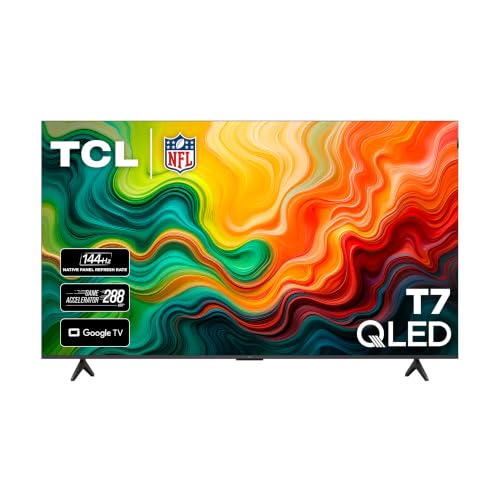
TCL 75 Inch T7 Series 4K 144Hz QLED Smart Google TV, 75T7 (Latest Model) | Dolby Vision HDR and Atmos, HDR10+, Game Accelerator 288 and VRR for Sports and Gaming, Alexa+, Native 144Hz Refresh Rate
Chosen because it specifies 75T7 (Latest Model).
View on Amazon
Hisense 75" U7 Mini-LED ULED 4K UHD Best Premium Gaming HDR Smart Google TV (75U7SG, 2026 NEW) - Hi-QLED, Native 165Hz, VRR 330, HDR10+, Dolby Vision IQ·Atmos, IMAX Enhanced, Anti-Reflection, 2.1.2 Ch
Chosen because it specifies 2026 NEW) and Hi-QLED.
View on AmazonOLED, Mini-LED, or Standard LED?
OLED: best contrast and viewing angles
OLED pixels switch off individually, so black areas can be effectively black without a backlight halo. This makes OLED the strongest choice for films, dark games, and rooms where viewers sit to the side of the screen. An LG OLED evo C5 or Samsung S90F is also well suited to current consoles and gaming PCs, with low input lag and high refresh rates.
The trade-offs are price, lower full-screen brightness than the brightest mini-LED televisions, and the possibility of permanent image retention after prolonged exposure to static content. Modern OLED protection systems reduce the risk, but a television used as a desktop monitor or left on a news channel all day deserves extra caution.
Mini-LED: best for bright rooms and HDR impact
Mini-LED TVs use many small backlight zones behind an LCD panel. Models such as the TCL QM8K and Sony BRAVIA 5 can become substantially brighter than most OLED televisions across large parts of the screen. That makes sunlight, explosions, snow, and sports highlights more visible during daytime viewing.
Mini-LED is not identical to OLED: a bright object on a black background may produce a faint halo, especially when viewed from an angle. The number of dimming zones and the quality of the local-dimming algorithm matter more than the “mini-LED” label alone.
Standard LED and QLED: best value
A conventional LED or QLED TV is usually the sensible choice when the budget is below $1,000 or the television will run for many hours every day. QLED generally improves color volume with a quantum-dot layer, while full-array local dimming improves contrast. Avoid assuming that every QLED model has strong HDR: some inexpensive sets still have limited brightness and few dimming zones.
Viewing Distance for a 72- to 75-Inch TV
For a 4K screen, a useful seating range is about 7 to 10 feet. At the shorter end, the picture feels more cinematic and exposes more detail; at the longer end, the screen is easier to take in during ordinary broadcast and sports viewing.
| Distance from eyes to screen | How a 75-inch 4K TV feels | Best use |
|---|---|---|
| 6–7 feet | Immersive; individual 4K detail is easier to appreciate | Movies, gaming, dedicated media rooms |
| 8–9 feet | Balanced and comfortable for most people | Mixed TV, sports, streaming, and console gaming |
| 10–11 feet | Large but less enveloping | General living-room viewing |
| 12 feet or more | Consider an 85-inch model if space and budget allow | Large rooms and group viewing |
Do not measure from the wall to the sofa. Measure from the position of your eyes to the front surface of the display. If most content is 1080p cable or compressed streaming video, sitting extremely close can make softness and compression more obvious.
HDR Brightness: What Numbers Matter?
HDR performance depends on peak brightness, sustained brightness, black level, color volume, and tone mapping. A television that briefly reaches a very high figure in a small white window may not look brighter than one that sustains a lower level across a large scene.
For a bright living room, prioritize a mini-LED model with strong sustained brightness and effective anti-reflection treatment. For a dark room, OLED’s black level can create greater perceived contrast even when its peak brightness is lower. Dolby Vision support may matter if it is part of your preferred streaming library, while HDR10 is the baseline format used by most HDR sources.
As a practical buying guide, aim for roughly 500 nits or more for recognizable HDR in a controlled room, around 800–1,200 nits for convincing highlights in a typical bright room, and higher sustained output when the screen faces windows. Treat manufacturer brightness claims as comparisons within a brand rather than laboratory-equivalent measurements.
Refresh Rate and Gaming Compatibility
A 120Hz panel is the sweet spot for a large gaming TV. It can display 24-frame-per-second films cleanly, show 30- and 60-frame games smoothly, and accept 4K signals at 120Hz from current consoles and compatible PCs. Some premium models support 4K at 144Hz, which is useful for a gaming PC but not essential for a console.
- 60Hz: adequate for films, television, and casual gaming, but less flexible for fast games.
- 120Hz: the recommended target for PlayStation 5, Xbox Series X, sports, and action games.
- 144Hz: valuable mainly for a PC with a graphics card capable of producing more than 120 frames per second.
- VRR: helps prevent tearing when frame rates fluctuate.
- HDMI 2.1: look for at least one port supporting 4K/120Hz; four full-bandwidth ports are more convenient for several gaming devices.
A useful bandwidth calculation explains why the cable and receiver matter. Uncompressed 4K at 120Hz contains 3,840 × 2,160 × 120, or about 995 million pixels per second. With 24 bits of RGB color, that is roughly 23.9 gigabits per second before blanking and protocol overhead. HDMI 2.1’s 48Gbps class therefore provides the necessary headroom for 4K/120 HDR, while older 18Gbps HDMI connections generally top out at 4K/60 with typical HDR formats.
Wall and Stand Dimensions
A 75-inch television is approximately 65.4 inches wide and 36.8 inches tall before its stand. The exact cabinet dimensions vary, so check the manufacturer’s specification drawing rather than relying on the diagonal size.
| Planning measurement | Recommended allowance |
|---|---|
| Wall width | At least 70 inches of clear width; 74–80 inches gives a more comfortable margin |
| Wall height | Allow about 40 inches for the screen, plus space for cables and ventilation |
| Console or cabinet width | At least 66 inches; 70 inches or more is safer for feet placed near the edges |
| Stand depth | Usually about 12–16 inches, but verify the exact model |
| Viewing height | Place the screen center close to seated eye level; avoid mounting it high above a fireplace |
Check the stand’s two foot positions. A television may fit on a wide cabinet with its feet in the outer position but fail on a narrower unit unless the feet can move inward. For wall mounting, confirm the VESA pattern, wall type, mount weight rating, and the depth required for angled HDMI connectors.
Which Big-Screen TV Fits Your Situation?
- Dark room, films, and side seating: choose OLED, especially the LG OLED evo C5 or Samsung S90F.
- Bright room, daytime sports, and HDR spectacle: choose a high-brightness mini-LED such as the TCL QM8K or Sony BRAVIA 5.
- Four gaming devices: prioritize four HDMI 2.1 inputs, 4K/120Hz, VRR, and an eARC port that does not remove the only gaming connection you need.
- Long daily operating hours or static interfaces: choose LED or mini-LED to avoid OLED image-retention concerns.
- Seating under 7 feet: consider whether a 65-inch model will be more comfortable, particularly with lower-quality broadcast sources.
- Limited cabinet depth: wall-mounting may be easier than finding a stable stand, but leave room for ventilation and cable bend radius.
Best 72 Inch TV Buying Verdict
For the best overall picture in a controlled room, buy a 77-inch OLED such as the LG OLED evo C5 or Samsung S90F. For a bright room, sustained HDR, and a lower price than premium OLED, a 75-inch mini-LED model such as the TCL QM8K or Sony BRAVIA 5 is the stronger choice. If the priority is simply obtaining the largest dependable screen for the least money, choose a 75-inch full-array LED or QLED TV with a genuine 120Hz panel rather than paying extra for a specification you will not use.