Key takeaways
- Continuous-duty or commercial-duty blower wording.
- A uniformly perforated playing surface without obvious dead zones.
- A sealed cabinet that directs air upward instead of leaking around the motor.
- Replaceable or accessible blower components, especially on expensive tables.
- A puck and striker set matched to the table rather than unusually heavy accessories.
The best air hockey tables for most home game rooms are 7- to 7.5-foot models with a full-size playing surface, a continuous-duty blower, and at least 3 feet of clearance around the cabinet; choose a 6.5-foot table only when room size or budget makes a larger table impractical.
Quick comparison: which table size fits your room?
| Table class | Typical outside size | Recommended room footprint | Motor and play characteristics | Typical market range | Best for |
|---|---|---|---|---|---|
| Compact 4.5–5 ft | 54–60 in long, 27–31 in wide | 10 × 8 ft minimum | Single small blower; slower, lighter puck | Usually $150–$300 | Children, apartments, occasional play |
| Mid-size 6–6.5 ft | 72–78 in long, 38–42 in wide | 12 × 10 ft minimum | Usually stronger single blower; adequate puck glide | Usually $300–$600 | Families and multipurpose rooms |
| Full-size home 7–7.5 ft | 84–90 in long, 42–48 in wide | 14 × 11 ft minimum | Higher-airflow blower; faster, more consistent play | Usually $600–$1,200 | Adults, regular competition, dedicated game rooms |
| Commercial-style 8 ft and larger | 96 in or longer, commonly 48–54 in wide | 16 × 12 ft or larger | Powerful continuous-duty system; loudest and heaviest | Often $1,200–$3,000+ | Serious play and permanent installations |
Our top picks by type of buyer
Best overall fit for many homes: a 7- to 7.5-foot table
A full-size home table offers the best balance between puck speed, realistic rebound angles, and manageable installation. Models such as the Atomic Top Shelf 7.5-foot air hockey table represent this category: they are substantially more playable than compact furniture-style tables without requiring the space or budget of a commercial Dynamo cabinet.
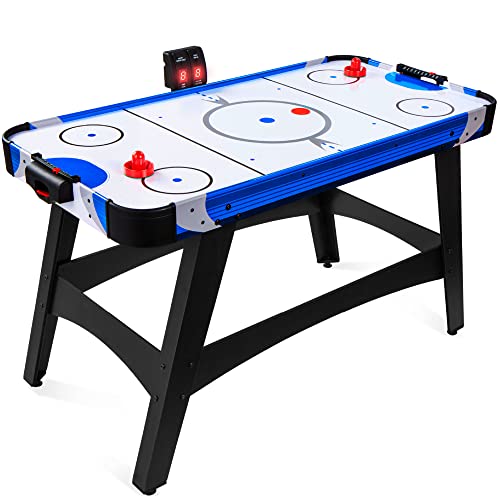
Best Choice Products 58in Mid-Size Arcade Style Air Hockey Table for Game Room, Home, Office w/ 2 Pucks, 2 Pushers, Digital LED Score Board, Powerful 12V Motor, Carrying Bag
Included for 'Best Air Hockey Tables for Home Game Rooms' because the listing specifies Home and Office w/ 2 Pucks, details this guide uses to compare options.
View on Amazon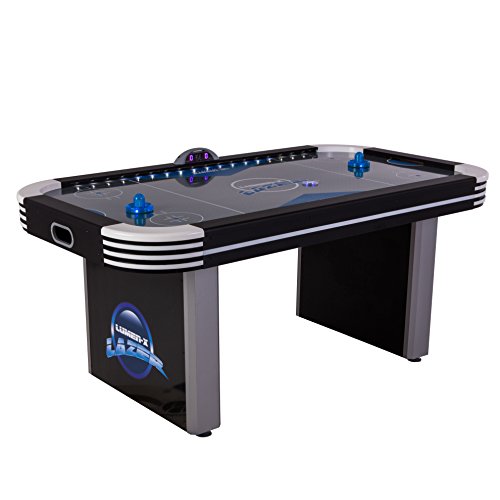
Triumph Lumen-X Lazer Air Hockey Table – 72" Full-Size LED Light-Up Air Hockey with Glowing Puck, Illuminated Strikers & Electronic Scoring – Arcade-Style Game for Family Fun & Game Rooms
Included for 'Best Air Hockey Tables for Home Game Rooms' because the listing specifies 72" Full-Size LED Light-Up Air Hockey with Glowing Puck and Illuminated Strikers & Electronic Scoring, details this guide uses to compare options.
View on Amazon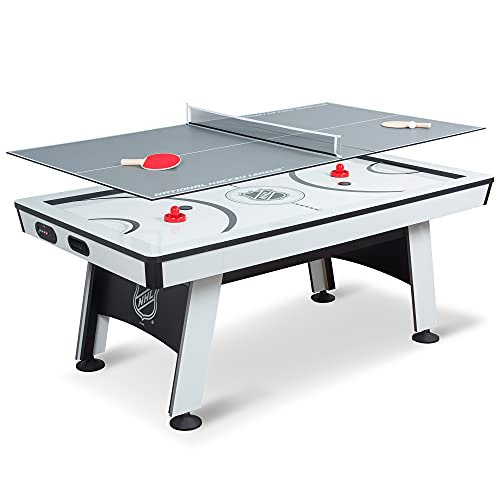
EastPoint 2-in-1 NHL Air Hockey Table and Table Tennis Top for Game Room
Included for 'Best Air Hockey Tables for Home Game Rooms' as a relevant option in this category; details come from the product listing.
View on Amazon
Triumph Fire ‘n Ice 54" LED Light-Up Air Hockey Table – Arcade-Style Game with Glowing Puck, Illuminated Pushers, Flashing Goal Corners & Electronic Scoring – Fun for Kids, Teens & Family Nights
Included for 'Best Air Hockey Tables for Home Game Rooms' because the listing specifies Arcade-Style Game with Glowing Puck and Illuminated Pushers, details this guide uses to compare options.
View on AmazonLook for a motor described as continuous-duty or high-output rather than relying on a vague “powerful motor” label. A stronger blower keeps the puck floating across the entire surface, including near the rails. That matters more than maximum puck speed: inconsistent airflow creates dead spots and makes the game feel slow even when the center of the table is slick.
Best for a multipurpose room: a 6- to 6.5-foot table
A 6.5-foot table is often the sensible choice for a family room, basement, or shared home office. Hathaway and Triumph have produced tables in this general class, although exact dimensions and features vary by model year. These tables normally provide enough playing length for casual adult games while leaving more space for sofas, storage, or a pool table.
The compromise is noticeable. The goals are closer together, the playing area is narrower, and lower-cost blowers may struggle more with a heavy puck or a surface that has collected dust. Choose a model with leg levelers and a rigid cabinet rather than paying extra for decorative graphics or electronic scoring alone.
Best for serious home play: a commercial-style table
Gold Standard Games and Dynamo are established names in commercial and higher-end air hockey. Their tables are designed around durable rails, strong airflow, and long operating periods. A commercial-style table is the better choice when several adults will play every week, but measure carefully: these cabinets are heavy, loud, and difficult to move through narrow stairs or doorways.
Commercial construction also changes the noise profile. The blower may be smoother and more durable, but the large cabinet and hard rails can make rebounds sound sharper. If the game room is beside a bedroom, a well-built mid-size table may be a better household choice than the most powerful table available.
How to compare the specifications that affect play
Dimensions and playing surface
Do not compare only the advertised table length. A 7.5-foot cabinet may include wide end caps, scoring electronics, or decorative side panels that do not increase the playing surface. Check the interior playfield length and width, goal opening, cabinet height, and leg footprint.
Adult players generally find a playing surface around 80–84 inches long and 40–42 inches wide more comfortable than a narrow tabletop. Children can use smaller tables, but a very compact model can make the game feel more like sliding a puck across a toy than playing air hockey.
Motor strength and airflow
Manufacturers do not use a consistent airflow rating, so motor wattage alone is not a reliable performance measure. A blower with a higher electrical rating can still perform poorly if the plenum, holes, or seals are badly designed. Give priority to:
- Continuous-duty or commercial-duty blower wording.
- A uniformly perforated playing surface without obvious dead zones.
- A sealed cabinet that directs air upward instead of leaking around the motor.
- Replaceable or accessible blower components, especially on expensive tables.
- A puck and striker set matched to the table rather than unusually heavy accessories.
For a rough electrical estimate, a 120-watt blower running for two hours uses 0.24 kilowatt-hours: 0.12 kW × 2 hours. Even at $0.25 per kilowatt-hour, that is only about six cents of blower electricity per session. The practical issue is not energy cost; it is whether the motor stays cool and maintains airflow during a long evening of play.
Puck speed and surface friction
Puck speed depends on airflow, puck weight, surface smoothness, rail rebound, and whether the table is level. A faster table is not automatically better. Excessive speed can make a narrow table frustrating, while a broad, level table benefits from a lively but controllable glide.
Use the manufacturer’s supplied puck first. If a replacement puck is heavier or larger, it can reduce lift and overload a marginal blower. Clean the surface with the method specified by the manufacturer; household waxes and oily cleaners can clog air holes or make rebounds unpredictable.
Noise
Every air hockey table makes two different noises: the constant blower hum and the sharp impact of the puck against the rails. Compact tables often have less cabinet mass, so their motors and vibrations can sound harsher. Large commercial cabinets may have quieter airflow but louder low-frequency cabinet resonance.
For a shared living space, place the table on a solid, level floor and use manufacturer-approved feet or thin vibration-damping pads. Do not block ventilation openings to reduce sound. If noise is a major concern, favor a 6.5- or 7-foot table with a well-enclosed blower over an ultra-cheap compact model.
Room-clearance calculation before you buy
Allow at least 36 inches of active space at each end and along both sides. That clearance lets players stand squarely, reach the goal, and step aside without hitting furniture. A table that measures 90 × 48 inches therefore needs:
- Length: 90 + 36 + 36 = 162 inches, or 13.5 feet.
- Width: 48 + 36 + 36 = 120 inches, or 10 feet.
- Practical minimum: about 13.5 × 10 feet before accounting for doors, columns, or other furniture.
For active adult play, 42 inches at the ends is more comfortable. The same table then needs 174 inches, or 14.5 feet, of length. Also measure the route into the room. A table may fit the finished room but fail at a 30-inch doorway, a tight stair landing, or a turn in a hallway.
Decision matrix for common home setups
| Your situation | Recommended choice | Why | What to avoid |
|---|---|---|---|
| Room is under 12 × 10 ft | Compact or 6-foot class | Preserves usable walking space | 7.5-foot cabinet with only narrow end clearance |
| Children are the primary players | 4.5–6.5 ft with stable legs | Lower height and shorter reach are easier | Lightweight tables that slide during play |
| Adults play several times per week | 7–7.5 ft, high-output blower | Better angles, speed, and durability | Novelty-size tables with thin rails |
| Bedroom or apartment nearby | Mid-size table with enclosed blower | Balances playability and noise | Open, vibrating cabinet with a rattling fan |
| Permanent dedicated game room | Commercial-style 8 ft or larger | Best durability and continuous play | Buying before checking weight and doorway access |
Features worth paying for
- Independent leg levelers: A level playfield is essential for predictable puck movement.
- Rigid, thick rails: They produce more consistent rebounds and resist damage.
- Reliable electronic scoring: Useful for family play, but not a substitute for a good blower.
- Accessible service panels: Make cleaning and blower replacement less disruptive.
- Heavy cabinet construction: Reduces movement and vibration during aggressive play.
Features such as lights, sound effects, and automatic scoring can be enjoyable, but they should come after dimensions, airflow, leveling, and construction. A plain table with consistent lift will deliver a better game than a flashy table with dead spots.
Final buying recommendation
Choose a 6- to 6.5-foot table if your room is shared or smaller than roughly 13 × 10 feet. Choose a 7- to 7.5-foot model if adults will play regularly and you can provide at least 3 feet of clearance on every side. Move to an 8-foot commercial-style table only when you have a dedicated room, a clear delivery path, and tolerance for higher noise, weight, and cost. For any size, prioritize a levelable cabinet and dependable continuous-duty airflow over decorative features or headline motor wattage.