Key takeaways
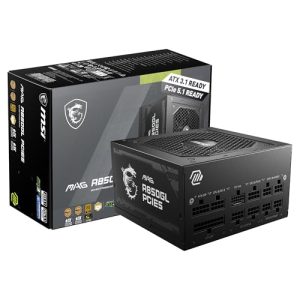
- Five 750W power supplies for an AMD RX 7900 XT build, each with two 8-pin PCIe connectors, 80 Plus Gold efficiency, and quiet fans. See how they compare.
The AMD RX 7900 XT is a serious graphics card for 1440p and 4K gaming, with 20GB of GDDR6 memory and a 315W total board power figure. It draws that power through two standard 8-pin PCIe connectors, and AMD guidance pairs the card with a 750W power supply. That figure comes from the ASUS recommended PSU table, which lists 750W for the RX 7900 XT with a Ryzen 5 or Ryzen 7 processor, moving to 850W only with a Ryzen 9 or Threadripper. So a good 750W unit is the right match for most RX 7900 XT systems, and every pick here is a 750W unit with 80 Plus Gold efficiency.
As an Amazon Associate, we earn from qualifying purchases.
One point matters more than any other when you shop for this card: the RX 7900 XT uses two 8-pin PCIe connectors, not the 12V-2×6 connector found on newer cards. Many current 750W units ship with a native 12V-2×6 cable anyway, but it does not feed this card. What feeds the card is a pair of 6+2-pin PCIe cables, so check that any unit you buy includes at least two of them. All five picks below meet that test.
How to Choose a 750W PSU for the RX 7900 XT
Wattage comes first. A 750W unit gives the 315W card room to breathe alongside a modern CPU, storage, fans, and lighting, while leaving headroom for the short power spikes that graphics cards produce under load. A heavily overclocked partner card with a raised power limit may call for 850W instead.
Connectors come second. The card needs two 8-pin PCIe plugs, which arrive as 6+2-pin cables on modern units. Two separate cables are better than one cable with a daisy-chained second plug, because each cable then carries its own share of the load. Four of the five units below are fully modular, so you connect only the cables your build needs. The fifth is a fixed-cable unit, which suits a builder who wants a simple install.
Efficiency comes third. Every pick here carries 80 Plus Gold certification, which means the unit converts wall power to component power with less waste heat than a Bronze unit. Less waste heat means a cooler PSU, a quieter fan, and a longer life for the parts inside.
Fan behavior is worth a close look. Several of these units keep the fan off entirely at low loads and spin it up only when the system warms up, which keeps a desktop silent while you browse or watch video. A fluid dynamic bearing or dual-ball bearing fan tends to last longer than a sleeve bearing fan.
Warranty length is a useful signal of how much faith the maker has in its own unit. The picks below range from a 3-year warranty on the simplest unit to a 10-year warranty on the quietest one. A longer warranty does not make a unit better on its own, but it does tell you the maker expects the unit to last through more than one graphics card upgrade. Physical size is the last check: most ATX units in this class measure 140mm to 160mm deep, and most mid-tower cases accept them without trouble. Two of the picks below use a short 140mm chassis, which helps in tighter layouts.
1. be quiet! Pure Power 13 M 750W
The be quiet! Pure Power 13 M 750W is the quietest unit in this guide, and it is the pick for a builder who wants the power supply to disappear into the background. Its 120mm fan stays off entirely up to around 40 percent load, which covers web browsing, office work, and light gaming. When the fan does spin up, it stays quiet even at high load, with maker-listed noise figures of 7.2 dB(A) at 10 and 20 percent load, rising to 16.5 dB(A) at full load.
Efficiency is a strong point too. The unit carries 80 Plus Gold certification with peak efficiency up to 94.3 percent, which beats many units sold under a higher tier label. The LLC topology gives tight voltage regulation, and the single 12V rail handles power excursions up to double the rated 750W, the kind of spike a graphics card produces when a game scene changes in an instant.
Cable support is generous for this card. The unit ships with four PCIe 6+2-pin connectors alongside its native 12V-2×6 cable, so the RX 7900 XT gets two dedicated cables with spares left over. The fully modular layout means you connect only what you need. The main trade-off is cable length: the 24-pin motherboard cable measures 450mm, which can feel short in a full-tower case with a bottom-mounted power supply.
The 10-year warranty is the longest in this guide. At 2.94 kg it is a dense, solid unit, and the build quality is obvious the moment you lift it. If silence is your top priority and you plan to keep the unit through your next graphics card as well, this is the pick.
Specs
- Model: BP026US
- Wattage: 750W
- Efficiency: 80 Plus Gold, up to 94.3 percent peak
- Standard: ATX 3.1, PCIe 5.1
- Connectors: Native 12V-2×6, 4x PCIe 6+2-pin
- Design: Fully modular
- Fan: 120mm semi-passive, zero-RPM up to around 40 percent load
- Topology: LLC, single 12V rail
- Warranty: 10 years
- Dimensions: 6.3 x 5.91 x 3.39 inches
- Weight: 2.94 kg
2. Cooler Master MWE Gold 750 V2
The Cooler Master MWE Gold 750 V2 is the workhorse of this guide. It is a fully modular 750W unit with 80 Plus Gold efficiency, an ATX 3.1 design, and PCIe 5.1 cabling, and it has been on the market long enough to build a solid track record. It is the pick for a builder who wants a known quantity without paying for premium extras.
The 120mm HDB fan runs in a semi-fanless mode, staying off at low loads and spinning up only when the system needs it. The unit is built to handle high temperatures, and it ships with two EPS connectors, which matters for motherboards that use an 8-pin plus 4-pin CPU power layout. The flat black cables are easy to route, and the fully modular design means unused cables stay in the box.
One detail worth noting is that a newer V3 version of this line exists, so match the model number MPE-7501-AFAAG-US when you buy. The V2 remains a current and widely stocked unit, and its 5-year warranty is standard for this class.
Specs
- Model: MPE-7501-AFAAG-US
- Wattage: 750W
- Efficiency: 80 Plus Gold
- Standard: ATX 3.1, PCIe 5.1 cabling
- Design: Fully modular
- Fan: 120mm HDB, semi-fanless
- Connectors: 2x EPS
- Warranty: 5 years
3. ASUS Prime 750W Gold
The ASUS Prime 750W Gold is the pick for a builder who wants a long warranty and a maker with a deep bench in PC hardware. Its 8-year warranty sits between the 5-year units and the 10-year be quiet! unit, and it covers a long ownership period that may span two graphics card upgrades.
The unit is fully modular with 80 Plus Gold efficiency and ATX 3.1 compliance, and it ships with a 16-pin PCIe cable for newer graphics cards alongside the 6+2-pin cables the RX 7900 XT needs. That 16-pin cable is not used by this card, but it keeps the unit useful if your next card uses the newer connector. The dual-ball bearing fan is built for long life, and the unit uses low-ESR capacitors to hold its 80 Plus Gold efficiency across the load range.
Specs
- Model: AP-750G
- Wattage: 750W
- Efficiency: 80 Plus Gold
- Standard: ATX 3.1, PCIe 5.1
- +12V rail: 744W
- Design: Fully modular
- Fan: Dual-ball bearing
- Connectors: 16-pin PCIe cable included, plus 6+2-pin PCIe cables
- Protections: OPP, OVP, UVP, SCP, OCP, OTP
- Warranty: 8 years
- Colors: Black and white options in one listing
4. Rosewill VMG 750W
The Rosewill VMG 750W is the compact pick in this guide. Its chassis measures 140 x 150 x 86 mm, which is about 35 percent shorter than a standard-length unit, and that short depth helps in mid-tower cases where a long power supply crowds the drive cage or the cable shroud. Despite the small size, it is a fully modular 80 Plus Gold unit with ATX 3.0 and 3.1 compliance and a native PCIe 5.1 12V-2×6 connector.
Inside, the unit uses 100 percent Japanese electrolytic capacitors, which are known for long life and stable power delivery. The 120mm FDB fan is tuned for quiet running, and the unit is built to absorb power excursions well beyond its rated wattage, which matters when a graphics card spikes under load. The 5-year warranty matches the Cooler Master unit, and the VMG line is a newer entry in the Rosewill range, launched with ATX 3.1 support from the outset. If your case is on the tighter side, or you simply want more room behind the power supply shroud for cable routing, this is the pick.
Specs
- Model: VMG750
- Wattage: 750W
- Efficiency: 80 Plus Gold
- Standard: ATX 3.0 and 3.1, PCIe 5.1
- Design: Fully modular
- Fan: 120mm FDB, silent
- Capacitors: 100 percent Japanese electrolytic
- Connectors: Native 12V-2×6, plus 6+2-pin PCIe cables
- Warranty: 5 years
- Dimensions: 140 x 150 x 86 mm
5. ASRock PRO 750G
The ASRock PRO 750G is the simple pick in this guide, and it is the only one with fixed cables. Every cable is attached at the factory, so there is nothing to plug in at the power supply end and nothing to lose. That simplicity suits a first-time builder or anyone who wants the fewest possible steps during the install. The trade-off is that unused cables stay in the case, so cable management takes a little more care than with a modular unit.
What the unit does offer is a current connector set. It is an ATX 3.1 unit with 80 Plus Gold efficiency, a native 12V-2×6 connector, and exactly two PCIe 6+2-pin connectors, which is precisely what the RX 7900 XT needs. There is no spare PCIe cable, so this is a unit for a single-graphics-card build, which is what most RX 7900 XT systems are. The chassis is a short 140mm deep, the same compact size as the Rosewill.
The 120mm fan is a low-noise design, and the unit carries the full set of protections: over-current, short-circuit, over-voltage, under-voltage, over-temperature, and over-power. Mean time between failures is listed above 100,000 hours. The 3-year warranty is the shortest in this guide, and that is the clearest compromise here. You trade long coverage for a straightforward unit at a modest outlay.
Specs
- Model: PRO-750G
- Wattage: 750W
- Efficiency: 80 Plus Gold
- Standard: ATX 3.1, PCIe 5.1
- Design: Fixed cables, non-modular
- Fan: 120mm, low-noise
- Connectors: 1x 24-pin ATX, 1x EPS 4+4, 1x PCIe 5.1 12+4, 2x PCIe 6+2, 4x SATA, 2x 4-pin peripheral
- Protections: OCP, SCP, OVP, UVP, OTP, OPP
- Warranty: 3 years
- Dimensions: 140 x 150 x 86 mm
- Weight: 4.78 lb
What We Left Out
Several well-known 750W units did not make this guide because they were already picks in earlier power supply roundups on this site. The Corsair RM750x, MSI MAG A750GL, Seasonic FOCUS GX-750, EVGA SuperNOVA 750 GT, and NZXT C750 Gold are all solid units, and any of them would feed an RX 7900 XT without trouble, but repeating them here would duplicate earlier coverage. If you already own one of those units, there is no need to replace it for this card.
Frequently Asked Questions
Does the RX 7900 XT need a 750W power supply?
Yes. AMD guidance pairs the card with a 750W unit for a typical build with a Ryzen 5 or Ryzen 7 processor, and the ASUS recommended PSU table lists the same figure. A heavily overclocked partner card may call for 850W instead, so check your card’s own guidance if it carries a raised power limit.
Does the RX 7900 XT use a 12V-2×6 connector?
No. The card uses two standard 8-pin PCIe connectors, which arrive as 6+2-pin cables on modern power supplies. The 12V-2×6 cable on newer units is not needed for this card, though it does no harm and may be useful for a future graphics card.
Should I use two separate PCIe cables for the RX 7900 XT?
Yes, when the unit allows it. Two separate cables spread the load across two runs instead of asking one cable to carry the full draw through a daisy-chained second plug. Four of the five units in this guide are fully modular, so running two cables is straightforward.
Is 80 Plus Gold enough for an RX 7900 XT build?
Yes. Gold efficiency keeps waste heat low, which keeps the fan quiet and the parts inside the unit cooler over a long life. Higher tiers exist, but they add little for a single-card build at this wattage.
More from Amazon
Programs that pair well with the guide above. Offers and eligibility are set by Amazon and may change.
Free shipping on eligible items, Prime Video and more. Eligible new members can start with a free trial.
Start a Prime free trialAd-free music streaming. Eligible new subscribers can start with a free trial.
Try Music Unlimited freeA Prime membership for ages 18-24 with a trial period. Eligibility is set by Amazon.
See Prime for Young AdultsAudiobooks and podcasts to listen to on the go. Eligible new members can start with a free trial.
Try Audible freeAs an Amazon Associate we earn from qualifying purchases.