Our Top Picks
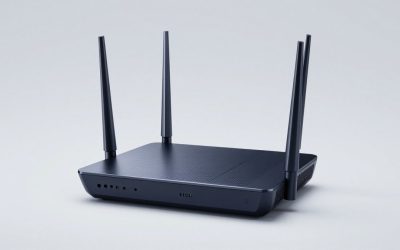
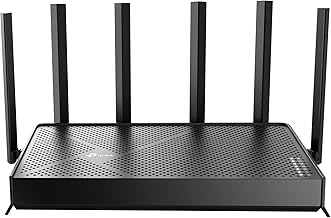
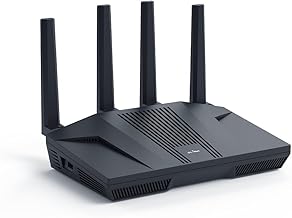
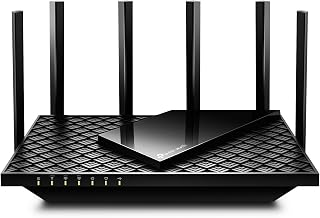
 TP-Link AXE5400 Tri-Band WiFi 6E RouterWiFi 6E, Tri-Band AXE540012.91 x 10.43 x 4.72 inches1.5 poundsCheck on Amazon
 ASUS RT-AXE7800 Tri-Band WiFi 6E199.97 cubic inches8.27 x 9.49 x 2.44 inches2.28 poundsCheck on Amazon


WiFi 6E adds one thing that matters more than any headline throughput number: a clean 6 GHz band. On 2.4 GHz and 5 GHz, your console, your phone, your neighbors, and every smart plug in the house fight over the same crowded airwaves. The 6 GHz band opens fresh spectrum with far fewer competing networks, which means lower latency and steadier throughput when a match gets busy. That is why a WiFi 6E router can feel better in play even when its headline numbers look close to a good WiFi 6 model.
Every pick below is a single router unit with a real 6 GHz radio, wired ports, and traffic tools that let gaming packets jump the queue. Mesh-only systems and WiFi 6 or WiFi 7 models have their own roundups.
As an Amazon Associate, we earn from qualifying purchases.
How to Pick a WiFi 6E Router for Gaming
Check the 6 GHz band first. A router can carry a WiFi 6E label and still lean on its 2.4 GHz and 5 GHz radios for most traffic. Look for a tri-band layout with a dedicated 6 GHz radio and wide 160 MHz channels on that band. Your console or PC also needs a WiFi 6E adapter to use the 6 GHz band; older devices fall back to 5 GHz and still work fine, they just do not get the clean-air benefit.
Wire your console when you can. Wireless is convenient, but a wired link removes interference from the equation entirely. A router with a 2.5 Gbps WAN port and at least one 2.5 Gbps LAN port gives a wired console or PC room to breathe, and it keeps the wireless bands free for phones, tablets, and handhelds. Four gigabit LAN ports is a sensible minimum for a gaming setup with a console, a PC, and a streaming box.
Look at the processor and memory. A router is a small computer, and gaming households push it hard: dozens of devices, constant traffic shaping, VPN tunnels, and security scans. A quad-core processor around 1.7 GHz or faster, paired with at least 512 MB of RAM, keeps the admin interface responsive and the traffic tools working under load. Weak hardware shows up as lag spikes when several people use the network at once.
Traffic tools matter more than raw throughput. Adaptive QoS, gaming ports, and device prioritization let the router recognize gaming traffic and move it ahead of downloads and video streams. A dedicated gaming LAN port that auto-prioritizes whatever plugs into it is genuinely useful in a house where someone is always downloading something.
Match coverage to your home. A single high-power router covers most apartments and smaller houses. Larger homes need a stronger antenna array or a mesh add-on from the same ecosystem. Treat quoted coverage as a rough guide: walls, floors, and building materials cut real-world range well below the headline figure.
Security and parental controls are part of the package. Built-in network security, safe browsing filters, and parental controls protect every device on the network at once, including consoles that cannot run their own security software. A lifetime security bundle beats a one-year trial that quietly lapses.
1. TP-Link Archer AXE75
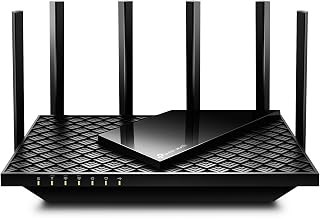
The Archer AXE75 is the most balanced WiFi 6E router in this roundup. It is a tri-band AXE5400 model with a dedicated 6 GHz band, a 2.5 Gbps WAN port, and a quad-core processor, and it does all of that in a compact six-antenna chassis that fits on a shelf without dominating the room. TP-Link’s OneMesh support lets you add a compatible extender later if one corner of the house stays weak, without buying a whole new system.
In play, the AXE75’s strength is consistency. The 6 GHz band carries gaming traffic while the 5 GHz and 2.4 GHz bands handle everything else, and HomeShield plus WPA3 keep the network locked down. Four gigabit LAN ports cover a console, a PC, and two more wired devices, and the USB 3.0 port supports shared storage or a printer.
The AXE75 suits a household that wants WiFi 6E without paying flagship money for throughput it will never use. Its 5,400 Mbps combined throughput is more than enough for gigabit internet and several simultaneous streams, and the 6 GHz band is where the real gaming benefit lives. Match the listing by ASIN B0B3SQK74L and model Archer AXE75.
Specs
- Standard: WiFi 6E (802.11ax), tri-band
- Throughput: AXE5400 (574 + 2,402 + 2,402 Mbps)
- Bands: 2.4 GHz, 5 GHz, 6 GHz with 160 MHz channels
- Wired: 2.5 Gbps WAN, 4x gigabit LAN, 1x USB 3.0
- Processor: 1.7 GHz quad-core
- Antennas: 6 external high-gain
- Extras: OneMesh, HomeShield security, WPA3, VPN support
2. ASUS RT-AXE7800
The RT-AXE7800 is ASUS’s mid-range WiFi 6E router, and it is the pick for buyers who want ASUS’s security and mesh ecosystem without the flagship ROG markup. It is a tri-band model rated at 7,800 Mbps, with the 6 GHz band doing the heavy lifting for gaming traffic and AiMesh support for expanding coverage later with another ASUS router.
ASUS loads this model with network protection: AiProtection Pro, Safe Browsing, parental controls, Instant Guard VPN, and full VPN client and server support. The 2.5 Gbps port handles a fast wired link to a console or PC, and the admin app shows which device uses bandwidth so you can prioritize the gaming machine.
Setup is straightforward through the ASUS app, and the router’s firmware gets regular updates. The RT-AXE7800 fits a gaming household that already owns ASUS gear or plans to build an AiMesh network over time. Match the listing by ASIN B0BLGGN4Z9 and model RT-AXE7800.
Specs
- Standard: WiFi 6E (802.11ax), tri-band
- Throughput: Up to 7,800 Mbps
- Bands: 2.4 GHz, 5 GHz, 6 GHz
- Wired: 2.5 Gbps port, gigabit LAN, 1x USB 3.0
- Processor: 1.7 GHz quad-core Broadcom
- Extras: AiMesh, AiProtection Pro, Safe Browsing, Instant Guard VPN, parental controls
3. NETGEAR Nighthawk RAXE300
The Nighthawk RAXE300 brings NETGEAR’s winged Nighthawk design to WiFi 6E at a mid-range tier. It is an AXE7800 tri-band router with eight streams, a 6 GHz band, and six high-performance antennas hidden inside the folding wings. Coverage reaches up to 2,500 square feet with support for up to 40 devices, which covers most family homes and their growing pile of connected gadgets.
Inside, a 1.7 GHz quad-core processor drives the tri-band radio and the traffic tools. NETGEAR Armor guards the network against threats, and Smart Parental Controls let you set schedules and filters per device. The router has a 1 Gbps WAN port and four gigabit LAN ports, plus a USB 3.0 port for shared storage. Its 6 GHz radio runs at up to 2,402 Mbps, giving WiFi 6E devices a fast, uncongested lane for gaming.
The RAXE300 suits a household that wants Nighthawk looks and NETGEAR’s app-based management in a router that does not need the flagship’s 10 Gbps wired ports. Match the listing by ASIN B0B1LZMH78 and model RAXE300-100NAS, and match the new condition: a Renewed listing circulates under a separate code, so check the condition field before ordering.
Specs
- Standard: WiFi 6E (802.11ax), tri-band
- Throughput: AXE7800, up to 7.8 Gbps
- Bands: 2.4 GHz, 5 GHz, 6 GHz
- Streams: 8
- Wired: 1 Gbps WAN, 4x gigabit LAN, 1x USB 3.0
- Processor: 1.7 GHz quad-core
- Coverage: Up to 2,500 sq ft, up to 40 devices
- Extras: NETGEAR Armor, Smart Parental Controls, Nighthawk app
4. MSI RadiX AXE6600
MSI’s RadiX AXE6600 is the gaming-branded option in this roundup, and it wears that identity openly: RGB lighting on the chassis, an AI QoS engine that learns which traffic is gaming traffic, and a dedicated set of gaming features in the admin interface. Under the styling it is a serious tri-band WiFi 6E router with eight streams and up to 6,600 Mbps of combined throughput.
The AXE6600’s 6 GHz band gives WiFi 6E devices a clean lane, while MU-MIMO and beamforming keep the signal focused on active devices rather than spraying it everywhere. A 2.5 Gbps WAN/LAN port handles a wired console or PC, backed by four gigabit LAN ports. The 1.8 GHz quad-core processor is the fastest in this group, which helps when AI QoS, security scans, and dozens of devices all demand attention at once.
This router fits a gaming desk setup where the router sits in view and the RGB lighting matches the rest of the rig. The AI QoS is genuinely useful in a house where downloads and streams compete with a live match. Match the listing by ASIN B0BTQ637LJ and model RadiX AXE6600 (GRAXE66). Do not confuse it with the RadiX AX6600, the WiFi 6 sibling without the 6 GHz band.
Specs
- Standard: WiFi 6E (802.11ax), tri-band
- Throughput: Up to 6,600 Mbps
- Bands: 2.4 GHz, 5 GHz, 6 GHz
- Streams: 8
- Wired: 2.5 Gbps WAN/LAN, 4x gigabit LAN
- Processor: 1.8 GHz quad-core
- Extras: AI QoS, RGB lighting, MU-MIMO, beamforming, WPA3
5. NETGEAR Nighthawk RAXE500
The Nighthawk RAXE500 is the flagship of this roundup and the most powerful WiFi 6E router here. It is an AXE11000 tri-band model with twelve streams and up to 10.8 Gbps of combined throughput: 1.2 Gbps on 2.4 GHz, 4.8 Gbps on 5 GHz, and 4.8 Gbps on the 6 GHz band. Coverage reaches up to 3,500 square feet with support for up to 60 devices, which makes it the pick for large homes and heavy multi-user households.
Eight antennas fold out of the winged chassis, and a 1.8 GHz quad-core processor with 1 GB of RAM drives the whole system. Wired connectivity includes a configurable 2.5 Gbps multi-gig port, four gigabit LAN ports, and two USB 3.0 ports. NETGEAR Armor and Smart Parental Controls come built in, and the Nighthawk app handles setup and monitoring.
The RAXE500 is overkill for a single gamer in a small apartment, but it earns its place in a big household where several people game, stream, and work from home at once. Its 6 GHz band stays clear even when the 5 GHz band is saturated, which is exactly where WiFi 6E pays off. Match the listing by ASIN B08R58D9FH and model RAXE500-100NAS.
Specs
- Standard: WiFi 6E (802.11ax), tri-band
- Throughput: AXE11000, up to 10.8 Gbps
- Bands: 2.4 GHz, 5 GHz, 6 GHz
- Streams: 12
- Wired: 2.5 Gbps multi-gig port, 4x gigabit LAN, 2x USB 3.0
- Processor: 1.8 GHz quad-core, 1 GB RAM, 512 MB flash
- Coverage: Up to 3,500 sq ft, up to 60 devices
- Extras: NETGEAR Armor, Smart Parental Controls, Nighthawk app
What We Left Out
The ASUS ROG Rapture GT-AXE16000 is a superb quad-band WiFi 6E gaming router, but it already appears in our earlier WiFi routers roundup, so it does not get a second slot here. The ASUS ROG Rapture GT-AXE11000, the world’s first WiFi 6E router, is a strong backup with a verified listing, and it stays in reserve for a future update. The ASUS RT-AX5400 looks similar to the 6E models at a glance, but it is a WiFi 6 router without a 6 GHz band, so it does not belong in this roundup. Mesh systems were excluded because this guide covers standalone routers; a mesh node on its own is not a like-for-like pick against these five.
Frequently Asked Questions
Do I need a WiFi 6E device to benefit from a WiFi 6E router?
Yes, for the 6 GHz band. Only WiFi 6E devices can join the 6 GHz band, so a console or PC with a WiFi 6 or older adapter uses the 5 GHz band instead. Older devices still work on a WiFi 6E router and still benefit from its faster processor, better QoS, and stronger wired ports.
Is WiFi 6E better than WiFi 6 for gaming?
It is better when your devices support it. The 6 GHz band has far less congestion than 5 GHz, which means lower latency and fewer spikes during busy hours. If none of your devices support WiFi 6E yet, a good WiFi 6 router performs the same today, and the 6E router is a bet on your next upgrade.
Should I wire my console or use the 6 GHz band?
Wire it when you can. A wired link removes wireless interference entirely and leaves the 6 GHz band free for handhelds, phones, and laptops. Use the 6 GHz band for devices that cannot be wired, or for a console in a room where running a cable is not practical.
How many devices can a WiFi 6E router handle?
It depends on the model. The routers in this guide range from 40 to 60 connected devices, and the higher-end models handle that load better thanks to faster processors and more streams. In practice, most gaming households stay well under those limits, and the processor matters more than the headline device count.
More from Amazon
Programs that pair well with the guide above. Offers and eligibility are set by Amazon and may change.
Free shipping on eligible items, Prime Video and more. Eligible new members can start with a free trial.
Start a Prime free trialAd-free music streaming. Eligible new subscribers can start with a free trial.
Try Music Unlimited freeA Prime membership for ages 18-24 with a trial period. Eligibility is set by Amazon.
See Prime for Young AdultsAudiobooks and podcasts to listen to on the go. Eligible new members can start with a free trial.
Try Audible freeAs an Amazon Associate we earn from qualifying purchases.