Key takeaways
- Table of Contents 7 sections 7 min read 1 Quick comparison: the best DDR5 editing kits 2 How much RAM does a video-editing PC need? 3 Head-to-head: Corsair Vengeance vs G.Skill Trident Z5 vs Kingston FURY 3.1 Corsair Vengeance DDR5…
What's inside
- Quick comparison: the best DDR5 editing kits
- How much RAM does a video-editing PC need?
- Head-to-head: Corsair Vengeance vs G.Skill Trident Z5 vs Kingston FURY
- Decision matrix: which kit fits your system?
- Speed, latency, and the bandwidth calculation
- Installation and stability checklist
- What should you buy?
The best RAM sticks for video editing in 2026 are usually a 64GB or 96GB DDR5 kit running around 6,000–6,400 MT/s, with Corsair Vengeance, G.Skill Trident Z5, and Kingston FURY Beast offering the strongest balance of capacity, stability, and platform compatibility.
- Quick comparison: the best DDR5 editing kits
- How much RAM does a video-editing PC need?
- Head-to-head: Corsair Vengeance vs G.Skill Trident Z5 vs Kingston FURY
- Decision matrix: which kit fits your system?
- Speed, latency, and the bandwidth calculation
- Installation and stability checklist
- What should you buy?
Quick comparison: the best DDR5 editing kits
| Product family | Useful configurations | Typical speed range | Best platform fit | Why choose it |
|---|---|---|---|---|
| Corsair Vengeance DDR5 | 2x32GB, 2x48GB, 2x64GB | 5,600–6,400 MT/s | Intel XMP or AMD EXPO versions | Broad availability, restrained heatsinks, dependable mainstream tuning |
| G.Skill Trident Z5 DDR5 | 2x32GB, 2x48GB, 2x64GB | 6,000–7,200+ MT/s | Intel XMP; Trident Z5 Neo for AMD EXPO | Excellent latency and high-speed options for compatible boards |
| Kingston FURY Beast DDR5 | 2x32GB, 2x48GB, 2x64GB | 5,600–6,400 MT/s | Intel XMP or AMD EXPO versions | Good compatibility, sensible heatspreaders, easy-to-source capacities |
These are desktop UDIMM families. Do not buy them for a laptop, mini PC, or workstation that requires registered ECC memory. Always match the kit’s profile—XMP for most Intel systems and EXPO for AMD Ryzen systems—to the motherboard and processor you plan to use.
How much RAM does a video-editing PC need?
Capacity matters more than chasing the highest advertised speed. Editing applications use memory for source clips, decoded frames, timelines, previews, effects, audio tools, browser tabs, and background applications. A faster 32GB kit cannot compensate for running out of memory during a complex project.
| Editing workload | Recommended capacity | Recommended kit | Reasonable speed target |
|---|---|---|---|
| 1080p, short projects, basic cuts | 32GB | 2x16GB | 5,600–6,000 MT/s |
| 4K editing, color correction, multiple layers | 64GB | 2x32GB | 6,000–6,400 MT/s |
| 4K multicam, After Effects, heavy effects | 96GB | 2x48GB | 5,600–6,400 MT/s |
| 8K, RAW, long-form production, 3D and editing together | 128GB | 2x64GB | 5,600–6,000 MT/s |
A 2x32GB kit is the practical starting point for a serious 4K workstation. Choose 2x48GB when you want more headroom but do not need 128GB. A matched 2x64GB kit is preferable to adding a second, unrelated 2x32GB kit later, because four modules can place more electrical load on the memory controller and may require slower settings.
Head-to-head: Corsair Vengeance vs G.Skill Trident Z5 vs Kingston FURY
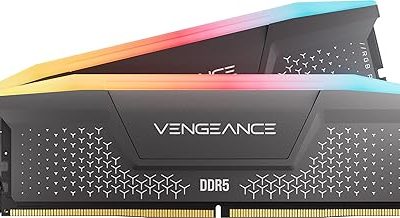
Corsair Vengeance DDR5
Corsair Vengeance is the safest general-purpose recommendation for builders who value compatibility, physical clearance, and straightforward configuration. Its low-profile versions are less likely to interfere with large air coolers than tall RGB memory. The family is sold in both Intel XMP and AMD EXPO variants, so check the exact part number rather than assuming every Vengeance kit supports both.
For video editing, a 2x32GB kit at 6,000 or 6,400 MT/s is a strong pairing for a current mid-range or high-end desktop. If stability is more important than benchmark results, a 5,600 MT/s kit can be a sensible choice for 96GB or 128GB configurations.
G.Skill Trident Z5 DDR5
G.Skill Trident Z5 is aimed at users who want tighter timings or higher memory speeds. Standard Trident Z5 kits are commonly associated with Intel XMP, while Trident Z5 Neo models are designed for AMD EXPO. Both can be excellent, but the profile must match the platform for the easiest setup.
Trident Z5 is often physically taller than low-profile alternatives, particularly RGB versions. Check CPU-cooler clearance before buying. For an Intel editing build with a capable motherboard, a 2x32GB 6,400 MT/s kit can provide a useful performance target without moving into unnecessarily aggressive memory overclocking. On AMD, 6,000 MT/s is commonly the more practical starting point because it balances speed with memory-controller stability.
Kingston FURY Beast DDR5
Kingston FURY Beast DDR5 is a strong choice when you want a conservative, widely compatible kit with fewer aesthetic compromises. It is available in large capacities, including 2x48GB and 2x64GB configurations, and in versions supporting Intel XMP or AMD EXPO.
FURY Beast makes particular sense for an editing workstation where reliability and capacity come before maximum benchmark speed. A 96GB kit at 5,600 or 6,000 MT/s can be more useful than a smaller 7,200 MT/s kit if your project includes large RAW files, motion graphics, or a second application such as Photoshop or After Effects.
Decision matrix: which kit fits your system?
| Your situation | Best choice | Suggested specification | Why |
|---|---|---|---|
| AMD Ryzen desktop, 4K editing | Corsair Vengeance EXPO or Kingston FURY Beast EXPO | 64GB, 2x32GB, 6,000 MT/s | Good balance for the memory controller and editing capacity |
| Intel desktop, 4K plus effects | G.Skill Trident Z5 or Corsair Vengeance XMP | 64GB, 2x32GB, 6,000–6,400 MT/s | Extra bandwidth can help when the CPU is also heavily loaded |
| Large projects without extreme overclocking | Kingston FURY Beast | 96GB, 2x48GB, 5,600–6,000 MT/s | More capacity while keeping a moderate memory speed |
| 8K, multicam, compositing, or 3D | Any matched kit from these families | 128GB, 2x64GB, 5,600–6,000 MT/s | Capacity prevents paging and keeps complex timelines responsive |
| Large air cooler or compact case | Low-profile Corsair Vengeance or Kingston FURY Beast | 64GB or 96GB, moderate-speed kit | Reduces cooler and side-panel clearance problems |
Speed, latency, and the bandwidth calculation
DDR5-6000 is not 6,000 MHz. It transfers 6,000 million data operations per second, while the physical memory clock is half that figure. Because DDR5 has a 64-bit data path per module, a dual-channel DDR5-6000 kit offers approximately:
6,000 MT/s × 8 bytes × 2 channels = 96,000 MB/s, or about 96GB/s of theoretical bandwidth.
Real applications deliver less because of overhead, and video editing is often limited by the CPU, GPU, storage, codecs, or effects engine rather than memory bandwidth. Moving from DDR5-6000 to DDR5-7200 can produce a smaller benefit than moving from 32GB to 64GB when the original system is paging to its SSD.
Latency also matters. A DDR5-6000 kit rated at CL30 has an approximate first-word latency of 10 nanoseconds, calculated as 30 × 2,000 ÷ 6,000. A DDR5-6400 CL32 kit has the same approximate 10ns figure. This is why both speed and timings should be considered instead of choosing the largest MT/s number.
Installation and stability checklist
-
Confirm the memory type. Check the motherboard manual for DDR5 UDIMM support, maximum capacity, and validated speeds. DDR4 and DDR5 slots are not interchangeable.
-
Use the recommended slots. With two modules, boards usually want slots A2 and B2, but follow the manual. Correct slot placement preserves dual-channel operation.
-
Update the motherboard firmware. A recent BIOS can improve support for newer 24GB and 48GB memory chips and improve high-capacity training.
-
Enable the correct profile. Select XMP on Intel or EXPO on AMD. Without a profile, memory may run at a conservative default such as 4,800 MT/s.
-
Test before starting a major project. Run a memory test such as MemTest86 or an extended Windows memory test, then render a demanding timeline. A crash, corrupted archive, or failed export can indicate unstable memory.
-
Reduce speed if necessary. If a 6,400 MT/s or higher kit produces errors, try 6,000 MT/s first rather than immediately increasing voltage. Stability is more valuable than a small synthetic benchmark gain.
What should you buy?
For most editors, buy a matched 2x32GB DDR5-6000 or DDR5-6400 kit. Choose Corsair Vengeance for a low-profile, uncomplicated build, G.Skill Trident Z5 when you want higher-end timings and have verified motherboard support, or Kingston FURY Beast when capacity and conservative stability are the priority. Move to 2x48GB for demanding 4K and motion-graphics work, and choose 2x64GB for sustained 8K, RAW, multicam, or editing-plus-compositing workloads.
In 2026, typical market ranges are roughly $100–$180 for 64GB DDR5 kits, $180–$300 for 96GB kits, and $300–$500 or more for 128GB kits, depending on speed, timings, lighting, and sales. Spend on capacity first, confirm XMP or EXPO compatibility second, and only then pay extra for extreme memory speeds.