Our Top Picks
 Tenergy Centura C Rechargeable Batteries 4000mAh NiMH Precharged2 Pack4.5 x 2.7 x 1 inches0.2 poundsCheck on Amazon

C cells live in the devices people forget about until they die: the big torch by the door, the portable radio, the baby swing, the lantern in the camping box. The real decision is not which pack has the biggest number on the front, because C rechargeables come in two chemistries that behave differently. NiMH cells run at 1.2V and suit most devices, while 1.5V lithium cells hold full voltage to the end and recharge over USB, which some electronics demand and others dislike.
This guide is for households replacing a steady drip of disposable C batteries, for campers and emergency-kit builders who need cells that hold a charge in storage, and for anyone whose device specifically wants full 1.5V power. Every figure below, from capacity to cycle ratings, comes from the product’s Amazon listing title and description rather than from outside testing.
Quick Picks
As an Amazon Associate we earn from qualifying purchases.
| Product | Best for | Key spec from title |
|---|---|---|
| EBL Rechargeable C Batteries, 2 Pack | High capacity NiMH for hungry devices | 5000mAh Ni-MH, 1.2V |
| Tenergy Centura C, 2 Pack | Emergency gear that sits unused for months | 4000mAh low self-discharge NiMH |
| YUEBVIWIE Rechargeable C Batteries, 4 Pack | Devices that need a true 1.5V | 5000mWh 1.5V lithium, USB-C charging |
How to Choose
Start with chemistry, because it decides the voltage
NiMH C cells deliver a nominal 1.2V, which is lower than the 1.5V of a fresh alkaline. Most torches, radios, toys and lanterns run happily on 1.2V, but a minority of devices, including some battery-powered electronics with voltage cut-offs, dim early or shut down. Lithium rechargeable C cells solve that by holding a regulated 1.5V until they are nearly empty, then dropping quickly. Read your device’s manual if it is fussy, and treat the chemistry choice as the first filter: it matters more than any capacity figure printed on the pack.
Read capacity in the right unit for the chemistry
NiMH capacity is quoted in milliamp hours, and honest C cells land roughly between 4000mAh and 5000mAh; claims far above that range deserve suspicion. Lithium 1.5V cells are usually quoted in milliwatt hours instead, because their internal cell runs at a higher voltage that is stepped down. A 5000mWh lithium cell is not directly comparable to a 5000mAh NiMH cell, and converting between the two is the only fair way to compare runtime. Check which unit a listing uses before deciding that one pack is bigger than another.
Storage behaviour matters for C cells more than most sizes
C batteries often power equipment that waits: emergency torches, storm radios, seasonal decorations. Standard NiMH cells lose charge steadily on the shelf, so a cell charged in spring may be half empty by autumn. Low self-discharge NiMH, like the Tenergy Centura below, is made to retain most of its charge across a year of storage, and the listing states the retention figure. Lithium cells also hold charge well in storage. If your C devices are everyday items in constant rotation, ordinary high-capacity NiMH is fine; if they wait for an emergency, storage retention is the spec to pay for.
Charging method and charger compatibility
NiMH C cells need a charger with bays wide enough for C size, and many compact AA/AAA chargers cannot physically take them, so check your charger’s stated size range before ordering cells it cannot hold. Smart chargers that monitor each bay separately are kinder to cells than paired-slot timers. The lithium option in this guide takes a different route entirely: it charges from a USB-C cable, with no separate charger required, but it must never be placed in a NiMH charger. Mixing up the two systems is the one genuinely damaging mistake in this category.
The 3 Best Options
EBL Rechargeable C Batteries, 2 Pack
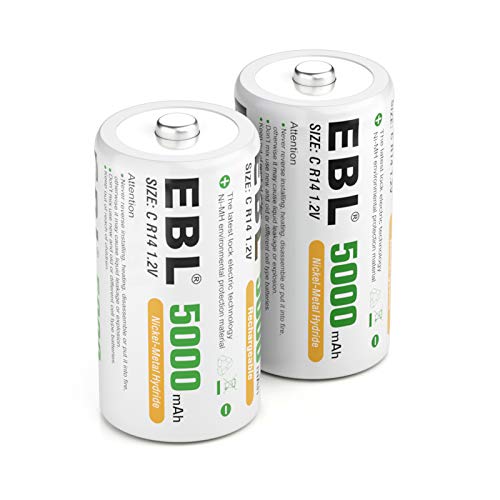
EBL’s C cell is the straightforward high-capacity NiMH choice: the listing rates it at 5000mAh and 1.2V, the top of the honest capacity range for this size, and describes low self-discharge behaviour with a long cycle life. The pack of two suits the many devices that take a pair, from large torches to portable radios, and the cells arrive as standard button-top C size, so they drop into any compartment built for disposables. Pick this one if your devices are in regular use and you simply want the longest runtime per charge from a conventional NiMH cell.
Specs
- C size (R14) Ni-MH rechargeable battery
- 5000mAh capacity, 1.2V
- Pack of 2
- Low self-discharge design
- Listing states up to 1200 recharge cycles
- Height 50 mm, diameter 25.5 mm
Best for: Regularly used torches, radios and toys where maximum NiMH runtime matters.
Watch out for: You need a charger with C-size bays; many AA/AAA-only chargers cannot fit these cells.
ASIN: B00ZA7PYE0
Tenergy Centura C, 2 Pack
The Centura line is Tenergy’s low self-discharge range, and this C version trades a little capacity, 4000mAh against the EBL’s 5000mAh, for storage behaviour: the listing states the cells retain up to 85 percent of their charge after a year unused, and that they ship pre-charged and ready to use. That makes this the pack for the emergency radio, the storm lantern and the torch in the hallway drawer, where a battery that quietly empties itself is worse than a slightly smaller one. Tenergy’s model number for the two-pack is 10207.
Specs
- C size NiMH rechargeable battery, model 10207
- 4000mAh capacity, 1.2V
- Pack of 2
- Low self-discharge: listing states up to 85 percent charge retained after 1 year of storage
- Pre-charged and ready to use
- Dimensions 26 x 50 mm
Best for: Emergency and standby devices that sit for months between uses.
Watch out for: The 4000mAh rating gives shorter runtime in constantly used, high-drain devices than a 5000mAh cell.
ASIN: B0041TF5KQ
YUEBVIWIE Rechargeable C Batteries, 4 Pack
This is the different chemistry: a lithium C cell with a regulated 1.5V output, rated at 5000mWh in the listing, which holds full voltage through the discharge instead of sagging the way NiMH does. It charges over USB-C with the included 4-in-1 cable, so one cable tops up all four cells without a bay charger, and the listing claims more than 1500 cycles. Choose it for electronics that misbehave on 1.2V, or if you would rather not buy a C-capable charger at all. The four-pack suits devices that take a full set.
Specs
- C size (LR14) lithium rechargeable battery
- 5000mWh capacity, constant 1.5V output
- Pack of 4
- USB-C charging with 4-in-1 charging cable included
- Listing states 1500+ recharge cycles
- Built-in LED charge indicator
Best for: Devices that need a true 1.5V and owners who want USB charging instead of a bay charger.
Watch out for: Never charge these in a NiMH bay charger, and the sudden voltage drop at empty gives little warning before a device stops.
ASIN: B0F2T5MFJG
Which One Fits Your Situation
Your C devices run every week
Take the EBL two-pack. In constant rotation, storage losses never get time to matter, so the higher 5000mAh capacity is worth more than the Centura’s shelf life. Radios, big torches and motorised toys around the house will run longest between charges on the biggest honest NiMH capacity in this list.
You are stocking an emergency kit
Take the Tenergy Centura. A torch or radio that must work after ten months in a drawer needs charge retention more than peak capacity, and the listing’s stated retention figure is exactly the spec written for that job. Top the cells up once or twice a year and they stay ready.
A device keeps shutting down on NiMH cells
Take the YUEBVIWIE lithium pack. Some electronics read the 1.2V of NiMH as a nearly flat battery and cut out early; a regulated 1.5V cell removes that problem entirely. The USB-C charging also suits a household that owns no C-size bay charger and does not want to buy one for a single device.
You are replacing batteries in a child’s toy or a baby swing
Either NiMH option works, and the choice is about rhythm: the EBL for a swing in daily use, the Centura if the toy spends long spells in a cupboard. Avoid leaving any rechargeable in a toy that will be stored for a season; take the cells out and keep them with the charger.
Common Mistakes
- Comparing a lithium cell’s milliwatt hours directly against a NiMH cell’s milliamp hours and calling one bigger.
- Putting 1.5V lithium rechargeables into a NiMH bay charger, or NiMH cells into a device charger meant only for lithium.
- Buying C cells before checking that your existing charger actually has bays wide enough for C size.
- Believing capacity claims far beyond 5000mAh for NiMH C cells; the size physically limits what fits inside.
- Storing standard NiMH cells fully charged for a year and expecting them to be ready in an emergency.
Frequently Asked Questions
Will 1.2V NiMH C batteries work in a device made for 1.5V alkaline cells?
Usually, yes. Most torches, radios, lanterns and toys are designed with enough voltage tolerance to run on 1.2V, sometimes with slightly dimmer output near the end of the charge. A minority of electronics with strict voltage cut-offs stop early, and those are the cases where a regulated 1.5V lithium cell is the better answer.
How many times can I recharge C batteries?
It depends on chemistry and how hard the cells are used. The listings here state up to 1200 cycles for the EBL NiMH and more than 1500 for the lithium pack. Real life is usually lower: deep discharges, heat and fast charging all shorten a cell’s life, so treat the printed figure as a best case rather than a promise.
Can I mix rechargeable C batteries with disposables in one device?
No. Cells in a device discharge together, and mixing chemistries or charge levels makes the weakest cell drag the rest down and can drive it into reverse charge, which damages it. Replace the whole set at once, keep packs together, and charge them together so they age at the same rate.
Do I need a special charger for C rechargeables?
For NiMH, you need a charger whose bays physically accept C cells and that lists C among its supported sizes; many compact chargers only fit AA and AAA. A smart charger that monitors each bay separately will also treat the cells more gently than a basic timer model. For the USB-C lithium cells in this guide, no bay charger is needed at all, but they must only ever be charged with their cable, never in a NiMH charger.
FAQ
Will 1.2V NiMH C batteries work in a device made for 1.5V alkaline cells?
How many times can I recharge C batteries?
Can I mix rechargeable C batteries with disposables in one device?
Do I need a special charger for C rechargeables?
More from Amazon
Programs that pair well with the guide above. Offers and eligibility are set by Amazon and may change.
Free shipping on eligible items, Prime Video and more. Eligible new members can start with a free trial.
Start a Prime free trialAd-free music streaming. Eligible new subscribers can start with a free trial.
Try Music Unlimited freeA Prime membership for ages 18-24 with a trial period. Eligibility is set by Amazon.
See Prime for Young AdultsAudiobooks and podcasts to listen to on the go. Eligible new members can start with a free trial.
Try Audible freeAs an Amazon Associate we earn from qualifying purchases.