Our Top Picks


The best medical smartwatches are not medical devices in the usual sense, and that distinction matters before anything else in this guide. These are consumer smartwatches with health-tracking features, such as heart-rate monitoring, ECG apps, blood oxygen sensing, and sleep tracking, that can help you notice patterns and share information with a clinician. They do not diagnose conditions, replace a medical checkup, or substitute for professional advice. If you have a heart condition, a sleep disorder, or any symptom that worries you, talk with a clinician rather than relying on a watch reading alone.


With that boundary clear, a good health-focused smartwatch can still be a useful daily companion. A watch that records your resting heart rate, tracks your sleep stages, flags an irregular rhythm, or logs your blood oxygen overnight gives you a record to bring to an appointment, and trends over weeks are often more informative than any single reading. The watches in this guide were chosen for the breadth and quality of their health sensors, the clarity of their companion apps, battery life that allows overnight tracking, and comfort for all-day wear.
This guide explains what to look for in a health-focused smartwatch, then compares four watches that cover the main platforms: Apple, Samsung, Fitbit, and Garmin. Each one approaches health tracking differently, and the right choice depends on your phone, your priorities, and which measurements matter most to you. Read the health features as tools for awareness and conversation with your clinician, not as answers on their own.
How to Choose
1. Heart-rate monitoring and ECG
Continuous heart-rate tracking is the foundation of every health watch, and all four watches in this guide record your heart rate around the clock, including a resting rate that can be a useful baseline over time. An ECG app goes further, letting you record a short electrocardiogram from your wrist that can be shared with a clinician. ECG features on consumer watches are cleared for over-the-counter use in many regions, but a watch ECG is not the same as a clinical ECG, and any result that concerns you should be discussed with a clinician promptly. Look for watches that store ECG recordings in a companion app where they can be exported or shown at an appointment.
2. Irregular rhythm and high or low heart-rate notifications
Beyond on-demand ECG readings, several watches can notify you when they detect an irregular rhythm or a heart rate that is unusually high or low while you are at rest. These notifications are designed to prompt a conversation with a clinician, not to deliver a diagnosis. When comparing watches, check which notifications each one offers, whether they run in the background, and how the companion app presents the history behind an alert. A notification without context is far less useful than one paired with a readable timeline you can share.
3. Sleep tracking and overnight measurements
Sleep is where a watch earns its keep, because it is the one time of day when a sensor can record for hours without interruption. Look for sleep tracking that covers duration, stages, and consistency, plus overnight measurements such as blood oxygen variation and skin temperature trends where available. Battery life matters here: a watch that needs charging every night cannot track your sleep. The watches in this guide range from about a day and a half to nearly two weeks of battery life, and that gap decides whether overnight tracking is practical every night or only occasionally.
4. Blood oxygen sensing
Blood oxygen sensing, often labeled SpO2, measures the saturation of oxygen in your blood using light sensors on the wrist. On consumer watches it is best treated as a general wellness trend rather than a precise clinical measurement, since wrist readings can be affected by movement, skin tone, temperature, and fit. Overnight SpO2 variation can still be interesting to discuss with a clinician, particularly alongside sleep data. If blood oxygen trends matter to you, choose a watch that records them automatically overnight and presents them as a clear graph in its app.
5. Blood pressure and body composition features
A few watches add blood pressure monitoring or body composition estimates, and these features vary widely in how they work. Some watches estimate blood pressure after calibration with a traditional cuff, while others do not offer it at all. Body composition readings from a watch use bioelectrical impedance, which gives an estimate rather than a clinical measurement. Treat both as directional information, keep a cuff-based blood pressure monitor for readings that guide care, and ask a clinician how much weight to give any watch-based estimate.
6. Phone compatibility and app quality
A health watch is only as useful as the app that presents its data. Apple Watch pairs with iPhone, Galaxy Watch works best with Android phones, Fitbit and Garmin work with both iPhone and Android. Beyond compatibility, look at how clearly the app shows trends: resting heart rate over weeks, sleep consistency, and ECG history should be easy to find and easy to share. If you plan to show data to a clinician, an app that exports a readable summary is worth more than one that buries numbers behind many taps.
7. Comfort, battery life, and wearability
A health watch only helps if you actually wear it, including overnight. That makes comfort, weight, band options, and battery life practical health features in their own right. A light watch with a soft band is easier to sleep in than a heavy metal case, and a watch that lasts many days between charges is more likely to be on your wrist at night. Water resistance matters too, since a watch you have to remove for showers and swimming leaves gaps in your record. Try the band fit before committing, and remember that a sensor needs steady skin contact to record well.
Top Picks
Apple Watch Series 10 (GPS, 46mm)
The Apple Watch Series 10 is the strongest health watch for iPhone owners, with the most polished combination of sensors and software in this guide. The model linked here is the GPS 46mm version in Jet Black aluminum with a black sport band, model MWWQ3LW/A, with an always-on Retina display and a thinner, lighter case than earlier models. Its health features include an ECG app, heart-rate monitoring with high and low heart-rate notifications and irregular rhythm notifications, sleep tracking with sleep apnea notifications, blood oxygen sensing, and temperature sensing for sleep and cycle tracking.
What sets the Series 10 apart is how clearly the companion Health app on iPhone presents trends, from resting heart rate and heart-rate variability to sleep stages and ECG recordings that can be shared as a document. Fall detection and Emergency SOS add a safety layer for older wearers and people who live alone, and the watch can call for help and notify emergency contacts when a hard fall is detected and the wearer does not respond. It pairs only with iPhone, which is the main limitation for Android users.
Who it is for: iPhone owners who want the most complete and best-presented set of health features, including ECG, sleep apnea notifications, and fall detection, in a comfortable everyday watch.
Caveats: battery life is around a day and a half to two days with normal use, so overnight sleep tracking requires a charging routine, such as topping up while getting ready in the morning. It works only with iPhone, and some health features vary by region and require setup in the Health app.
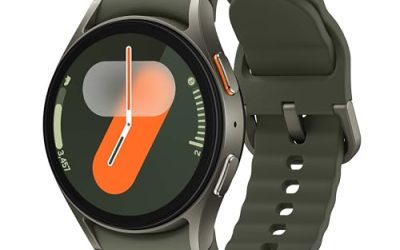
Samsung Galaxy Watch 8 (44mm, Bluetooth)
The Samsung Galaxy Watch 8 is the leading health watch for Android users, and it brings several measurements the other watches here do not offer. The model linked here is the 44mm Bluetooth version in Silver, model SM-L330NZSQXAA, with a cushion design, a bright display, and a two-year warranty. Its health features include an ECG app, irregular heart rhythm notifications, blood pressure monitoring after calibration with a cuff, blood oxygen sensing, sleep coaching, an energy score based on sleep and activity, and an antioxidant index measured from the fingertip sensor.
The Galaxy Watch 8 is notable for the breadth of its health suite on a single wrist: heart-rate tracking, sleep stages and coaching, vascular load monitoring, and running coaching sit alongside the ECG and blood pressure tools. Samsung Health presents the data in a clear timeline, and the watch is designed for all-day and overnight wear. It works with Android phones, and some features work best with Samsung phones, so check compatibility if you use another Android brand.
Who it is for: Android users who want the widest set of health measurements in one watch, including blood pressure monitoring and sleep coaching, with a modern design and solid battery life.
Caveats: it is designed for Android, so iPhone owners should look elsewhere. Blood pressure monitoring requires periodic calibration with a traditional cuff, and readings should be treated as estimates to discuss with a clinician rather than replacements for cuff measurements. Some advanced features are limited to Samsung phones.
Fitbit Sense 2
The Fitbit Sense 2 is the most focused health watch in this guide, built around stress, sleep, and heart health rather than apps and general smartwatch features. The model linked here is the Shadow Grey and Graphite version, model FB521, with S and L bands included. Its health features include an ECG app, blood oxygen sensing, continuous heart-rate monitoring, sleep tracking with a sleep score, stress management tools with an electrodermal activity sensor, and built-in GPS for outdoor activity.
Its main advantage is battery life: the Sense 2 runs for six days or more between charges, which makes overnight sleep and blood oxygen tracking practical every night without a charging routine. The Fitbit app presents daily readiness, sleep, and stress trends in a straightforward way, and the watch works with both iPhone and Android. For someone whose main goal is a long-running health record rather than a general-purpose smartwatch, that combination is hard to beat.
Who it is for: people who want a dedicated health watch with multi-day battery life for reliable overnight tracking, and who use either iPhone or Android.
Caveats: it is less capable as a general smartwatch than the Apple or Samsung watches, with fewer third-party apps and no cellular option in this model. Some deeper insights and scores require a Fitbit Premium membership, and ECG availability varies by region.
Garmin Venu 4 (45mm)
The Garmin Venu 4 is the endurance pick in this guide, with the longest battery life and a health suite that covers sleep, recovery, and heart-rate variability in unusual depth. The model linked here is the 45mm version in Slate with a black silicone band, model 010-03014-00, with a bright AMOLED display, a built-in flashlight, and up to 12 days of battery life. Its health features include an ECG app, wrist-based heart-rate monitoring, heart-rate variability status, sleep coaching, blood oxygen sensing, stress tracking, and a body battery energy monitor that reflects sleep, activity, and stress together.
Garmin Connect presents long-term trends clearly, and the watch is designed for people who want to follow recovery and sleep consistency over weeks and months rather than day to day. It works with both iPhone and Android, and it is water resistant for swimming and showering, so it can stay on the wrist almost all the time. The long battery life means overnight tracking never competes with charging.
Who it is for: people who want the longest battery life and the deepest sleep and recovery tracking in this guide, and who use either iPhone or Android.
Caveats: the Venu 4 is a large 45mm watch, so people with smaller wrists may prefer the 41mm version. Its smartwatch features are more limited than the Apple or Samsung watches, and the ECG app availability varies by region.
Comparison Table
| Watch | Display | ECG | Blood Oxygen | Sleep Tracking | Battery Life | Phone Compatibility |
|---|---|---|---|---|---|---|
| Apple Watch Series 10 | Always-on Retina, 46mm | Yes | Yes | Yes, with sleep apnea notifications | Up to 36 hours | iPhone |
| Samsung Galaxy Watch 8 | AMOLED, 44mm | Yes | Yes | Yes, with sleep coaching | Up to 40 hours | Android |
| Fitbit Sense 2 | AMOLED | Yes | Yes | Yes, with sleep score | 6+ days | iPhone and Android |
| Garmin Venu 4 | AMOLED, 45mm | Yes | Yes | Yes, with sleep coaching | Up to 12 days | iPhone and Android |
Which One Is Right for You?
Your phone decides the first cut. If you use an iPhone, the Apple Watch Series 10 is the natural choice, with the most complete health features and the clearest app for sharing data with a clinician. If you use Android, the Samsung Galaxy Watch 8 is the equivalent pick, with the widest measurement suite, including blood pressure monitoring after cuff calibration.
If you use either phone and your priority is a long, unbroken health record, look at the Fitbit Sense 2 or the Garmin Venu 4. The Sense 2 is the simpler, more focused health watch, with six days of battery life and strong stress and sleep tools. The Venu 4 goes further on battery life and recovery tracking, with up to 12 days between charges and deep sleep coaching, and it suits people who follow training, recovery, and sleep consistency closely.
Whichever watch you choose, remember the boundary that matters most: a smartwatch can surface patterns and prompt useful conversations, but it does not diagnose or treat anything. Bring its data to your clinician, ask what it means for you, and let professional guidance decide what happens next.
Frequently Asked Questions
Can a smartwatch diagnose a heart condition?
No. A smartwatch can record heart-rate patterns and take a single-lead ECG, and it can notify you about an irregular rhythm, but those are screening tools, not diagnoses. Only a clinician with proper equipment and your full history can diagnose a heart condition. If your watch flags an irregular rhythm or you notice symptoms such as chest discomfort, shortness of breath, or fainting, contact a clinician promptly rather than waiting to see whether the watch flags it again.
Are blood oxygen readings from a smartwatch accurate?
Blood oxygen readings from a wrist sensor are best treated as general wellness trends rather than precise clinical measurements. Movement, fit, skin temperature, and skin tone can all affect a reading, and a single low number on its own usually means the sensor lost good contact rather than a medical problem. Overnight trends recorded while you sleep are more informative than one-off readings, and anything that concerns you is worth discussing with a clinician, who can measure blood oxygen with clinical equipment.
Do I need a smartwatch with an ECG app?
An ECG app is useful if you want to record a heart rhythm tracing to share with a clinician, particularly if you have been told to watch for an irregular rhythm. It is not necessary for everyone, and many people get what they need from continuous heart-rate monitoring and sleep tracking alone. If you are considering a watch mainly for ECG, check that the feature is available in your region and that your phone is compatible, since availability varies.
How important is battery life for a health smartwatch?
Battery life matters more for health tracking than for most other uses, because the most useful measurements happen overnight while you sleep. A watch that lasts six to twelve days can track every night without a charging routine, while a watch that lasts a day and a half needs a deliberate habit, such as charging during a morning routine. If sleep tracking is a priority, weigh battery life as heavily as any sensor.
Disclosure: As an Amazon Associate, we may earn from qualifying purchases.
FAQ
Which One Is Right for You?
Can a smartwatch diagnose a heart condition?
Are blood oxygen readings from a smartwatch accurate?
Do I need a smartwatch with an ECG app?
How important is battery life for a health smartwatch?
More from Amazon
Programs that pair well with the guide above. Offers and eligibility are set by Amazon and may change.
Free shipping on eligible items, Prime Video and more. Eligible new members can start with a free trial.
Start a Prime free trialAd-free music streaming. Eligible new subscribers can start with a free trial.
Try Music Unlimited freeA Prime membership for ages 18-24 with a trial period. Eligibility is set by Amazon.
See Prime for Young AdultsAudiobooks and podcasts to listen to on the go. Eligible new members can start with a free trial.
Try Audible freeAs an Amazon Associate we earn from qualifying purchases.