Key takeaways
- Find the best pocket chargers for phones, earbuds and handhelds. Compare capacity, output, size and safety so the power bank you carry fits your day perfectly.
As an Amazon Associate we earn from qualifying purchases.
A pocket charger promises a simple thing: enough power to get through the day away from a socket. The hard part is that every model trades something away. A slimmer bank slips into a jeans pocket and disappears, yet it may hold only a single phone charge. A larger bank keeps a phone, earbuds and a handheld console going for hours, yet it weighs down that pocket and needs a cable. Choosing well means deciding which compromise you can live with, not chasing the biggest number on the box.
This guide is written for commuters who top up a phone between meetings, travellers who need a bank that survives a long day away from sockets, handheld gamers who play on trains and in waiting rooms, and walkers who carry a phone for maps and safety. It compares pocket chargers using the names and specifications shown on their Amazon product pages, so you can match capacity, output and size to the way you travel, instead of guessing from headlines.
How to Choose
A good pocket charger is a balance of four things: how much charge it holds, how fast it delivers that charge, how easily it fits in a pocket, and how simply it connects to your devices. Work through each one in turn before you settle on a model.
Capacity That Matches a Real Day
Capacity, printed in milliamp-hours, tells you how much charge a bank stores, not how much reaches your phone. Some energy is always lost as heat while voltage is converted, so a bank rated at 10,000 milliamp-hours will not deliver a full 10,000 to a handset. Think in charges instead of raw numbers: a slim 5,000 model usually manages about one full phone charge, while a 10,000 model generally covers a phone twice or a phone plus a pair of earbuds. Match that to your routine. If you leave home full and only need an evening top-up, the smaller bank is enough. If you stream, navigate and play games all afternoon, the larger one earns its weight.
Output Wattage and Charging Speed
Wattage decides how quickly a bank refills a device, and the figure that matters is the output of the single port you will actually use. A 20-watt or 30-watt USB-C port will bring a modern phone up noticeably faster than an older 10-watt or 12-watt port, provided the phone itself supports fast charging. Check whether the headline wattage applies to one port alone or to several ports combined, because a bank can advertise a high total while splitting it between devices. Also look at the input wattage, which governs how long the bank takes to recharge. A slow input turns a useful bank into one that is still half empty at breakfast.
Size, Weight and Pocket Fit
A pocket charger earns its name only if you carry it without thinking about it. Dimensions and weight matter more than capacity once the bank leaves the house, because a heavy slab stays in a bag or on a desk instead of travelling with you. A bank around the size of a credit card and roughly half an inch thick slides into a jacket pocket beside a phone, while thicker models suit a coat pocket or a small sling. Built-in cables save space and remove the need to remember a lead, though they add a little bulk and fix the connector type. Rounded edges and a flat profile also sit far more comfortably against a leg than a chunky brick.
Ports, Cables and Recharging the Bank
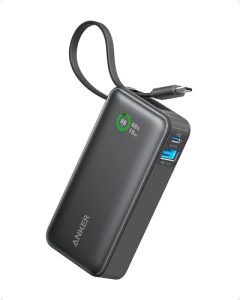
Ports decide what the bank can charge and how many things it can handle at once. One USB-C port covers most modern phones, earbuds and handheld consoles, while a second port or a USB-A port lets you add a watch, earbuds or a friend’s phone without unplugging your own. A built-in USB-C cable is the most convenient option for daily carry, since it cannot be left behind, and one that doubles as a carry loop is a thoughtful touch. Recharging matters as much: a bank that refills through the USB-C port it charges from is simpler to live with, and a clear battery indicator, display or row of lights, stops you setting off with an empty bank.
Pocket Charger Safety: Handling a Lithium-Ion Battery
Pocket chargers use lithium-ion cells, the same kind of battery found in phones and laptops, and they deserve the same basic care. Most problems come from heat, damage or cheap construction rather than from ordinary use, so a few habits go a long way. Buy from a maker with a real name and a product page that states built-in protections against overcharging, over-current, short circuits and overheating, and be wary of any listing that gives no maker name at all.
Keep the bank away from strong heat, such as a car dashboard in summer sun or a radiator, and never charge it on soft bedding or inside a closed bag where heat cannot escape. A hard, ventilated surface is the safer spot. Do not use a bank that is swollen, cracked, unusually hot during charging, or giving off a strange smell; move it away from flammable material, stop charging it, and contact the maker about a replacement. Never puncture, crush, bend or open a power bank, and keep it dry, since water and a damaged cell are a poor combination.
For flights, carry the bank in cabin baggage rather than checked luggage, and check your airline’s rules before you travel, since carriers set their own limits on battery size and on the number of spare batteries. A bank that has been dropped hard deserves a close look before its next charge: check the case for cracks and the ports for bent pins, and retire it if anything looks or smells wrong. Charge the bank with the cable and wall adapter the maker recommends, or a reputable equivalent, and unplug it once it is full rather than leaving it connected for days. Stored well, in a cool, dry place at partial charge when it will sit unused for weeks, a pocket charger should serve for many trips.
Which One Fits Your Situation
A pocket charger earns its place by matching the way you actually spend your day, not by looking impressive on a spec sheet. A commuter who tops up a phone on the train needs something slim that slips into a jacket pocket and delivers a quick boost before the next stop, while a traveller crossing time zones wants enough capacity for a phone and a pair of earbuds through a long day away from a socket. Students and festival goers care more about weight and a cable that will not tangle in a bag, and parents packing a day bag want a charger that can be handed to a child without fuss. Think about the devices you carry, the hours you spend away from power, and how much bulk you are willing to carry before you settle on a size.
The right pocket charger depends less on the largest capacity you can afford and more on the shape of your ordinary day. Start from where you go and what you carry, then let capacity and output follow.
For the Daily Commute
Commuters need a bank that disappears into a jacket pocket and is ready without a second thought. A slim 5,000 or 10,000 model with a built-in USB-C cable suits this best, because there is no loose lead to forget at home and the whole kit weighs little. Fast output matters less here than reliability, since most commutes need only a partial top-up between home and office.
For Travel Days and Long Flights
Travellers should carry more capacity, since sockets may be scarce for a whole day of navigation, photos and messaging. A 10,000 or 20,000 model with a fast USB-C port covers a phone several times over and can also top up earbuds or a tablet. Keep it in cabin baggage, confirm the airline’s battery rules before departure, and recharge it fully the night before you leave.
For Handheld Gaming on the Move
Handheld gamers need steady output above all, because a console draws power continuously while you play. Look for a 10,000 model or larger with a USB-C port rated at 20 watts or more, so the bank can keep pace with the console rather than merely slowing its drain. A short built-in cable keeps the setup tidy in a bag, and a slim shape matters when the bank rides beside the console.
For Hiking and Time Outdoors
Walkers and hikers should favour light weight and a shape that packs flat, since every extra gram is carried uphill. A 10,000 model in a slim shell is usually the sweet spot, giving a phone enough charge for maps and photos without dominating a hip-belt pocket. A bank with a clear charge indicator is useful outdoors, where there is no socket to fall back on, and a sturdy shell survives knocks far better than a glossy one.
Common Mistakes
- Buying capacity you will never carry: a huge bank left at home because it is heavy helps nobody, so choose the largest size you will actually put in a pocket every day.
- Trusting the headline wattage blindly: a total wattage split across two ports can mean slow charging for a single phone, so always check the output of one port on its own.
- Forgetting the recharge time: a bank that charges your phone quickly but takes all night to refill itself is a poor companion on back-to-back travel days.
- Ignoring the cable: a bank with no built-in cable is only useful if you remember a lead, so plan for the cable as part of the purchase, not an afterthought.
- Leaving a bank empty for months: a lithium-ion cell stored flat for a long stretch can lose capacity, so top it up to a partial charge before putting it away.
Frequently Asked Questions
How much capacity do I need in a pocket charger?
For most people, 10,000 milliamp-hours is the practical middle ground, covering roughly two full phone charges or a phone plus earbuds across a long day. A 5,000 model suits light users who only need one top-up, while a 20,000 model fits travellers and gamers who charge several devices. Choose by the number of charges your day needs, not by the biggest figure available.
Can I take a pocket charger on a plane?
Yes, in almost all cases, provided it travels in your cabin baggage rather than in checked luggage. Airlines set their own limits on battery size and on how many spare batteries each passenger may carry, so check your carrier’s rules before you fly. Keep the bank switched off and protected from short circuits, and avoid very large models unless your airline clearly allows them.
Why does my phone charge more slowly from a power bank?
Slow charging usually has three causes: the bank’s port delivers fewer watts than the phone can accept, the cable cannot carry the full current, or the phone runs apps and a bright screen while charging. Using the bank’s fastest USB-C port with a good cable, and closing heavy apps, usually restores normal speed. Heat can also slow charging, so move the phone and bank out of direct sun.
How long does a pocket charger take to recharge itself?
Recharge time depends on capacity and input wattage, so a small 5,000 model on a fast input can refill in a couple of hours, while a large 20,000 model on a slow input may need all night. Check the input figure on the product page and pair the bank with a wall adapter that can supply it. A battery indicator shows when it is ready to pack.
FAQ
How much capacity do I need in a pocket charger?
Can I take a pocket charger on a plane?
Why does my phone charge more slowly from a power bank?
How long does a pocket charger take to recharge itself?
More from Amazon
Programs that pair well with the guide above. Offers and eligibility are set by Amazon and may change.
Free shipping on eligible items, Prime Video and more. Eligible new members can start with a free trial.
Start a Prime free trialAd-free music streaming. Eligible new subscribers can start with a free trial.
Try Music Unlimited freeA Prime membership for ages 18-24 with a trial period. Eligibility is set by Amazon.
See Prime for Young AdultsAudiobooks and podcasts to listen to on the go. Eligible new members can start with a free trial.
Try Audible freeAs an Amazon Associate we earn from qualifying purchases.