
Key takeaways
- Sensor quality over DPI numbers: Almost no one games above 3,200 DPI. Ignore 26,000 DPI marketing and look for a proven optical sensor with consistent tracking and minimal smoothing.
- Grip style and hand size: Palm grippers with larger hands want a taller, contoured shell; claw and fingertip users are better served by something lighter and shorter. Measure your hand before you buy.
- Weight: Anything under 90g feels quick for FPS and tracking-heavy games. Heavier mice around 100–120g suit slower, deliberate aiming in MMOs and strategy titles.
- Switch durability: Cheap mice fail at the main buttons first. Look for rated switch lifespans of 50 million clicks or more, and check whether the model has a known double-click reputation.
- Wired vs. wireless: Modern budget wireless is genuinely competitive for latency, but wired models give you more sensor and build quality per dollar. Only pay the wireless premium if cable drag actually bothers you.
Shopping for a gaming mouse under $50 means wading through hundreds of near-identical listings, inflated DPI claims, and sensors that look impressive on a spec sheet but feel mushy in a firefight. The frustrating part is that price no longer tells you much: budget mice in 2026 routinely ship with sensors that were flagship-tier three years ago, while some overpriced options still use dated hardware and cheap switches that develop double-click problems within months.
This guide cuts through that noise. We’ve focused on models that genuinely stay at or below the $50 mark, prioritizing sensor accuracy, click consistency, build quality, and long-term reliability over marketing numbers. Below you’ll find our top picks, a short buying framework, and answers to the questions we get asked most often about budget gaming mice.
Our top picks
 Logitech G305 Lightspeed Wireless Gaming Mouse
- Formats: DVD-ROM
- Product Group: Personal Computer
- Binding: Personal Computers
 Logitech G502 Hero Wired Gaming Mouse
- Product Group: Personal Computer
- Binding: Personal Computers



As an Amazon Associate we earn from qualifying purchases at no extra cost to you. Ratings are shown as listed on Amazon.
⚡ Save on Your Next PC — Amazon Prime
Prime members get fast free shipping on the systems above, plus early access to Prime Day & Black Friday PC deals. New members get a 30-day free trial.
Watch: Best Gaming Mouse Under $50 — Video Review
How to Choose Gaming Mouse Under $50
- Sensor quality over DPI numbers: Almost no one games above 3,200 DPI. Ignore 26,000 DPI marketing and look for a proven optical sensor with consistent tracking and minimal smoothing.
- Grip style and hand size: Palm grippers with larger hands want a taller, contoured shell; claw and fingertip users are better served by something lighter and shorter. Measure your hand before you buy.
- Weight: Anything under 90g feels quick for FPS and tracking-heavy games. Heavier mice around 100–120g suit slower, deliberate aiming in MMOs and strategy titles.
- Switch durability: Cheap mice fail at the main buttons first. Look for rated switch lifespans of 50 million clicks or more, and check whether the model has a known double-click reputation.
- Wired vs. wireless: Modern budget wireless is genuinely competitive for latency, but wired models give you more sensor and build quality per dollar. Only pay the wireless premium if cable drag actually bothers you.
The Best Picks Reviewed
Logitech G305 Lightspeed
Still the benchmark for affordable wireless, the G305 pairs Logitech’s Lightspeed connection with a genuinely competitive sensor and multi-month AA battery life. At around 99g it’s not the lightest option anymore, but nothing else in this price bracket offers wireless performance this dependable.
Logitech G502 Hero
The G502 remains the go-to for players who want buttons — eleven of them, plus a free-spinning scroll wheel and an adjustable weight system. It’s heavy and unapologetically large, which makes it excellent for MMOs and productivity but a poor fit for low-sensitivity FPS players with smaller hands.
Redragon M612 Predator
The M612 is the value outlier here, delivering a competent 8000 DPI optical sensor, remappable buttons, and RGB lighting for a fraction of what the big brands charge. Build quality is a step below Logitech and Razer, but for a first gaming mouse or a backup, the price-to-performance ratio is hard to argue with.
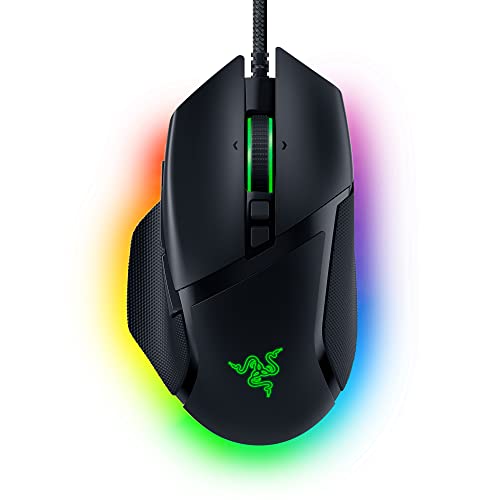
Razer Basilisk V3
Razer’s Basilisk V3 punches above its price with an excellent ergonomic shell, a tilt-click scroll wheel that switches between tactile and free-spin modes, and optical switches that sidestep the double-click failures plaguing mechanical designs. It frequently dips under $50 during sales, and at that price it’s arguably the best all-rounder on this list.
Razer DeathAdder Essential
The DeathAdder shape has sold tens of millions of units for good reason: it’s a near-universal fit for palm and hybrid grips, and the Essential version strips it down to the fundamentals at a very low price. You lose wireless, onboard memory, and the premium sensor, but the core tracking and comfort remain excellent.
Frequently Asked Questions
Is a $50 gaming mouse good enough for competitive play?
Yes. Sensor technology plateaued years ago, and mice in this range track accurately enough that hardware is no longer a meaningful limiting factor. Plenty of ranked players compete on the G305 and DeathAdder line.
Does wireless add noticeable input lag?
Not with modern proprietary 2.4GHz connections like Logitech’s Lightspeed or Razer’s HyperSpeed. The difference against wired is measured in fractions of a millisecond and is not perceptible in play. Avoid Bluetooth-only mice for gaming, however.
How much does mouse weight actually matter?
More than most specs. Lighter mice reduce fatigue during long sessions and make flick aiming easier, which is why competitive FPS players gravitate toward sub-70g designs. For slower genres, weight is largely a matter of personal preference.
What causes double-clicking, and can I avoid it?
It’s caused by wear or debris in mechanical switch contacts, and it’s the most common failure point on budget mice. Models using optical switches, like the Basilisk V3, eliminate the problem entirely. Otherwise, look for switches rated to at least 50 million clicks.
Final Thoughts
For most players, the Logitech G305 Lightspeed is the smartest buy under $50 — it delivers legitimate wireless performance and outstanding battery life with no meaningful compromise in tracking. If you prefer wired and want the most features for the money, the Razer Basilisk V3 is exceptional whenever it drops into this price range, thanks to its optical switches and superb ergonomics. Budget-conscious buyers or anyone building a secondary setup should look at the Redragon M612, which offers a genuinely capable sensor and remappable controls for a fraction of the cost of its rivals.


