Shopping for a gaming keyboard under $100 sounds easy until you actually start looking. The sub-$100 tier is the most crowded segment on the market, packed with boards that all promise RGB lighting, anti-ghosting and “mechanical feel” — a phrase that can mean anything from genuine hot-swappable switches to a membrane board wearing a costume. Spend badly here and you end up with mushy actuation, keycaps that shine within months, or a wireless board whose battery dies mid-raid.
The good news is that 2026 is genuinely the best year yet for budget keyboards. Hot-swap sockets, pre-lubed switches, PBT keycaps and tri-mode connectivity have all trickled down into the $30–$100 bracket, features that were flagship-only a few years ago. This guide covers six boards we consider the strongest value picks in the category, spanning full-size workhorses, compact 65% and 75% layouts, and both membrane and mechanical designs — so you can match the board to how you actually play, not just to a spec sheet.
Our top picks
 GEODMAER 65% Gaming Keyboard
- 【65% Compact Design】GEODMAER Wired gaming keyboard compact mini…
- 【Wired Connection】Gaming Keybaord connects via a detachable Type-C…
- 【Strong Working Life】Wired gaming keyboard has more than…
 Logitech G213 Prodigy Wired RGB Gaming Keyboard
Five customizable RGB zones sync with other Logitech G gear
Integrated palm rest adds comfort for long sessions
Dedicated media controls simplify volume and playback
Membrane-style keys trail mechanical switches in tactile feel
Full-size layout takes up more desk space
 TECKNET Wired Gaming Keyboard
- 【Ergonomic Design, Enhanced Typing Experience】Improve your typing experience…
- 【15-Zone Rainbow Backlit Keyboard】Customize your PC gaming keyboard…
- 【Whisper Quiet Design】Experience near-silent operation with our whisper-quiet…
| Product | Key specs | |
|---|---|---|
| GEODMAER 65% Gaming Keyboard | 【65% Compact Design】GEODMAER Wired gaming keyboard compact mini… 【Wired Connection】Gaming Keybaord connects via a detachable Type-C… 【Strong Working Life】Wired gaming keyboard has more than… | Check price |
| Logitech G213 Prodigy Wired RGB Gaming Keyboard | Check price | |
| TECKNET Wired Gaming Keyboard | 【Ergonomic Design, Enhanced Typing Experience】Improve your typing experience… 【15-Zone Rainbow Backlit Keyboard】Customize your PC gaming keyboard… 【Whisper Quiet Design】Experience near-silent operation with our whisper-quiet… | Check price |
 Redragon K521 Upgrade Rainbow LED Gaming Keyboard Redragon K521 Upgrade Rainbow LED Gaming Keyboard | 【Dreamy Rainbow Gaming Keyboard】K521 Gaming Keyboard Adopts a… 【One Touch Opens & Visual Feast】The K521 Red… 【Mechanical Feeling & Fast Tapping】The PC Keyboard Keys… | Check price |
 AULA F75 Pro Wireless Mechanical Keyboard AULA F75 Pro Wireless Mechanical Keyboard | Tri-mode Connection Keyboard: AULA F75 Pro wireless mechanical… Hot-swap Custom Keyboard: This custom mechanical keyboard with… Advanced Structure and PCB Single Key Slotting: This… | Check price |
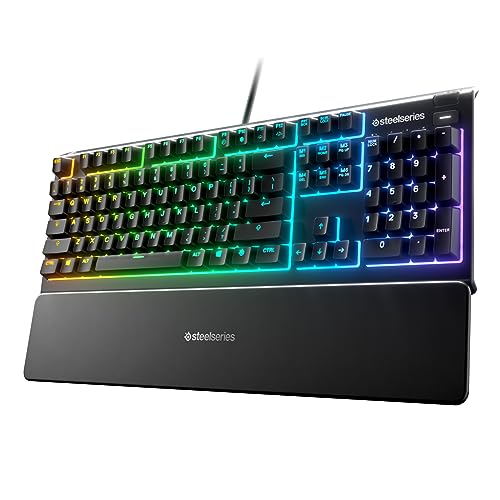 SteelSeries Apex 3 RGB Gaming Keyboard SteelSeries Apex 3 RGB Gaming Keyboard | Ip32 water resistant 10-zone RGB illumination Whisper quiet gaming switches | Check price |
 Redragon S101-3 PRO Gaming Keyboard and Mouse Redragon S101-3 PRO Gaming Keyboard and Mouse | 🎮𝐀𝐥𝐥-𝐢𝐧-𝐎𝐧𝐞 𝐆𝐚𝐦𝐢𝐧𝐠 & 𝐎𝐟𝐟𝐢𝐜𝐞 𝐂𝐨𝐦𝐛𝐨 - 𝐔𝐧𝐛𝐞𝐚𝐭𝐚𝐛𝐥𝐞 𝐕𝐚𝐥𝐮𝐞:… ✨𝐅𝐮𝐥𝐥𝐲 𝐂𝐮𝐬𝐭𝐨𝐦𝐢𝐳𝐚𝐛𝐥𝐞 𝐑𝐆𝐁 & 𝐌𝐚𝐜𝐫𝐨𝐬 - 𝐘𝐨𝐮𝐫 𝐂𝐨𝐧𝐭𝐫𝐨𝐥,… 🔇𝐐𝐮𝐢𝐞𝐭, 𝐂𝐨𝐦𝐟𝐨𝐫𝐭𝐚𝐛𝐥𝐞 & 𝐑𝐞𝐬𝐩𝐨𝐧𝐬𝐢𝐯𝐞 𝐓𝐲𝐩𝐢𝐧𝐠 𝐄𝐱𝐩𝐞𝐫𝐢𝐞𝐧𝐜𝐞: Designed for… | Check price |
 Redragon Mechanical Gaming Keyboard Wired Redragon Mechanical Gaming Keyboard Wired | Brilliant Color Illumination- With 11 unique backlights, choose… Support Macro Editing: The K671 Mechanical Gaming Keyboard… Hot-swappable Linear Red Switch- Our K671 gaming keyboard… | Check price |
As an Amazon Associate we earn from qualifying purchases at no extra cost to you.
⚡ Save on Your Next PC — Amazon Prime
Prime members get fast free shipping on the systems above, plus early access to Prime Day & Black Friday PC deals. New members get a 30-day free trial.
Watch: Best Gaming Keyboard Under $100 — Video Review
How to Choose Gaming Keyboard Under $100
- Switch type: Mechanical switches give you crisp actuation, per-key replaceability and a far longer lifespan, while membrane boards are quieter and cheaper. Under $100 you can now get real mechanical — but read carefully, since “mechanical feeling” almost always means membrane.
- Layout and desk space: Full-size boards keep the numpad for MMOs and spreadsheets; 65% and 75% layouts free up several inches of mouse room for low-sensitivity FPS players. A 75% board is the best compromise, keeping function keys and arrows without the bulk.
- Build quality and keycaps: Look for a metal or reinforced top plate to kill flex, and PBT keycaps rather than ABS. PBT resists the greasy shine that ruins cheap boards within a few months of heavy use.
- Anti-ghosting and rollover: Anything you game on should handle simultaneous inputs without dropping keys. Full N-key rollover is ideal; a well-implemented 26-key or conflict-free membrane matrix is acceptable at the lower end of this budget.
- Connectivity and extras: Wired USB-C is the simplest, latency-free option. If you want wireless, insist on a 2.4GHz dongle rather than Bluetooth alone for gaming, and treat volume knobs, media keys and wrist rests as genuine quality-of-life wins rather than gimmicks.
The Best Picks Reviewed
AULA F75 Pro Wireless Mechanical Keyboard
This is the most complete package in the group and the one we’d hand to most buyers: a 75% hot-swappable board with pre-lubed Reaper switches, side-printed PBT keycaps, a volume knob and tri-mode 2.4GHz/Bluetooth/USB-C connectivity. The hot-swap sockets are the real story, letting you change switch feel later without soldering, which is rare at this price and makes the board a long-term platform rather than a disposable purchase.
SteelSeries Apex 3 RGB
The Apex 3 is the safest buy here, pairing whisper-quiet gaming switches with IP32 water resistance and a genuinely good magnetic wrist rest — a combination that suits shared spaces, late-night sessions and clumsy desk drinkers alike. It’s a membrane board rather than mechanical, so the typing feel is soft, but the build quality, 10-zone RGB and SteelSeries software support are a clear step above generic budget offerings.
Logitech G213 Prodigy
Logitech’s veteran full-size board remains a sensible pick for anyone who wants reliability over novelty, with spill resistance, dedicated media controls, an integrated palm rest and per-zone RGB through G HUB. The tactile membrane switches won’t satisfy mechanical enthusiasts, but the 213 is quiet, durable and backed by support you can actually reach.
Redragon K521 Upgrade
The K521 targets players who want a full 104-key layout with multimedia keys, one-touch backlighting and console compatibility across PC, Mac, PS4/5 and Xbox. It uses mechanical-feel membrane switches rather than true mechanical ones, so treat it as a budget all-rounder — the value is in the feature list and the wide device support, not the typing purity.
GEODMAER 65% Gaming Keyboard
At the entry level, this ultra-compact 68-key membrane board is the cheapest legitimate way to free up mouse space, with conflict-free anti-ghosting and backlighting for players who mostly need WASD, arrows and a small footprint. It’s a starter or secondary board rather than an endgame purchase, but for a travel bag or a first gaming PC it does the job without drama.
Frequently Asked Questions
Do I really need a mechanical keyboard to game well?
No. Mechanical switches feel better and last longer, but a well-built membrane board with proper anti-ghosting will not cost you matches. Skill and consistent input matter far more than switch type, which is why boards like the Apex 3 and G213 remain popular with competitive players.
Is a 65% or 75% layout worth losing the numpad?
For FPS and third-person action games, yes — the extra mouse room is a real ergonomic benefit, especially at low sensitivity. If you play MMOs, sims, or use your PC for data entry, stick with full-size or add a separate numpad.
What does “hot-swappable” actually mean?
It means the switches sit in sockets rather than being soldered to the PCB, so you can pull them out with a puller and fit different ones. Practically, it lets you change from linear to tactile switches, or replace a single failed switch, without any tools beyond what’s usually included in the box.
Is wireless fast enough for competitive play?
Over a 2.4GHz dongle, yes — modern wireless latency is effectively indistinguishable from wired for keyboard input. Bluetooth is a different matter and is better reserved for typing, laptops and tablets, so choose a tri-mode board like the F75 Pro if you want both options.
Final Thoughts
If you want the most keyboard for your money in 2026, the AULA F75 Pro is our overall pick — hot-swap sockets, pre-lubed switches, PBT keycaps and tri-mode wireless make it feel far more expensive than it is. Buyers who prioritise durability, quiet operation and long-term software support should take the SteelSeries Apex 3 instead, while the Logitech G213 Prodigy remains the dependable full-size choice for players who want media keys, a built-in palm rest and a brand that will still be answering support tickets in five years.