Key takeaways
- Cost: Premium air coolers like the Peerless Assassin 120 SE undercut most quality AIOs, freeing budget for other parts.
- Peak cooling: A 360mm AIO such as the Liquid Freezer III Pro dissipates more heat under sustained heavy loads than a single-tower air cooler.
- Reliability: Air coolers have one moving part (the fan); AIOs add a pump that can eventually fail.
- Noise: Larger radiators move heat with slower fan speeds, so a big AIO can run quieter under load than a compact air cooler.
- Clearance: Tall air towers can block tall RAM or side panels; AIOs move the bulk to a radiator mounted on the case.
- Aesthetics: ARGB AIOs and a clean CPU block appeal to showcase builds, especially in dual-glass cases like the MUSETEX ATX.
Cooling is the quiet decision that shapes how loud, how cool, and how expensive your gaming PC ends up being. In 2026 both premium air coolers and all-in-one (AIO) liquid coolers can tame modern CPUs, so the choice comes down to noise targets, case clearance, aesthetics, and how much you want to spend.
This comparison weighs a top-tier air tower like the Thermalright Peerless Assassin 120 SE against AIO options such as the ARCTIC Liquid Freezer III Pro 360 and the Thermalright Aqua Elite 240, so you can match cooling to your CPU and case rather than guessing.
Our top picks



As an Amazon Associate we earn from qualifying purchases at no extra cost to you. Ratings are shown as listed on Amazon.
⚡ Save on Your Next PC — Amazon Prime
Prime members get fast free shipping on the systems above, plus early access to Prime Day & Black Friday PC deals. New members get a 30-day free trial.
Watch: Air vs Water Cooling for Gaming PCs — Video Review
Quick Verdict
For most builds, a high-end dual-tower air cooler delivers 90% of the performance of a 240mm AIO for less money and with zero pump-failure risk. Step up to a 360mm liquid cooler only if you run a power-hungry flagship CPU, want the lowest possible noise under sustained load, or care about the clean look of a liquid loop.
Key Differences
- Cost: Premium air coolers like the Peerless Assassin 120 SE undercut most quality AIOs, freeing budget for other parts.
- Peak cooling: A 360mm AIO such as the Liquid Freezer III Pro dissipates more heat under sustained heavy loads than a single-tower air cooler.
- Reliability: Air coolers have one moving part (the fan); AIOs add a pump that can eventually fail.
- Noise: Larger radiators move heat with slower fan speeds, so a big AIO can run quieter under load than a compact air cooler.
- Clearance: Tall air towers can block tall RAM or side panels; AIOs move the bulk to a radiator mounted on the case.
- Aesthetics: ARGB AIOs and a clean CPU block appeal to showcase builds, especially in dual-glass cases like the MUSETEX ATX.
Air Cooling: Simple and Bulletproof
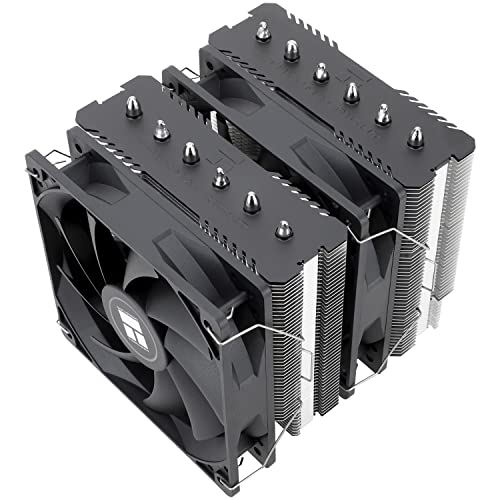
Air cooling wins on value and peace of mind. A dual-tower cooler like the Thermalright Peerless Assassin 120 SE, with six heat pipes and dual 120mm fans, keeps mainstream and even many high-end CPUs comfortably in check while costing a fraction of a comparable liquid loop. There is no pump to fail and no coolant to worry about years down the line.
The main downsides are size and looks. Big air towers are heavy, can crowd your first RAM slot, and dominate the interior of a windowed case. If clearance and aesthetics are not concerns, air is the pragmatic pick.
Water Cooling: Cool, Quiet, Clean
An AIO shines when heat output is high or noise must be minimal. The ARCTIC Liquid Freezer III Pro 360 spreads heat across a large radiator, letting its fans spin slower and quieter under the same load that would push an air cooler’s fans to a whine. It also clears the space above your RAM and gives the build that tidy, block-and-tube look many enthusiasts want.
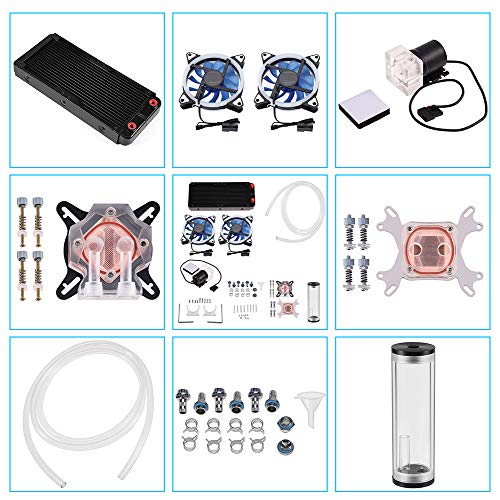
The trade-offs are price, install complexity, and the pump as a long-term wear item. Custom loops with parts like G1/4 fittings and dedicated radiators go further still, but for most gamers a sealed AIO strikes the right balance.
Which Should You Buy?
- Mainstream CPU, tight budget: A premium air tower is the smart buy.
- Flagship CPU or overclocking: A 280mm or 360mm AIO gives more thermal headroom.
- Quietest possible build: A large-radiator AIO runs its fans slower under load.
- Showcase build: An ARGB AIO plus a glass case looks the part.
- Set-and-forget reliability: Air cooling has fewer failure points.
Frequently Asked Questions
Will an AIO leak?
Modern sealed AIOs rarely leak; the more common failure is the pump wearing out after several years. Quality units carry long warranties for this reason.
Is a 240mm AIO enough?
For most mainstream CPUs, yes. Step up to 360mm for flagship chips, heavy overclocks, or if you want the quietest sustained operation.
Does air cooling hurt performance?
No. A good air cooler keeps most CPUs at safe temperatures and full boost clocks. Only extreme, sustained loads reveal a meaningful gap.
Can tall air coolers block my RAM?
Some can. Check the cooler’s RAM clearance spec against your memory height, or choose low-profile RAM to be safe.
Final Verdict
Air cooling is the value and reliability champion for the majority of 2026 gaming builds. Choose a 240mm or 360mm AIO when your CPU runs hot, you overclock, you crave near-silence under load, or you want that clean liquid-cooled aesthetic. Both approaches can keep your gaming rig cool for years.