Key takeaways
- Cache strategy: AMD’s 3D V-Cache stacks extra L3 cache directly on the die, which is why X3D chips crush esports and simulation titles that live and die on cache hits.
- Efficiency: AMD’s current Ryzen desktop parts generally draw less power and run cooler, easing cooling requirements compared with Intel’s higher-wattage K-series.
- Platform longevity: AMD’s AM5 socket is committed through 2027+, so a board bought today likely takes a future CPU; Intel tends to rotate sockets more often.
- Productivity: Intel’s hybrid P-core/E-core design shines in rendering, compiling, and heavy multitasking benchmarks.
- Integrated graphics: AMD Radeon integrated graphics (as seen in the NIMO Ryzen 5 6600H laptop) are stronger for light gaming when no discrete GPU is present.
- Price at the low end: Budget prebuilts like the Intel Core i5 tower keep entry pricing aggressive, so value shoppers still find Intel deals worth grabbing.
The Intel versus AMD debate has never been closer than it is in 2026. Both companies now ship gaming chips that can push a modern GPU to its limits at 1440p and 4K, so the “obvious winner” arguments of a few years ago no longer hold. What actually separates them today is efficiency, platform longevity, and how much raw single-thread speed your favorite games can use.
This comparison cuts through the marketing to focus on what matters when you are gaming: average and 1% low frame rates, thermals, upgrade path, and price-to-performance. Whether you are eyeing a prebuilt like the Blackout Computers Intel 12th Gen tower or an AMD Ryzen laptop, the guidance below applies to both desktops and gaming notebooks.
Our top picks
 Prebuilt Gaming PC Desktop
- 【Sleek Design & Efficient Cooling】 Features an A-pillar-free…
- 【Powerful Multi-Core Performance, Smooth Multitasking】 Equipped with the…
- 【Entry-Level Gaming Graphics】Powered by AMD Radeon R7 350…
 Blackout Computers Gaming PC Intel 12th Gen
- 802.11 AC WIFI | Bluetooth 5.0 | Graphic…
- AMD Radeon RX 580 8GB GDDR5 Graphics Card…
- 4 RGB Fans for Maximum Air Flow |…
 NIMO 15.6" IPS FHD-Light Gaming-Laptop
- [High-Performance Processing] Powered by the AMD Ryzen 5…
- [Future-Proof Expandability] Designed for longevity, the N153 allows…
- [Enhanced Privacy & Security] Protect your sensitive data…
| Product | Key specs | |
|---|---|---|
| Prebuilt Gaming PC Desktop | 【Sleek Design & Efficient Cooling】 Features an A-pillar-free… 【Powerful Multi-Core Performance, Smooth Multitasking】 Equipped with the… 【Entry-Level Gaming Graphics】Powered by AMD Radeon R7 350… | Check price |
| Blackout Computers Gaming PC Intel 12th Gen | 802.11 AC WIFI | Bluetooth 5.0 | Graphic… AMD Radeon RX 580 8GB GDDR5 Graphics Card… 4 RGB Fans for Maximum Air Flow |… | Check price |
| NIMO 15.6" IPS FHD-Light Gaming-Laptop | [High-Performance Processing] Powered by the AMD Ryzen 5… [Future-Proof Expandability] Designed for longevity, the N153 allows… [Enhanced Privacy & Security] Protect your sensitive data… | Check price |
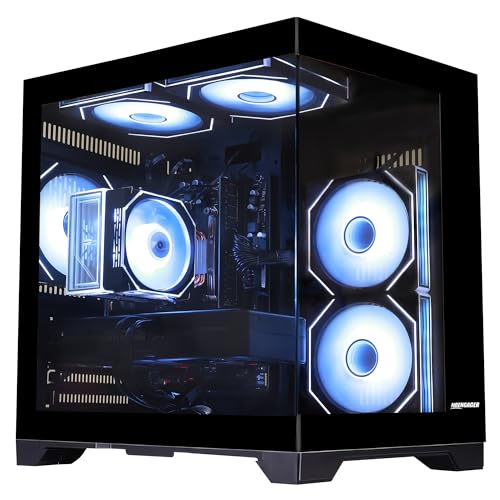 Prebuilt Gaming PC Desktop Prebuilt Gaming PC Desktop | High-Performance Gaming PC powered by Intel Core i5-14400F… 32GB DDR4 RAM 3200MHz ensures lag-free multitasking and… Built-in WiFi & Bluetooth for stable wireless connectivity,… | Check price |
 ASUS TUF A16 RTX 5060 Gaming Laptop ASUS TUF A16 RTX 5060 Gaming Laptop | Equipped with AMD Ryzen 7 260 processor and… IMMERSIVE 165Hz DISPLAY - Features a 16" FHD+… Built to withstand daily wear and tear with… | Check price |
 NOVATECH Phantom 2.0 NOVATECH Phantom 2.0 | AMD RX580 Graphics card delivers smooth visuals and… GET MORE DONE, FASTER: Powered by an Intel… UPGRADE YOUR SETUP’S LOOK: Encased in a high-quality… | Check price |
 Corsair Vengeance RGB RS DDR5 16GB Corsair Vengeance RGB RS DDR5 16GB | Disclaimer: Maximum Speed requires overclocking/PC BIOS adjustments AMD EXPO & Intel XMP 3.0 Compatible Only:… Dynamic RGB Lighting: Individually addressable RGB lighting delivers… | Check price |
 GMKtec M5 Ultra Gaming Mini PC AMD GMKtec M5 Ultra Gaming Mini PC AMD | Office Gaming Mini PC - UPGRADED GMKtec Nucbox… 32GB DDR4 RAM & 1TB PCIe SSD -… DUAL NIC LAN 2.5G RJ45 - Fast Network… | Check price |
As an Amazon Associate we earn from qualifying purchases at no extra cost to you.
⚡ Save on Your Next PC — Amazon Prime
Prime members get fast free shipping on the systems above, plus early access to Prime Day & Black Friday PC deals. New members get a 30-day free trial.
Watch: Intel vs AMD for Gaming in 2026 — Video Review
Quick Verdict
For most gamers in 2026, AMD’s Ryzen X3D chips deliver the highest average frame rates in CPU-bound titles thanks to their large 3D V-Cache, while Intel’s Core lineup often wins in productivity and mixed workloads. If you only game, lean AMD; if you stream, edit, and game on one machine, Intel’s extra multi-thread grunt makes a stronger case.
Key Differences
- Cache strategy: AMD’s 3D V-Cache stacks extra L3 cache directly on the die, which is why X3D chips crush esports and simulation titles that live and die on cache hits.
- Efficiency: AMD’s current Ryzen desktop parts generally draw less power and run cooler, easing cooling requirements compared with Intel’s higher-wattage K-series.
- Platform longevity: AMD’s AM5 socket is committed through 2027+, so a board bought today likely takes a future CPU; Intel tends to rotate sockets more often.
- Productivity: Intel’s hybrid P-core/E-core design shines in rendering, compiling, and heavy multitasking benchmarks.
- Integrated graphics: AMD Radeon integrated graphics (as seen in the NIMO Ryzen 5 6600H laptop) are stronger for light gaming when no discrete GPU is present.
- Price at the low end: Budget prebuilts like the Intel Core i5 tower keep entry pricing aggressive, so value shoppers still find Intel deals worth grabbing.
Intel Core: The Do-Everything Choice
Intel’s strength is versatility. A Core i5 or i7 build, such as the prebuilt pairing an i5-14400F with an RX 9060 XT, handles gaming, video calls, and content creation without breaking stride. The extra efficiency cores absorb background tasks so your game threads stay responsive, which is a real advantage if you keep Discord, OBS, and a browser open while playing.
The trade-off is power and heat. Intel’s higher-end K chips can pull significant wattage under load, so you will want a capable cooler and a case with good airflow. If your workload is a even split between gaming and creator apps, Intel usually gives you more total throughput per dollar.
AMD Ryzen: The Frame-Rate King
AMD’s X3D chips are the ones esports pros and simulation fans obsess over, and for good reason: in cache-sensitive games the 1% lows are noticeably smoother. Systems built around AMD, like the GMKtec M5 Ultra Mini PC with a Ryzen 7 7730U, also show how far Ryzen efficiency has come in small form factors.
Beyond raw speed, AMD’s AM5 platform is the safer long-term bet. Buying an AM5 motherboard today means you can likely drop in a next-gen Ryzen later without a full rebuild, which softens the sting of upgrading in two or three years.
Which Should You Buy?
- Pure gaming at high refresh: Choose an AMD X3D chip for the best 1% lows.
- Game + stream + edit: Choose Intel for the multi-thread headroom.
- Tight budget: Compare current prebuilt deals on both sides; entry Intel i5 towers are often the cheapest way in.
- Plan to upgrade the CPU later: AMD AM5 gives you a clearer upgrade path.
- Small form factor or laptop: AMD’s efficiency and integrated Radeon graphics are hard to beat.
Frequently Asked Questions
Does the CPU even matter if I game at 4K?
Less than at 1080p. At 4K the GPU is usually the bottleneck, so Intel and AMD converge. The CPU matters most at high refresh 1080p/1440p and in simulation or strategy games.
Are AMD X3D chips worth the premium?
If you chase the highest frame rates in competitive or CPU-heavy games, yes. For casual 60 fps gaming the premium is harder to justify.
Which runs cooler?
AMD’s current desktop Ryzen parts generally run cooler and sip less power than Intel’s top K-series, though a good cooler evens the field.
Can I reuse my old cooler and RAM?
Check the socket and memory type. AMD AM5 and modern Intel boards both use DDR5, but coolers may need a new mounting bracket depending on the socket.
Final Verdict
There is no universally wrong answer in 2026. Buy AMD if pure gaming frame rates and a long upgrade path top your list; buy Intel if you want one machine that games well and grinds through creator work with ease. Match the chip to how you actually use your PC and either brand will serve you for years.