Key takeaways
- Compare OLED and Mini-LED gaming displays by motion clarity, HDR brightness, black levels, blooming, burn-in risk, room lighting, and price.
OLED is usually the stronger choice for dark-room contrast, pixel response, and clean highlights without a halo. Mini-LED is often the safer choice for a bright room, sustained full-screen brightness, static desktop work, and buyers concerned about uneven OLED aging. Neither label guarantees a good gaming display: refresh rate, input processing, variable refresh rate, panel coating, dimming behavior, ports, and firmware can matter as much as the backlight technology.
This is a technology and specification comparison, not a claim that we instrument-tested every model. Performance varies by panel and firmware. Consult independent measurements before buying.
Our top picks
 KTC 27 Inch Mini LED Monitor
- [1440P 165Hz Mini LED Monitor] 27 inch HVA…
- [HDR1000 & Quantum Dot Technology] From gloomy shadows…
- KVM Switch & Built-in Speakers] KVM switch makes…
 INNOCN 24.5" 2K QHD 2560x1440P 240Hz Mini
- Rare 24.5 Inch 1440p 240hz & Mini-LED Back-Lit…
- Quick Response Time: Up to 0.5 milliseconds gray…
- High Image Quality QHD 1440P PC Gaming Monitor:…
| Product | Key specs | |
|---|---|---|
| KTC 27 Inch Mini LED Monitor | [1440P 165Hz Mini LED Monitor] 27 inch HVA… [HDR1000 & Quantum Dot Technology] From gloomy shadows… KVM Switch & Built-in Speakers] KVM switch makes… | Check price |
| INNOCN 24.5" 2K QHD 2560x1440P 240Hz Mini | Rare 24.5 Inch 1440p 240hz & Mini-LED Back-Lit… Quick Response Time: Up to 0.5 milliseconds gray… High Image Quality QHD 1440P PC Gaming Monitor:… | Check price |
 INNOCN 27" 2K 1440P 320Hz Mini LED INNOCN 27" 2K 1440P 320Hz Mini LED | Check price | |
 INNOCN 32" Mini LED 4K 160Hz 3840 INNOCN 32" Mini LED 4K 160Hz 3840 | 【4K 160Hz Gaming Monitor & Mini LED Backlit… 【Realistic View with Excellent Color Performance】This 32 Inch… 【Rich Connectivity & FreeSync Compatible】this 4K gaming monitor… | Check price |
 LG 27GX700A-B 27-inch Ultragear QHD LG 27GX700A-B 27-inch Ultragear QHD | Check price | |
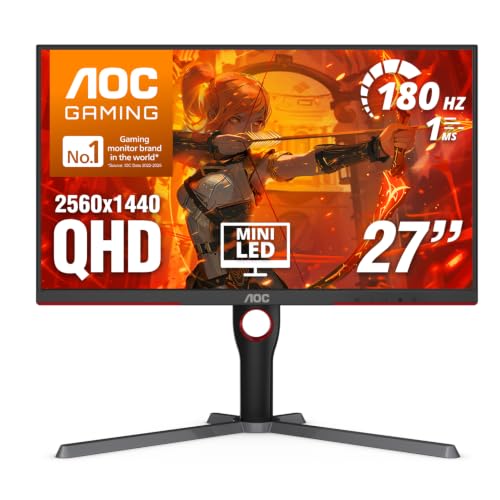 AOC 27 Inch Gaming Monitor QHD 180Hz AOC 27 Inch Gaming Monitor QHD 180Hz | Witness virtual worlds come to life on a… With Panel resolution 2560x1440, this monitor boasts a… Lightning-fast 180Hz (overclocked, via DP1.4) refresh rate and… | Check price |
 Acer Nitro 27in QHD 2560x1440 IPS MiniLED Acer Nitro 27in QHD 2560x1440 IPS MiniLED | Check price | |
 KTC 27 Inch 4K MiniLED Gaming Monitor KTC 27 Inch 4K MiniLED Gaming Monitor | Check price |
As an Amazon Associate we earn from qualifying purchases at no extra cost to you.
The difference in one minute
OLED is emissive: each pixel produces and controls its own light. A black pixel can turn off independently beside a bright pixel. Mini-LED is an LCD architecture with a backlight made from many small LEDs divided into local-dimming zones. One zone illuminates many LCD pixels, so the backlight has less spatial precision than pixel-level emission, even when the zone count is high.
That structural difference explains the major trade-offs:
| Gaming factor | OLED tendency | Mini-LED tendency |
|---|---|---|
| Black level | Pixel can switch off | Depends on local-dimming zones and algorithm |
| Bright highlights | Strong small highlights; model-dependent | Frequently higher peak and sustained brightness |
| Blooming | No backlight halo in the LCD sense | Possible around bright objects on dark backgrounds |
| Pixel response | Typically very fast | Depends on the underlying LCD panel and overdrive |
| Static-content aging | Uneven wear is possible | No OLED-style organic-pixel aging |
| Bright-room use | Coating and model brightness matter | Often better suited to strong ambient light |
| Desktop productivity | Requires sensible OLED care | Generally lower concern about static UI elements |
| Price | Premium, though range is widening | Ranges from mid-tier to premium by zone count and size |
These are category tendencies, not promises. A well-tuned Mini-LED can outperform a poorly configured OLED in a bright room, while a high-refresh OLED can provide a clearer competitive experience than a slower Mini-LED.
Black levels and dark-game detail
OLED’s pixel-level light control is its defining advantage. VESA’s DisplayHDR FAQ explains that OLED does not need a backlight because each pixel generates its own light. VESA created its DisplayHDR True Black tiers for emissive displays and sets a very low maximum black level in the certification criteria.
In a dark game, that means a star, HUD marker, or torch can appear beside black without asking a larger backlight zone to illuminate the surrounding area. The image can retain strong local contrast in small, mixed scenes.
Mini-LED narrows the gap with controlled backlight zones. A bright cursor can lift nearby black pixels within its zone, producing blooming. More zones can reduce the affected area, but zone count alone does not reveal algorithm quality or panel contrast.
Dark detail is not synonymous with “darkest possible black.” Poor tone mapping or aggressive dimming may crush near-black shades. VESA specifically tests whether a certified display distinguishes shadow detail from black. When evaluating a model, look beyond screenshots and compare measured near-black tracking in the picture mode you plan to use.
HDR brightness and bright-room performance
Mini-LED’s strongest argument is light output. An LCD backlight can drive bright highlights and, on some models, sustain a brighter large image than OLED. That helps HDR effects in daylight and counters reflections in a bright room. It also benefits games with large bright environments such as snow fields, stadiums, skies, and racing tracks.
OLED brightness is highly dependent on the model, panel type, window size, thermal behavior, and picture mode. Small specular highlights can be impressive because they sit beside true black, even if the measured peak number is lower. As the bright portion of the image grows, some OLED displays reduce output to manage power and heat. The visible impact varies with the content and implementation.
Do not compare only the largest advertised nit number. VESA’s DisplayHDR performance criteria use several patterns, including a small center patch, full-screen flash, and long-duration full-screen tests. That illustrates why one peak measurement does not describe the entire HDR experience. Seek measurements at multiple window sizes plus real-scene performance.
Motion clarity, response time, and refresh rate
OLED pixels can change state very quickly. LG Display, a panel manufacturer, describes its gaming OLED panels as self-emissive and has announced monitor panels with high refresh rates and very short claimed response times. Manufacturer response claims are not directly interchangeable with independent measurements, but the underlying fast transition behavior is a genuine reason OLED is attractive for motion clarity.
Mini-LED does not define pixel response. The displayed image still passes through an LCD layer, so transition speed depends on whether the panel is VA, IPS, or another LCD implementation and how overdrive is tuned. Some transitions may be fast while dark transitions smear. An aggressive overdrive mode can replace blur with inverse ghosting.
Refresh rate is separate from pixel response. A 240 Hz Mini-LED updates more frequently than a 144 Hz OLED, although the OLED may complete its pixel transitions more cleanly. Compare refresh rate, measured response across the full range, overshoot, and input lag together. Competitive players should also check whether the best overdrive setting works throughout the variable-refresh range.
Input lag and variable refresh rate
OLED does not automatically have lower input lag simply because its pixels respond quickly. Input lag includes processing before a pixel begins changing. A display’s game mode, scaling, HDR processing, frame rate, and firmware all contribute. Mini-LED local dimming can also involve processing, but the effect is model-specific.
For either technology, verify the supported VRR range and standards, whether VRR works over the required HDMI or DisplayPort input, and whether local dimming or image quality changes during VRR. Some OLED displays can show near-black flicker when frame timing varies sharply; some Mini-LED displays alter their dimming behavior in a VRR mode. These are implementation issues that require exact-model testing.
Console buyers should confirm 4K resolution at the target refresh rate, HDMI bandwidth, VRR, HDR, and automatic low-latency mode on the required number of ports. PC buyers should check DisplayPort capabilities, compression requirements, GPU compatibility, and text rendering at the chosen scaling level.
Blooming versus burn-in risk
The signature Mini-LED artifact is blooming. It is most apparent with small bright objects, subtitles, loading icons, or a mouse pointer on a dark screen. The viewer’s angle, room darkness, native LCD contrast, number of zones, and dimming algorithm influence visibility. A monitor may prioritize preserving bright detail or suppressing halos; neither tuning is perfect in every scene.
OLED avoids backlight blooming, but its organic pixels can age unevenly. Static taskbars, browser controls, game HUDs, channel logos, and repeated window layouts can contribute over long periods. Modern displays use measures such as pixel shifting, logo detection, compensation cycles, and screen savers, but these reduce rather than erase the underlying possibility.
Risk depends on usage. A person who alternates varied full-screen games and video has a different exposure pattern from someone displaying the same productivity interface for ten hours each day. Review the manufacturer’s warranty language for image retention and burn-in; policies vary by brand, model, region, and use classification.
Mini-LED is preferable when the display will show static dashboards or desktop applications all day and gaming is secondary. OLED becomes easier to justify when gaming and video dominate, content varies, sleep settings are enabled, and the user accepts routine panel-care features.
Room-by-room recommendations
Dark gaming room
OLED has the clearest advantage here. Pixel-level blacks, no local-dimming halos, and rapid transitions suit horror, space, and cinematic games. Control small reflections and avoid placing the display where bright objects reflect directly from its coating.
Bright living room
Mini-LED is usually the safer starting point because high sustained brightness can fight ambient light. Examine the screen coating and reflection handling, not just peak luminance. A glossy OLED can look excellent when reflections are controlled but distracting opposite a window.
Mixed work-and-play desk
Choose Mini-LED if static applications dominate or you do not want to manage OLED care. Choose OLED if gaming and media dominate and you value motion clarity and dark-scene contrast enough to alter habits. An OLED owner should use automatic sleep, hide static elements when practical, allow compensation cycles to complete, and avoid disabling protective features merely to maximize brightness.
How to compare exact models
First, match size, resolution, and refresh rate. Then confirm the required ports and bandwidth. Compare independent measurements for input lag, response-time distribution, overshoot, brightness at several window sizes, contrast, EOTF tracking, gamut, VRR behavior, and flicker. For Mini-LED, add dimming-zone behavior and blooming. For OLED, add text rendering, brightness limiting, panel-care routine, and warranty coverage.
VESA DisplayHDR and DisplayHDR True Black publish defined performance criteria, making a valid certification more informative than an undefined “HDR ready” badge. Still, the tier does not cover every gaming behavior.
If OLED is the likely choice, continue with our planned best OLED gaming monitor shortlist. Buyers targeting sharper console or PC visuals can compare the best 4K gaming monitor options. Our HDR gaming monitor guide will explain tone mapping and certification in more depth.
FAQ
Is OLED always better than Mini-LED for gaming?
No. OLED generally leads in black precision and pixel response, while Mini-LED often leads in bright-room output and avoids OLED-style uneven organic aging. The better choice follows the room, content mix, target refresh rate, and tolerance for each technology’s artifacts.
Does Mini-LED get burn-in?
Mini-LED LCDs do not use self-emissive organic pixels, so they do not share OLED’s specific uneven-aging mechanism. LCD image retention or other failures can still occur, but that is not the same technology or risk profile.
Which technology is better for HDR?
OLED delivers pixel-level black and precise small highlights; Mini-LED can deliver stronger peak and sustained brightness. Dark-room cinematic HDR often favors OLED, while bright-room and large-area HDR may favor Mini-LED. Exact-model tone mapping is decisive.
Verdict
Choose OLED for the cleanest blacks, absence of backlight blooming, rapid pixel transitions, and a premium dark-room gaming experience. Choose Mini-LED for stronger bright-room performance, potentially higher sustained brightness, and lower concern when the screen also serves as a static productivity workspace. Then judge the actual models—not just their panel labels—using measured performance, connectivity, firmware behavior, and warranty coverage.
Sources
- VESA Certified DisplayHDR: Performance Criteria
- VESA Certified DisplayHDR: FAQ
- VESA: DisplayHDR True Black Standard Announcement
- LG Display: High-Performance Gaming OLED Displays
- TCL: Mini-LED Technology Overview