Key takeaways
- Table of Contents 7 sections 9 min read 1 Quick Verdict 2 Side by Side 3 Where Official Steam Deck Dock Wins 4 Where Third Party Usb C Dock Wins 5 Cost Over 5 Years 6 Which One for Your…
What's inside
Choosing between the official Steam Deck Dock and a third-party USB-C dock is less about finding a single “best” accessory and more about deciding how much convenience, flexibility, and long-term reassurance your home setup needs. Both options can connect a Steam Deck to a TV or monitor, add USB ports, and provide wired networking. The meaningful differences appear in power delivery, firmware support, physical fit, warranty coverage, and how well the dock suits the room where it will live.
The official dock costs more, but it includes a 45W power supply and is designed specifically around Steam Deck software updates. Third-party docks often cost far less and may offer extra ports, a smaller footprint, or compatibility with devices such as the ROG Ally and Lenovo Legion Go. For a desk, bedroom TV, or family room, the right choice depends on whether you value a polished, predictable setup or maximum value per port.
As an Amazon Associate we earn from qualifying purchases at no extra cost to you. Product prices and availability are accurate as of the date shown and are subject to change.


Quick Verdict
Choose the official Steam Deck Dock if you want the simplest long-term setup, included charging hardware, official firmware support, and a dock that is easy to recommend for a primary TV or monitor. Its usual price is about $79, before occasional discounts.
Choose a third-party USB-C dock if you want to spend roughly $30 to $60, need a particular mix of ports, or plan to use the dock with several handheld PCs. A reputable third-party model can deliver excellent everyday performance, but you should check its charger requirements, display specifications, USB speeds, and return policy before buying.
For many homes, the most sensible answer is practical rather than brand-based: use the official dock in a permanent living-room setup and a lower-cost third-party dock as a portable or secondary station.
Side by Side
| Factor | Official Steam Deck Dock | Third-Party USB-C Dock |
|---|---|---|
| Comfort | Simple plug-in setup with included 45W charger | Often easy to use, but charger and compatibility vary |
| Durability | Solid, purpose-built design with official support | Ranges from basic plastic to sturdy aluminum |
| Price range | About $79, including power supply | About $25-$100; many basic models cost $30-$50 |
| Maintenance | Dock firmware can receive official updates | Usually plug-and-play; update support varies by brand |
| Space needed | About 4.6 x 1.1 x 2.0 inches, plus cable clearance | Roughly 4-6 inches wide; compact travel models are smaller |
| Look | Clean, understated finish matched to Steam Deck | Ranges from minimalist to visibly computer-accessory styling |
| Resale | Easier to identify and sell as an official accessory | Lower resale demand, especially for obscure brands |
| Port selection | HDMI, DisplayPort, Ethernet, USB-A, and USB-C power input | May add card readers, extra USB ports, or alternate video outputs |
| Best for | Permanent home setups and buyers who want fewer variables | Budget setups, travel, multi-device households, and expansion |
Where Official Steam Deck Dock Wins
The biggest advantage is predictability. The official dock includes a 45W USB-C power supply, so you do not have to reuse the Deck’s charger or buy a separate power brick. That matters in a living-room setup, where one missing charger can turn a quick gaming session into cable searching.
It also provides HDMI 2.0, DisplayPort 1.4, Gigabit Ethernet, three USB-A ports, and a USB-C power input. That is enough for a TV, wired internet, keyboard, mouse, external storage, or controller receiver. The dock measures approximately 4.6 by 1.1 by 2.0 inches and weighs around 120 grams, making it small enough to sit behind a monitor without dominating a shelf.
Official firmware support is another meaningful benefit. Display compatibility and USB-C behavior can change as SteamOS develops. An updateable dock gives Valve a way to address certain issues without requiring you to replace the accessory. That does not guarantee that every television or monitor will behave perfectly, but it reduces one category of uncertainty.
The official dock is also a sensible choice when appearance matters. Its low-profile shape and Deck-matching design look more intentional beside a television or on an open desk. For a home office, it can function as a neat charging-and-display station rather than a bundle of adapters.
Finally, the official name helps with resale. If you later move to a different handheld or decide that docked gaming is not for you, buyers generally understand what an official Steam Deck Dock is and what it includes.
Where Third Party Usb C Dock Wins
Price is the clearest advantage. A basic third-party dock commonly costs $25 to $50, while models with more ports or higher-end construction may run $60 to $100. That leaves room in the budget for an HDMI cable, a longer Ethernet cable, or a second controller.
Port variety can be better, too. Some docks add microSD and SD card readers, additional USB-C ports, or several USB-A connections. This is useful if your handheld doubles as a desktop computer and you regularly connect storage, peripherals, and a camera card. Some models are also marketed for multiple handhelds, including the ROG Ally, Legion Go, and Nintendo Switch, although compatibility should be confirmed for each device.
For reference, current examples cover a broad range: the JSAUX 6-in-1 Docking Station S-HB0603 is listed at $35.99, the Anker Steam Deck Dock 6-in-1 is listed at $29.99, and the YCE 12-in-1 dock is listed at $43.99. These prices illustrate why third-party docks are attractive, but the number of ports alone does not establish charging performance, video quality, or long-term reliability.
Third-party docks are also useful for divided spaces. A compact dock can stay in a travel bag, guest room, or office while the official dock remains connected to the main TV. Reusing one dock across several compatible handhelds may be more economical than purchasing a separate branded accessory for every device.
The tradeoff is research. Check whether the dock supports 4K at 60Hz or only 4K at 30Hz, whether its Ethernet port is Gigabit, and whether its USB ports share bandwidth. A dock may advertise 100W power delivery while the handheld receives less after the dock uses power for itself. It may also require you to supply a 45W or higher USB-C charger.
Cost Over 5 Years
At the time of purchase, the official option is straightforward: about $79 for the dock and included 45W power supply. If it lasts five years, the hardware cost works out to roughly $15.80 per year, not counting electricity or optional replacement cables.
A $30 third-party dock works out to $6 per year over the same period, while a $50 model averages $10 per year. However, the comparison changes if the third-party unit requires a separate charger. A capable USB-C power supply can add approximately $20 to $40, bringing a $30 dock’s practical starting cost to $50-$70.
There is also a risk-cost question. If a low-cost dock must be replaced once during five years, a $30 purchase becomes $60 total, before a charger. That can still be cheaper than the official dock, but the savings narrow. Conversely, a well-supported third-party dock that works for the full period offers the lowest cost.
For a primary family-room station, paying more for included power and official support may be worthwhile. For occasional use, a $30-$45 dock is often the better financial decision. Keep the receipt and favor brands with clear warranty and return terms.
Which One for Your Home
Small apartment
Choose a compact third-party dock if shelf space and budget are tight. A six-in-one model can handle a TV, controller, storage, and network cable without requiring a large hub. The official dock is still attractive if you want a tidy permanent station and do not need card readers or extra ports.
Family with kids or pets
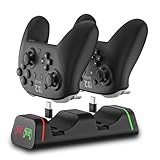
The official dock’s included charger and predictable setup reduce misplaced accessories. Its low, stable footprint is helpful near a television, but keep the dock and cables out of reach of pets and young children. For an additional room, a less expensive third-party dock may make sense. A separate controller charging station, such as the $20.99 model designed for Switch Pro, Switch 2 Pro, PS5, and Xbox controllers, can also keep gamepads organized, though it is a separate accessory rather than a Steam Deck dock.
Rental
A third-party dock is often the practical choice because renters may move frequently between TVs, monitors, and rooms. Look for a model under about 6 inches wide, a removable HDMI cable, and enough USB ports for your usual accessories. Avoid permanently routing cables through walls or furniture; a portable dock is easier to pack and replace.
Long-term home
For a settled home with one main gaming screen, choose the official dock if you value a clean installation and ongoing software support. Its DisplayPort and HDMI outputs also give you flexibility when a monitor or television changes. If several handheld PCs will share the station, a reputable multi-device third-party dock may provide better overall value.
FAQ
Does the official Steam Deck Dock charge faster?
It includes a 45W charger, which is appropriate for the Steam Deck. A third-party dock can provide similar charging when paired with a suitable 45W-or-higher USB-C power supply, but the dock may reserve some power for its own operation. Check the dock’s actual power-delivery specifications rather than relying only on a “100W” label.
Can a third-party dock display 4K video?
Many can, but the refresh rate matters. Look for explicit support for 4K at 60Hz if you want smoother desktop use or compatible game output. Some less expensive docks support 4K at 30Hz. Your cable, television, monitor, and Steam Deck settings must also support the selected resolution and refresh rate.
Is an Ethernet connection worth having?
Yes, if the dock will stay beside a TV or desk. Wired Gigabit Ethernet can provide a more consistent connection for downloads, streaming, and online play than crowded wireless networks. It is less important for a travel dock that will mostly be used away from home.
Should I buy the official dock for every Steam Deck?
No. One official dock for the main room is enough for many households. Add a third-party dock for a bedroom, office, or travel bag when lower cost and broader device compatibility matter more than official support.