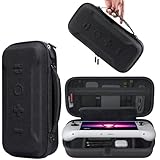
Key takeaways
- Table of Contents 6 sections 8 min read 1 The Short Answer 2 Standard Sizes 3 How to Measure Your Space 4 By Room or Use Case 4.1 Daily Commuting 4.2 Air Travel and Personal-Item Bags 4.3 Weekend Trips 4.4…
What's inside
The Short Answer
For backpack travel, plan around a Steam Deck carrying case that measures approximately 12 to 14 inches long, 5.5 to 7 inches wide, and 2.5 to 4 inches deep on the outside. That is the practical size range for a fitted hard case with room for the console, charger, cable, and a few small accessories.
The Steam Deck itself measures 11.73 x 4.61 x 1.93 inches (298 x 117 x 49 mm). Its controls, grips, and sticks make it much bulkier than a flat tablet, so a backpack pocket needs more clearance than the console measurements alone suggest. A slim protective case can fit into a backpack sleeve about 13 x 6 x 3 inches, while a large-capacity case or sling usually needs a compartment closer to 14 x 8 x 5 inches.
As an Amazon Associate we earn from qualifying purchases at no extra cost to you. Product prices and availability are accurate as of the date shown and are subject to change.
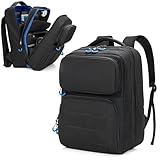
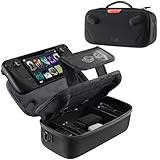


For most travelers in 2026, the best backpack-friendly choice is a hard-shell case no larger than roughly 13.5 x 6.5 x 3.5 inches. It protects the Deck without taking over a daypack. If you carry the original charger, power bank, dock, headphones, or extra storage accessories, choose a deeper case or a dedicated sling instead of forcing those items into the console compartment.
Standard Sizes
Always check whether a listing gives exterior dimensions, interior dimensions, or package dimensions. Exterior measurements matter when choosing a backpack; interior measurements matter when confirming that the Steam Deck and accessories will fit safely.
| Item or Case Style | Typical Exterior Size, Inches | Typical Exterior Size, Centimeters | Best For |
|---|---|---|---|
| Steam Deck console | 11.73 x 4.61 x 1.93 in. | 298 x 117 x 49 mm | Minimum sizing reference |
| Official-style fitted hard case | About 12.2 x 5.4 x 2.4 in. | About 31 x 13.7 x 6.1 cm | Console, cloth, and slim cable |
| Standard hard travel case | About 13.0 x 5.8 x 3.0 in. | About 33 x 14.7 x 7.6 cm | Console plus charger and cards |
| Large-capacity hard case | About 13.5 x 6.2 x 3.7 in. | About 34.3 x 15.7 x 9.4 cm | Console, charger, cable, and compact accessories |
| Sling or crossbody Deck bag | About 13.5 x 7.0 x 4.0 in. | About 34.3 x 17.8 x 10.2 cm | Daily carry with charger and personal items |
| Dedicated Deck backpack | About 15.5 x 11.5 x 6.5 in. | About 39.4 x 29.2 x 16.5 cm | Travel kit, dock, battery, and multiple accessories |
A JSAUX-style hard-shell travel case generally falls into the standard hard-case category. At around $30 to $35, these cases are a sensible fit when your backpack has a dedicated electronics section. Large-capacity cases such as the Mooroer style, often around $25 to $35, add organized space for an AC adapter but may be too deep for a narrow commuter bag.
Sling bags such as the JSAUX crossbody format, commonly priced around $35 to $40, are more flexible than hard cases because they have soft outer walls and extra pockets. A Steam Deck-specific backpack, including designs similar to the PGmoon backpack around $55 to $65, offers the most capacity but is a separate travel bag rather than an insert for a smaller backpack.
How to Measure Your Space
- Empty the backpack pocket first. Remove chargers, pens, notebooks, and loose items. A pocket that looks large enough can lose an inch or more of usable depth when it is already packed.
- Measure the internal height. Measure from the bottom seam to the zipper line or top edge. For a standard hard case, look for at least 13.5 inches of usable height. Add 1 inch if the pocket tapers toward the top.
- Measure the internal width. Measure side seam to side seam at the narrowest point, not just across the opening. A practical minimum is 6.5 inches for a slim case and 7.5 inches for a large-capacity case.
- Measure the depth while the bag is loaded. Put in the laptop, books, camera gear, or clothing you normally carry, then measure the remaining depth. Aim for 3.5 inches for a standard Deck case or 4.5 inches for a charger-storage case.
- Allow room for the zipper curve. A rectangular case does not slide cleanly into a curved backpack compartment. Leave at least 0.5 inch on the sides and 1 inch above the case for easy access.
- Check pressure points. Avoid pockets where a laptop corner, water bottle, or packed book presses directly on the analog sticks. A hard shell helps, but it cannot prevent damage from heavy compression.
If your backpack compartment measures 14 x 8 x 4 inches internally, it will accommodate nearly any standard Steam Deck hard case. A 13 x 6 x 3 inch pocket is more restrictive: it may fit an official-style fitted case, but it is not a reliable match for a charger-storage model.
By Room or Use Case
Daily Commuting
For commuting, choose the smallest case that fully covers the Deck. A fitted hard case around 12.2 x 5.4 x 2.4 inches is easiest to place in a work backpack alongside a 13-inch or 14-inch laptop. Keep the charger in a separate accessory pouch if your bag is already crowded.
The Steam Deck’s included power adapter is rated at up to 45 watts. Its plug, cable bend, and transformer block are often the reason a slim case becomes difficult to close. Separating the charger can save nearly an inch of case depth.
Air Travel and Personal-Item Bags
For flights, a standard hard case around 13 x 5.8 x 3 inches is the most practical compromise. It fits inside most personal-item backpacks and can be removed quickly at security if needed. Place it near the top of the bag rather than at the bottom beneath shoes, toiletries, or a heavy laptop.
A case with a zippered accessory pocket is useful for a USB-C cable, microfiber cloth, and two or three microSD cards. Do not expect that pocket to safely hold a large battery bank or dock without increasing bulk.
Weekend Trips
For a weekend trip, a large-capacity case around 13.5 x 6.2 x 3.7 inches makes sense if the Deck is your main entertainment device. This size can hold the console, 45-watt charger, cable, earbuds, and small card case in one protected unit.
Look for an internal divider or molded charger compartment. Loose power bricks can rub against the console shell and place pressure on the sticks when the case is squeezed into a packed bag.
Road Trips, Hotels, and Docked Play
If you will play on a hotel television or portable monitor, a sling or dedicated backpack is easier than overstuffing a hard case. Plan on a 13.5 x 7 x 4 inch sling for the console and essentials. Add separate space for a compact dock, HDMI cable, and power adapter.
A dedicated gaming backpack around 15.5 x 11.5 x 6.5 inches is best for travelers carrying a full setup. It is larger, but it keeps cables, controller, charger, and handheld organized instead of loose around the Deck.
Common Sizing Mistakes
Buying to the console’s dimensions only. The Deck is 11.73 inches long, but a case must protect the grips and sticks. A 12-inch-long pouch can be uncomfortably tight or unsuitable.
Ignoring zipper and seam thickness. A backpack pocket that measures exactly 13 x 6 x 3 inches may not accept a 13 x 6 x 3 inch hard case. Interior seams, padding, and curved zipper tracks reduce usable space.
Assuming “large capacity” means backpack-friendly. Large cases are excellent organizers, but their extra depth can make a backpack bulge. If your bag is under 5 inches deep, favor a standard hard case and separate the charger.
Storing hard accessories against the screen. Chargers, docks, and adapters should sit behind a divider or in a dedicated pocket. Never place them loose over the display, even if the case closes.
Forgetting the backpack’s other cargo. A case may fit in an empty backpack but become difficult to access once a laptop, sweater, water bottle, and lunch are packed. Measure under real travel conditions.
FAQ
What size backpack pocket do I need for a Steam Deck carrying case?
For a standard hard case, choose a pocket with at least 14 x 7 x 4 inches of usable internal space. That leaves reasonable clearance for insertion, removal, and zipper movement. For a fitted slim case, 13 x 6 x 3 inches can work.
Will a Steam Deck case fit in a laptop sleeve?
Usually not comfortably. Laptop sleeves are designed for thin devices and often measure only 1 to 2 inches deep. The Steam Deck console alone is 1.93 inches thick, while a protective case is commonly 2.4 to 3.7 inches deep.
Should I use a hard case or sling bag for backpack travel?
Use a hard case when protection is the priority and the Deck will ride inside another bag. Choose a sling when you want to carry the Deck, charger, wallet, phone, and small accessories as one standalone kit. A hard case is more compact; a sling is more versatile.
Can I keep the charger inside the Steam Deck case?
Yes, but only if the case has a dedicated accessory compartment or enough depth to keep the charger away from the screen and controls. A case around 3.5 to 3.7 inches deep is generally more suitable than a slim 2.4-inch fitted case for carrying the 45-watt adapter.