Key takeaways
- Learn how to choose the best affordable portable chargers for phones, handhelds and travel, comparing capacity, charging speed, size and safety first.
As an Amazon Associate we earn from qualifying purchases.
The real decision behind an affordable portable charger is not which box carries the biggest capacity number. It is which combination of capacity, charging speed, size and build quality keeps your own devices alive through the moments when you actually run low. A slim bank that tops up a phone twice can be the right buy for a commuter, while the same bank would leave a handheld gamer stranded halfway through a long session away from a wall outlet.
This guide is written for commuters who watch a phone drain on the way home, travellers who share one bag between flights and hotels, students who move between lectures with no spare socket, and handheld gamers who want a Steam Deck, ROG Ally or Switch to last through a journey. It explains how to read the capacity, wattage, ports and safety notes published on Amazon product pages, so you can judge any low-cost charger on its stated specifications rather than on its marketing.
How to Choose
Capacity That Matches Your Day, Not the Label
Capacity, stated in milliamp-hours, tells you how much charge a bank holds, but only part of that energy ever reaches your device. Conversion losses and heat eat into the headline figure, so a 10,000mAh bank usually delivers around two full phone charges rather than three, and a 20,000mAh bank suits a weekend better than a single evening out. Start by counting what you actually charge in a day: one phone, a phone plus earbuds, or a phone plus a handheld console. Then pick the smallest capacity that covers that load, because every extra milliamp-hour adds weight and bulk you will carry on every trip. A bank that stays at home because it is too heavy helps nobody.
Charging Speed: Watts, Ports and Cable Choices
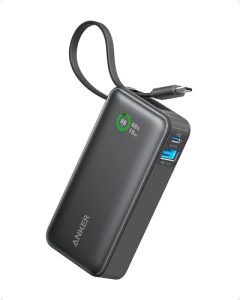
Wattage decides how quickly a bank refills your device, and the number only matters if your device can accept it. A phone that draws 18W gains nothing from a 45W output, while a handheld console or tablet may charge slowly or even lose charge during play on a low-wattage port. Check the USB-C output figure on the listing, whether total wattage is shared when two ports run at once, and whether a cable is built in. A built-in cable means one less thing to forget, though a frayed one cannot be swapped. Two ports earn their place when you regularly charge a phone and earbuds together, but a single strong port beats two weak ones for gaming hardware.
Size, Weight and the Pocket Test
A portable charger earns its keep by being there when you need it, which means it has to fit the bag or pocket you actually carry. Compare the listed dimensions and weight against something familiar: a phone, a wallet, or a paperback. Slim banks around the size of a phone slide into a jacket pocket and disappear, while heavier bricks belong in a backpack and suit travel rather than daily carry. Shape matters as much as size, since sharp corners snag on pocket linings and a flat slab stacks neatly against a phone. If you fly often, check the watt-hour figure on the listing as well, because airlines set limits on the batteries you can carry in cabin luggage.
Build Quality, Extras and What Budget Really Buys
A low price should mean fewer frills, not a bank that fails after a few months. Read the listing for the details that signal careful construction: a clear capacity and watt-hour rating, a stated warranty length, and honest notes about the ports and included cable. Useful extras include a battery-level display, a low-current mode for earbuds, and pass-through charging that lets the bank refill itself while topping up a phone. Skip gimmicks you will never use, such as a built-in flashlight on a bank that lives in a desk drawer. On a tight budget, the smartest trade is usually to give up a second port or a display rather than capacity or charging speed.
Which One Fits Your Situation
You Just Need a Phone Top-Up on the Commute
A compact 10,000mAh bank with a single fast USB-C port covers this day comfortably. It holds enough for a full recharge plus a safety margin, slips into a coat pocket, and refills overnight from any ordinary USB-C adapter. Give priority to light weight and a built-in cable, because the charger you leave at home is the one that cannot help when the battery warning appears on the train.
You Play a Handheld Console Away From an Outlet
Handheld gaming asks far more of a bank than a phone does, so capacity and output both move up the list. A 20,000mAh bank with a USB-C port rated for the higher wattage your console accepts keeps a Steam Deck or ROG Ally playing longer and charges it faster between sessions. Check the listing for the output figure and the watt-hour rating, and carry a cable rated for the same power, since a thin cable can throttle the whole setup.
You Travel Light and Share One Charger
Travellers who pack one bag do best with a bank that serves every device in it. Two outputs let a phone and earbuds, or a phone and a tablet, charge side by side overnight. A built-in cable removes one item from the packing list, and a battery display shows how much charge remains before a long flight. Keep the bank in your carry-on, where it is easy to reach and where airline rules expect it to be.
You Want One Bank for a Whole Weekend
A weekend away means two or three days of phones, earbuds and maybe a handheld, with no guarantee of a free socket. A larger bank in the 20,000mAh range handles that load, provided its output is strong enough to refill a phone quickly between outings. Accept the extra weight in exchange for not hunting for outlets, and recharge the bank fully the night before you leave so the weekend starts with every milliamp-hour available.
Staying Safe With Lithium-Ion Power Banks
Every portable charger in this category runs on lithium-ion cells, and a little care goes a long way toward keeping one safe through years of use. Charge the bank on a hard, flat surface with air around it, never buried under bedding or clothing, and unplug it once it is full rather than leaving it attached for days. Keep it away from radiators, sunny dashboards and other hot places, because heat is the main enemy of battery health, and never charge a bank that feels swollen, smells unusual, or has a cracked case. Use the cable supplied with the bank or a good-quality replacement, and retire any cable with exposed wires or a loose connector. Buy from sellers with clear contact details and a stated warranty, and be wary of listings that hide the capacity, watt-hour rating or brand name behind vague wording. Store a bank partly charged if you will not use it for weeks, top it up every few months, and when it finally reaches the end of its life, hand it to a battery recycling point instead of throwing it in household waste. If anything about a bank ever feels wrong while it charges, unplug it, move it away from anything flammable, and let it cool before handling it further.
Common Mistakes
- Chasing the biggest capacity number. A huge milliamp-hour figure looks impressive, but it means little if the output wattage is too low for your device. A phone that draws power faster than the bank supplies it will still drain during use, and the extra weight makes the bank less likely to leave the house.
- Assuming every device fast-charges. Fast charging only happens when the bank, the cable and the device all support the same charging standard and wattage. A bank advertising high wattage will still charge an older phone slowly, so match the output to what your own devices can actually accept.
- Forgetting the cable entirely. Many affordable banks ship with a short cable, or none at all, and a cable bought in a hurry at a station kiosk may carry far less power than the bank can deliver. Check the listing for what is included, and keep a cable rated for the bank’s output in the same pocket.
- Leaving a bank drained for months. A lithium-ion cell left empty for a long stretch can lose its ability to hold a charge. Top up a stored bank every couple of months, keep it somewhere cool and dry, and store it partly charged rather than flat or completely full.
- Charging on soft surfaces in the heat. A bank working hard on a bed, a sofa cushion or a sun-baked car seat cannot shed heat properly. That shortens its life and, in rare cases, creates a safety risk, so always charge on a hard surface with air circulating around the bank.
Frequently Asked Questions
How much capacity do I need for a phone?
A 10,000mAh bank is the practical starting point for most phone owners, since it normally delivers one full charge plus a useful top-up after conversion losses. If you also charge earbuds or a smartwatch, or you spend long days away from outlets, step up to a larger bank rather than carrying two small ones. The right size is the smallest one that covers your heaviest day.
Can a budget portable charger power a Steam Deck or a laptop?
It can, provided the bank’s USB-C output is strong enough and the listing states a suitable wattage. Many handheld consoles accept a charge from a modest bank but play longer from a higher-wattage port, while most laptops need considerably more power than a typical budget bank offers. Check the watt-hour figure and the output rating on the listing before assuming a bank will keep a large device running.
Why does my phone charge slower than the wattage on the box?
The figure on the box is the maximum the bank can deliver, not what your phone will always draw. Phones slow down as the battery fills, and heat, a low-quality cable, or a second device sharing the output can all reduce the speed further. Using the cable supplied with the bank and charging one device at a time usually gets you closest to the advertised rate.
How long does a portable charger last?
A well-made bank usually serves for a few years of regular use, its capacity fading gradually rather than failing all at once. How you treat it matters most: avoiding heat, not leaving it flat for months, and recharging it with a sound cable all stretch its life. When charging takes noticeably longer or the bank holds far less than it used to, it is time to replace it.
FAQ
How much capacity do I need for a phone?
Can a budget portable charger power a Steam Deck or a laptop?
Why does my phone charge slower than the wattage on the box?
How long does a portable charger last?
More from Amazon
Programs that pair well with the guide above. Offers and eligibility are set by Amazon and may change.
Free shipping on eligible items, Prime Video and more. Eligible new members can start with a free trial.
Start a Prime free trialAd-free music streaming. Eligible new subscribers can start with a free trial.
Try Music Unlimited freeA Prime membership for ages 18-24 with a trial period. Eligibility is set by Amazon.
See Prime for Young AdultsAudiobooks and podcasts to listen to on the go. Eligible new members can start with a free trial.
Try Audible freeAs an Amazon Associate we earn from qualifying purchases.