Our Top Picks
The best phones for vlogging in 2026 are the iPhone 16 Pro for dependable handheld video, the Samsung Galaxy S25 Ultra for flexible rear-camera coverage, and the Google Pixel 9 Pro XL for easy voice-to-camera clips with excellent computational processing.
Best phones for vlogging: quick comparison
| Phone | Best use | Video strengths | Microphone support | Weight | Storage options |
|---|---|---|---|---|---|
| iPhone 16 Pro | All-round handheld and tripod vlogging | 4K Dolby Vision, strong stabilization, 4K/120 fps slow motion | USB-C digital microphones, wireless receivers, stereo recording | 199 g | 128 GB, 256 GB, 512 GB, 1 TB |
| Samsung Galaxy S25 Ultra | Multi-camera travel and outdoor filming | 8K rear video, several useful focal lengths, strong stabilization | USB-C microphones and wireless receivers | 218 g | 256 GB, 512 GB, 1 TB |
| Google Pixel 9 Pro XL | Point-and-shoot talking-head videos | Excellent HDR processing, stabilized 4K, useful audio cleanup tools | USB-C digital audio and Bluetooth accessories | 221 g | 128 GB, 256 GB, 512 GB, 1 TB |
| iPhone 16 Pro Max | Long shoots and large-screen monitoring | Same core video system as Pro, excellent stabilization and color consistency | USB-C digital microphones and wireless systems | 227 g | 256 GB, 512 GB, 1 TB |
| Sony Xperia 1 VI | Manual control and creator workflows | Manual video controls, headphone jack, expandable storage | USB-C, 3.5 mm microphone-compatible workflows, wireless receivers | 192 g | 256 GB internal storage plus microSDXC |
Storage figures and regional configurations can vary. These phones usually occupy a premium market range of roughly $900–$1,300, with older configurations and sales often reducing the cost.

Content Creator Essentials Vlogging Kit for iPhone, Tripod & Wireless Mic | 71" Tripod with light, remote, selfie stick, phone stand. Designed for TikTok, YouTube, video recording
Chosen because it specifies Tripod & Wireless Mic.
View on Amazon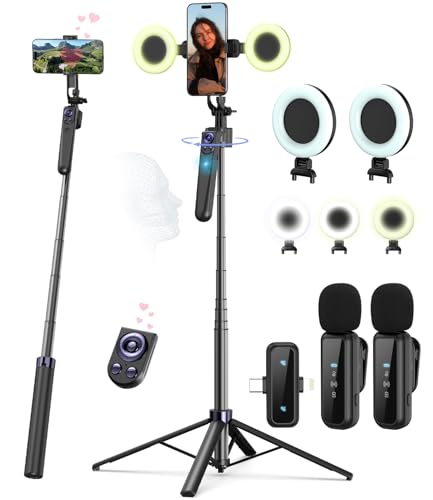
Vlogging Kit for iPhone/Android, 63”Auto Face Tracking Tripod for iPhone with Light, Wireless Microphones, Scrolling Remote Control for TikTok, Content Creator Kit for YouTube Starter
Chosen because it specifies 63”Auto Face Tracking Tripod for iPhone with Light and Wireless Microphones.
View on Amazon
Vlogging Kit for iPhone/Android, 71" Selfie Stick Tripod for iPhone with Fill Light, Wireless Mic & Remote, Adjustable Aluminum Phone Tripod for TikTok/YouTube Content Creator Essentials Starter Kit
Chosen because it specifies 71" Selfie Stick Tripod for iPhone with Fill Light and Wireless Mic & Remote.
View on Amazon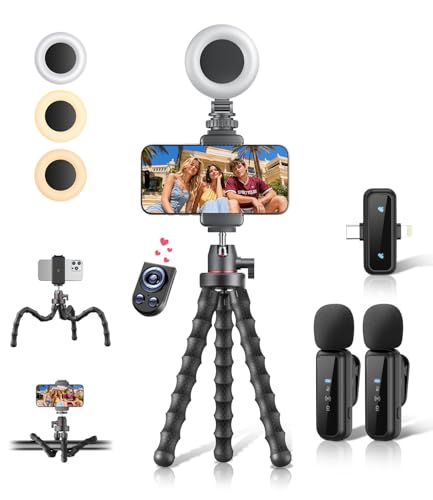
Vlogging Kit for iPhone/Android, 9" Flexible Tripod for iPhone with Light, Wireless Remote & Microphone, Adjustable Content Creator YouTube Starter Kit for TikTok/Recording/Live Streaming
Chosen because it specifies 9" Flexible Tripod for iPhone with Light and Wireless Remote & Microphone.
View on Amazon1. iPhone 16 Pro: the safest choice for most vloggers
The iPhone 16 Pro is the best phones for vlogging pick when your priority is consistent video rather than the highest specification in one particular category. Its rear cameras maintain a relatively consistent look between lenses, while optical and electronic stabilization make walking footage easier to use. The 48MP main camera, 48MP ultrawide camera, and 5x telephoto camera cover ordinary talking-head shots, interiors, landscapes, and distant subjects without requiring a separate camera.
The front camera records up to 4K at 60 frames per second and is suitable for direct-to-camera work. The rear cameras add 4K Dolby Vision recording and 4K at 120 fps for slow motion. USB-C makes it straightforward to connect a digital microphone or a wireless receiver, and Apple’s video and audio processing generally reduces the amount of correction needed during editing.
The main limitation is storage. ProRes files are large, so the 128GB version is not ideal for serious filming. Choose at least 256GB, or 512GB if you regularly record long interviews, travel days, or high-frame-rate clips. The iPhone 16 Pro is also light enough for a compact grip or small tripod, making it less tiring than the Pro Max during extended handheld filming.
2. Samsung Galaxy S25 Ultra: best for flexible rear-camera coverage
The Galaxy S25 Ultra is the strongest choice for vloggers who frequently switch between wide establishing shots, standard talking-head footage, and distant subjects. Its rear camera system provides multiple focal lengths, and 8K recording is available when you need to crop into a clip or extract a still frame. For normal publishing, 4K is usually the better balance between quality, heat, storage, and editing speed.
Stabilization is effective for walking and casual movement, although the result depends on which lens is selected and how much digital stabilization is applied. The large display is useful when the phone is mounted on a tripod, particularly outdoors where a bigger preview helps with framing. The 5,000mAh battery is also well suited to a full day of mixed filming, navigation, and uploading.
Its 218g weight is noticeable on a small handheld grip. A powered gimbal or a compact tripod is preferable for long pieces to camera. The front camera is good for 4K clips, but creators who switch repeatedly between front and rear cameras may find Apple’s color matching more predictable. Select the S25 Ultra if rear-camera flexibility matters more than minimum weight.
3. Google Pixel 9 Pro XL: best for simple, polished talking-head clips
The Pixel 9 Pro XL is a strong option for creators who want to record, trim, and publish with minimal manual adjustment. Its HDR processing can preserve faces and bright backgrounds in difficult daylight, while stabilized 4K video works well for stationary and gently moving shots. Google’s audio tools can help reduce unwanted background noise, though they should not replace a proper microphone in a busy street or windy location.
The 42MP front camera is particularly useful for self-recording because it provides a wide field of view and detailed results in good light. The rear camera system adds a high-quality main camera, ultrawide camera, and telephoto camera for travel content. Its 221g body is comfortable on a tripod but moderately heavy for a bare-hand selfie grip.
Pixel phones are best suited to creators who value automatic exposure, HDR, and quick editing. They are less attractive if you want extensive manual control, a headphone jack, or expandable storage. Buy 256GB or more if you record in 4K regularly.
4. iPhone 16 Pro Max: best for long handheld sessions
The iPhone 16 Pro Max offers the same broad video strengths as the Pro but adds a larger display and a larger battery. The screen makes it easier to check focus, read a script, and monitor framing from a tripod several feet away. Its 227g weight is the trade-off: it can make a compact selfie stick or mini tripod feel front-heavy.
This is a good choice for walking tours, event coverage, and long days where charging opportunities are limited. It starts at 256GB, avoiding the most restrictive storage option in the smaller Pro model. If your vlogs involve frequent front-camera recording, the larger preview can be more valuable than the extra battery capacity alone.
5. Sony Xperia 1 VI: best for manual control and expandable storage
The Sony Xperia 1 VI is aimed at creators who want to make more decisions themselves. Its camera apps offer more manual control over exposure, focus, shutter speed, and color than most mainstream phones. The 3.5mm headphone jack is useful for monitoring compatible microphones, and microSDXC support allows you to expand storage without replacing the phone.
The phone is relatively light at 192g, which helps when filming handheld. Its rear cameras are versatile, but Sony’s automatic processing may require more careful exposure and color decisions than an iPhone or Pixel. It is therefore better for a creator who understands basic video settings than for someone who wants every shot to look finished automatically.
Handheld versus tripod: choose by weight and stabilization
| Filming situation | Recommended choice | Why | Useful setup |
|---|---|---|---|
| Walking and speaking to camera | iPhone 16 Pro | Lower weight and reliable stabilization | 1x camera, 4K/30, small grip |
| Static indoor tutorials | iPhone 16 Pro Max or Pixel 9 Pro XL | Large screens make framing and script reading easier | Tripod, 4K/30, external USB-C microphone |
| Travel scenes and distant subjects | Galaxy S25 Ultra | Several rear focal lengths reduce the need to move or crop | 4K/30, rear camera, tripod or gimbal |
| Manual filmmaking | Sony Xperia 1 VI | Manual controls, headphone monitoring, expandable storage | Manual exposure, external mic, microSDXC backup |
Video settings that make a practical difference
Use 4K at 30 frames per second as the default. It provides enough detail for cropping while keeping file sizes and heat manageable. Use 4K/60 when you are filming movement or want smoother motion, but expect higher battery and storage consumption. Reserve 4K/120 for short slow-motion clips rather than entire vlogs.
Keep shutter speed near double the frame rate when manual control is available: approximately 1/60 second at 30 fps and 1/120 second at 60 fps. This creates natural motion blur. In bright sunlight, an ND filter for a compatible phone case or rig can help maintain those shutter speeds without overexposing the image.
For audio, place a wireless microphone roughly 15–20cm from your mouth and monitor for clothing noise. A phone’s built-in microphones are acceptable for a quick clip, but distance causes more quality loss than camera resolution. A $50–$250 wired or wireless microphone can improve a vlog more than moving from one flagship phone to another.
Storage and battery: a simple planning calculation
High-quality video can consume storage faster than expected. If a phone records at an average 100 megabits per second, the calculation is:
100 megabits ÷ 8 = 12.5 megabytes per second
12.5 × 60 × 60 = 45,000 megabytes, or about 45GB per hour
That is before adding slow-motion, HDR variants, photos, apps, and editing exports. A 256GB phone may provide roughly 180–220GB of practical free space after the operating system and apps, so it can hold about four to five hours at this bitrate. ProRes and other high-bitrate formats can use storage many times faster.
For battery planning, a phone battery around 18Wh does not provide 18Wh to the camera because the display, processor, stabilization, radios, and heat losses also consume power. If video recording averages 6–9W, a realistic continuous recording estimate is approximately two to three hours before accounting for thermal limits. Carry a USB-C power bank for tripod filming, but avoid blocking the phone’s cooling area with a thick enclosed case.
Which phone should you buy?
- Choose the iPhone 16 Pro for the best balance of stabilization, front-camera quality, audio accessories, weight, and editing compatibility.
- Choose the Galaxy S25 Ultra if you need multiple rear focal lengths, a large battery, 8K capture, and strong outdoor flexibility.
- Choose the Pixel 9 Pro XL if automatic HDR, simple processing, and polished talking-head results matter most.
- Choose the iPhone 16 Pro Max if you film for long periods and value screen size and battery capacity over low weight.
- Choose the Sony Xperia 1 VI if manual controls, headphone monitoring, and microSD storage are more important than fully automatic results.
For most new vloggers, an iPhone 16 Pro with 256GB storage and a USB-C wireless microphone is the most balanced setup. Spend the remaining budget on a stable grip, a small tripod, spare power, and better lighting; those accessories usually produce a more visible improvement than paying for a phone with a marginally higher camera specification.