Key takeaways
- Far better battery capacity: The 80Wh battery is the clearest reason to choose the Ally X over the 40Wh original.
- More memory: 24GB of LPDDR5X gives Windows and modern games more breathing room than 16GB.
- Twice the included storage: A 1TB SSD is much more practical for a PC game library than 512GB.
- Simple storage upgrades: The M.2 2280 SSD slot supports a wider, usually less expensive selection of drives.
- Better handheld ergonomics: Revised grips, sticks, triggers, and D-pad make the system more comfortable for longer sessions.
- USB4 support: This is a more flexible connection for docks, external displays, storage, and other USB-C accessories.
- Same excellent display basics: You still get a sharp 7-inch, 1080p, 120Hz variable-refresh-rate screen.
The Short Answer
Yes—if you play away from an outlet regularly and can afford the higher price. The ROG Ally X is worth buying over the original ROG Ally because it fixes the handheld’s biggest practical weakness: battery life. Its 80Wh battery is double the original model’s 40Wh capacity, and it also adds 24GB of faster memory, a 1TB SSD, a more standard M.2 2280 storage slot, improved controls, and a USB4 port.
However, the Ally X does not deliver a dramatic jump in raw gaming speed. Both versions use AMD’s Z1 Extreme processor, so frame rates at the same settings are generally in the same neighborhood. If you mostly play plugged in, dock your handheld to a monitor, or find the original Ally at a steep discount, the older model can still be the smarter value in 2026.
Our top picks
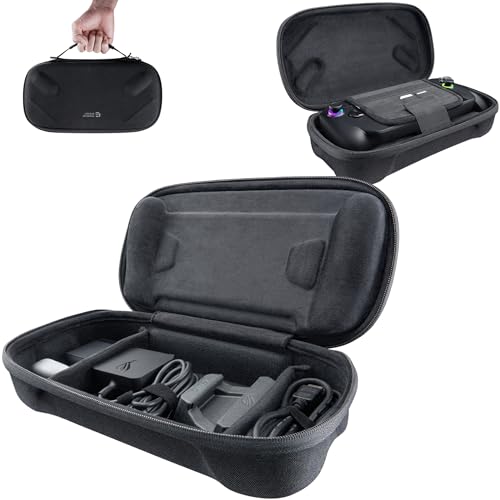 JSAUX Carrying Case for ROG Xbox Ally/Ally
- [Compatibility] Only compatible with ROG Xbox Ally and…
- [Tailored Protection for ROG Xbox Ally (X)] This…
- [Dual Layer Storage] Top layer securely holds your…
 JSAUX Docking Station for ROG Xbox Ally
- When the ROG Xbox Ally / ROG Xbox…
- 6-in-1 Docking Station for Handheld: Experience enhanced gaming…
- Modular Docking Station: The JSAUX docking station provides…
As an Amazon Associate we earn from qualifying purchases at no extra cost to you. Ratings are shown as listed on Amazon.
What You Actually Get
The ROG Ally X keeps the core formula of the original ROG Ally: a 7-inch, 1920 x 1080 touchscreen with a 120Hz refresh rate, AMD Z1 Extreme chip, Windows gaming compatibility, microSD card reader, and a compact white handheld design. It is not a new performance generation. Instead, it is a substantially improved version of the same machine.
The most important upgrade is the battery. The original Ally has a 40Wh battery, while the Ally X has an 80Wh battery. That does not necessarily mean twice as much real-world play time in every game—performance settings, screen brightness, and game demands matter—but it gives the Ally X far more flexibility. Less demanding indie games and streaming can be realistic unplugged activities, while demanding games no longer require constant anxiety about finding a charger.
Memory also matters. The original model has 16GB of shared LPDDR5 memory, while the Ally X includes 24GB of LPDDR5X memory. Because the system and integrated graphics draw from the same memory pool, the additional capacity can help with modern games, multitasking, browser use, and games that benefit from allocating more memory to the GPU.
Storage is more generous and easier to upgrade. The original Ally typically came with a 512GB SSD and uses the smaller M.2 2230 format. The Ally X comes with a 1TB SSD and accepts the much more common M.2 2280 format. With many current PC games consuming 80GB to 150GB or more, that change can save both money and frustration.
There are physical improvements, too. The Ally X weighs about 678 grams, compared with roughly 608 grams for the original. It is also slightly thicker, measuring about 11.0 x 4.5 x 1.45 inches. The trade-off is a more substantial grip, revised analog sticks rated for greater durability, a better D-pad, and updated cooling. It remains portable, but it is not the better choice for someone who wants the lightest possible handheld.
Connectivity is another meaningful difference. The Ally X includes USB4 through one USB-C port, allowing broader dock, display, and accessory compatibility. The original Ally has a standard USB-C port alongside ASUS’s proprietary XG Mobile connection. For most buyers, USB4 is the more useful everyday option.
Pros
- Far better battery capacity: The 80Wh battery is the clearest reason to choose the Ally X over the 40Wh original.
- More memory: 24GB of LPDDR5X gives Windows and modern games more breathing room than 16GB.
- Twice the included storage: A 1TB SSD is much more practical for a PC game library than 512GB.
- Simple storage upgrades: The M.2 2280 SSD slot supports a wider, usually less expensive selection of drives.
- Better handheld ergonomics: Revised grips, sticks, triggers, and D-pad make the system more comfortable for longer sessions.
- USB4 support: This is a more flexible connection for docks, external displays, storage, and other USB-C accessories.
- Same excellent display basics: You still get a sharp 7-inch, 1080p, 120Hz variable-refresh-rate screen.
Cons
- Similar gaming performance: Both handhelds use the Z1 Extreme, so do not buy the Ally X expecting a major frame-rate leap.
- Higher upfront cost: The Ally X commonly sits around $699 to $799, while original Ally deals can fall into the $400 to $550 range.
- Heavier build: At about 678 grams, it is around 70 grams heavier than the original Ally.
- Windows still requires patience: The broad game-library access is excellent, but small-screen Windows navigation and launcher updates can be fiddly.
- 1080p can be demanding: Many demanding games run best at 720p or 900p with upscaling rather than native 1080p.
- Existing original Ally owners may not need it: If your battery is acceptable and you play near power, this is more of a quality-of-life upgrade than a must-have replacement.
Who Should Buy It
Buy the ROG Ally X if you are purchasing your first Windows handheld and want the most complete version of the Ally concept. It makes particular sense for commuters, travelers, parents gaming around the house, and anyone who plays in places where an outlet is not always nearby. The larger battery changes how freely you can use the device.
It is also the better choice for buyers who keep several large games installed. Starting with 1TB helps immediately, and the standard 2280 SSD slot makes future expansion much easier. If you want to use a dock at a desk or living-room TV, USB4 is an additional advantage.
The Ally X is also worth the extra money when the price gap is modest. If it costs only about $150 more than a new original Z1 Extreme Ally, the improved battery, memory, storage, controls, and connectivity justify spending more.
Owners of the original Ally should consider upgrading only if battery life is actively limiting their use, 512GB is constantly full, or they want USB4 and easier storage upgrades. Otherwise, keeping the original and adding a power bank, larger SSD, or dock may be the better financial decision.
Who Should Skip It
Skip the Ally X if you primarily play plugged into a wall charger or a dock. In that situation, its biggest advantage—the 80Wh battery—has much less value, and the original Z1 Extreme Ally can provide a very similar gaming experience for considerably less money.
Budget-focused buyers should also skip it when the original model is discounted by $250 or more. At that point, the older Ally leaves enough room in the budget for games, a protective case, a microSD card, or a dock without giving up the same processor and display.
Finally, skip both versions if you want a console-like interface with minimal setup. Windows offers access to Steam, Xbox PC games, Epic Games, Battle.net, and more, but it also brings updates, sign-ins, settings menus, and occasional troubleshooting. The Ally X improves the hardware; it does not remove the Windows learning curve.
Cheaper Alternatives
| Option | Cost | Trade-off |
|---|---|---|
| Original ROG Ally with Z1 Extreme | About $400–$550 | Similar processor and display, but a 40Wh battery, 16GB memory, 512GB storage, and less convenient SSD upgrades. |
| Original ROG Ally with Z1 processor | About $300–$400 | Lower purchase price, but noticeably weaker graphics performance for demanding PC games. |
| Original Ally plus 1TB SSD upgrade | About $470–$650 total | More storage for less than an Ally X, but battery life, memory capacity, controls, and USB4 do not improve. |
| Original Ally plus dock and case | About $465–$615 total | A $35.99 six-in-one dock and $27.99 carrying case add convenience, but they cannot solve the original model’s shorter battery life. |
FAQ
Is the ROG Ally X faster than the original ROG Ally?
Not in a major way. Both use AMD’s Z1 Extreme processor, so their gaming performance is broadly similar at matching power settings. The Ally X’s 24GB of faster memory can help in some games and multitasking situations, but it is not a new chip generation.
Is the Ally X battery really worth the extra money?
For portable players, yes. Moving from 40Wh to 80Wh is the upgrade that most changes everyday ownership. If you normally play connected to power, it is less compelling.
Can the original ROG Ally use the same dock and carrying case as the Ally X?
Many third-party accessories support both. For example, a compatible six-in-one USB-C dock can work with either handheld, and dual-layer carrying cases are available for both sizes. Check the product’s fit and port-clearance details before ordering, especially if you use a thick protective shell.
Should I upgrade from an original Ally to an Ally X?
Upgrade if you are dissatisfied with battery life, need more memory and storage, or want USB4 and a standard 2280 SSD slot. If your original Ally still meets your needs and you mostly play while plugged in, keep it and save the money for games or accessories.