Key takeaways
- More reliable power during demanding gaming: A 65W-capable USB-C PD bank is far better suited to Legion Go use than low-wattage phone chargers.
- 100W adds flexibility: A 100W bank can be used with many laptops and other higher-draw USB-C devices, subject to each device’s charging requirements.
- 20,000mAh offers useful capacity: At roughly 74Wh, this size is a better fit for long trips than compact 10,000mAh models.
- Less chance of buying twice: If you may buy a USB-C laptop later, spending a little more for 100W can make sense.
- Potentially better value: When a 100W 20,000mAh pack costs about $55 to $75, it can be a stronger value than a specialized lower-capacity gaming pack.
- Portable play away from outlets: A battery bank is especially helpful on flights, in waiting rooms, or when a wall outlet is inconvenient.
The Short Answer
It depends: you do not need a 100W power bank for the Legion Go unless you want one battery pack that can keep up with demanding play while also serving larger USB-C devices. The Legion Go is designed around 65W USB-C Power Delivery charging, so a good 65W PD power bank is the sensible minimum for playing and charging at the same time. A 100W model will not make the handheld charge at 100W or unlock extra performance by itself.
That said, 100W power banks can be the better buy when the price difference is small. They usually have more output headroom, often use a 20,000mAh-class battery, and can later charge a laptop, tablet, phone, or accessories. At around $60, the UGREEN Nexode 100W 20,000mAh is a reasonable example of why 100W is no longer automatically overkill. But if you want the lightest setup for the Legion Go alone, a 65W battery pack is more practical.
Our top picks
 UGREEN Nexode 100W 20000mAh Power Bank
- Product Group: Personal Computer
- Binding: Electronics
As an Amazon Associate we earn from qualifying purchases at no extra cost to you. Ratings are shown as listed on Amazon.
What You Actually Get
The important number is not simply the large wattage printed on the power bank. For a Legion Go, look for a USB-C port that supports USB Power Delivery at 65W, typically listed as 20V/3.25A or higher. A bank labeled “100W” may provide that power from only one specific USB-C port, while its other ports offer less. It may also reduce output when more than one device is connected.
A proper 65W or 100W PD power bank lets the Legion Go draw power while you play, reducing battery drain or recharging the internal battery when game load is lower. The actual behavior depends on the game, display brightness, performance mode, and accessories connected to the handheld. A demanding AAA game can use a substantial amount of power, so a weak 18W, 20W, or 30W phone-oriented battery bank may slow the drain but is unlikely to provide the experience most buyers expect.
Capacity matters just as much as output. Power banks are commonly marketed in milliamp-hours, but watt-hours are more useful for comparing usable energy. A 20,000mAh power bank is typically about 74Wh internally, while a 10,000mAh model is roughly 37Wh. Due to voltage conversion and charging losses, you will not get every watt-hour into the Legion Go. Treat a 20,000mAh bank as meaningful extra playtime rather than a promise of multiple full recharges.
For travel, 100Wh is the key airline threshold commonly used for carry-on lithium-ion batteries. Most 20,000mAh packs are under it, but check the watt-hour label on the exact model before flying. Power banks generally belong in carry-on luggage, not checked baggage.
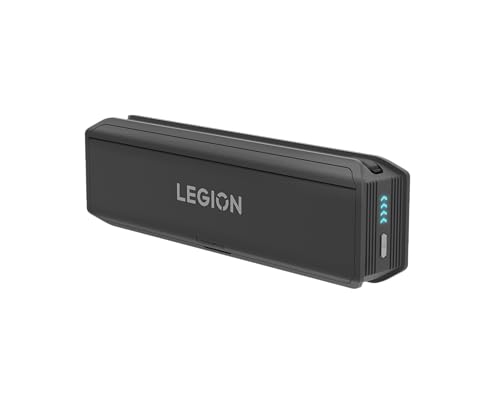
The $79.99 Lenovo Legion Go 65W 12,800mAh power bank takes a purpose-built approach. Its integrated USB-C cable, magnetic attachment, and built-in stand are designed to make the handheld setup tidier. Its 65W rating matches the Legion Go’s intended charging class, though its 12,800mAh capacity is notably smaller than a typical 20,000mAh bank.
By comparison, a $59.99 UGREEN Nexode 100W 20,000mAh power bank emphasizes capacity and versatility. It is likely the more useful choice for someone who also travels with a USB-C laptop, but it is a more general-purpose rectangular battery pack rather than an integrated Legion Go accessory.
Pros
- More reliable power during demanding gaming: A 65W-capable USB-C PD bank is far better suited to Legion Go use than low-wattage phone chargers.
- 100W adds flexibility: A 100W bank can be used with many laptops and other higher-draw USB-C devices, subject to each device’s charging requirements.
- 20,000mAh offers useful capacity: At roughly 74Wh, this size is a better fit for long trips than compact 10,000mAh models.
- Less chance of buying twice: If you may buy a USB-C laptop later, spending a little more for 100W can make sense.
- Potentially better value: When a 100W 20,000mAh pack costs about $55 to $75, it can be a stronger value than a specialized lower-capacity gaming pack.
- Portable play away from outlets: A battery bank is especially helpful on flights, in waiting rooms, or when a wall outlet is inconvenient.
Cons
- 100W does not mean the Legion Go uses 100W: The handheld will only draw the power it is designed to accept.
- Higher-output packs are often heavier: A typical 20,000mAh 100W bank can weigh roughly 12 to 16 ounces, before adding a cable.
- Capacity claims are not delivered one-for-one: Conversion losses mean a 20,000mAh rating is not equal to 20,000mAh of usable output at the Legion Go’s operating voltage.
- Multi-port charging can reduce available wattage: Read the power-sharing chart if you plan to charge a phone, headset, or tablet alongside the Legion Go.
- Integrated designs can be less versatile: A built-in cable and magnetic mount are convenient, but they may not suit a protective case or every preferred playing position.
- It adds bulk to handheld gaming: Even an attached, purpose-built pack changes the balance and feel of the device.
Who Should Buy It
Buy a 100W power bank if you use the Legion Go as part of a broader USB-C setup. It is the right choice for travelers who also carry a laptop, for households that want one shared battery pack, and for buyers who value 20,000mAh-class capacity over the smallest possible accessory. It is also a good choice if a trusted 100W model is only $10 to $20 more than a comparable 65W option.
A 100W pack makes particular sense if you want the confidence that the bank has adequate headroom for a 65W handheld connection. Just verify that its primary USB-C port can provide at least 65W by itself and use a cable rated for 100W USB-C PD. An older or bargain cable can be the weak link in an otherwise capable setup.
In 2026, buyers should also favor banks with clear on-device information: a battery percentage display, stated watt-hour rating, and a plainly published single-port versus multi-port output chart. Those details are more useful than a vague “fast charge” label.
Who Should Skip It
Skip the 100W tier if the Legion Go is your only high-power USB-C device and you mainly need a compact emergency backup. A 65W power bank is enough for the handheld when it genuinely supports 65W USB PD. You can save money, reduce carrying weight, and still avoid the limitations of low-wattage phone banks.
The Lenovo Legion Go 65W 12,800mAh pack is worth considering for buyers who prioritize a neater handheld-specific design. At $79.99, you are paying for the integrated cable, magnetic attachment, and stand rather than maximum energy capacity per dollar. That can be worthwhile for couch gaming or commuting, but less so for all-day travel.
Also skip a power bank entirely if you normally play near a wall outlet. A quality 65W USB-C wall charger and cable are lighter, cheaper, and do not need to be recharged after use.
Cheaper Alternatives
| Option | Cost | Trade-off |
|---|---|---|
| 65W USB-C PD power bank, 10,000mAh | $35–$50 | More portable, but roughly 37Wh means limited extra gaming time. |
| 65W USB-C PD power bank, 20,000mAh | $45–$65 | Similar capacity to many 100W models, but less useful for laptops that need more than 65W. |
| 45W USB-C PD power bank, 20,000mAh | $30–$45 | Can help while playing, but may not keep pace with the most demanding Legion Go sessions. |
| 65W USB-C wall charger plus 100W-rated cable | $25–$40 | Best value near an outlet, but provides no portable battery capacity. |
FAQ
Can I use a 100W charger or power bank with the Legion Go?
Yes. USB-C Power Delivery devices negotiate the power they use. A 100W power bank can safely charge the Legion Go as long as it is a reputable USB-C PD model and you use an appropriate USB-C cable. The Legion Go will not automatically pull the full 100W.
Is 65W enough for Legion Go gaming?
Yes, 65W USB-C PD is the target to look for when you want to play and charge. It aligns with the Legion Go’s intended charging class. Performance, charging speed, and battery behavior still vary with game load, screen settings, and the device’s power mode.
How much capacity should I buy?
Choose 10,000mAh for a lighter backup pack and 20,000mAh for travel or longer sessions. A 20,000mAh unit is roughly 74Wh internally and is the better all-purpose size, but it is noticeably heavier and larger than a 10,000mAh pack.
Why does my power bank not charge the Legion Go at full speed?
Common causes include a port that does not support 65W by itself, a low-rated or damaged USB-C cable, multi-port power sharing, or a bank that supports proprietary fast charging rather than the required USB Power Delivery profile. Check the specifications for 20V/3.25A or better on the USB-C port you plan to use.