Key takeaways
- Footprint: A full-size board typically spans 17–18 inches, while TKL models land around 14 inches — roughly a 20% reduction in width with no loss to the alphanumeric or function rows.
- Mouse ergonomics: TKL lets you centre your keyboard on your body while keeping the mouse close, reducing the shoulder abduction that causes fatigue during long sessions. Full-size forces the mouse further right.
- Number pad access: Full-size wins outright for data entry, spreadsheet work, and flight or space sims that use numpad bindings. TKL requires a separate pad or layer shortcuts.
- Portability: TKL boards fit standard backpacks and hard cases. The Logitech G PRO TKL even uses a detachable cable specifically for transport — a feature almost no full-size design bothers with.
- Price: TKL models frequently undercut their full-size equivalents by $10–$25 simply because there is less plastic, fewer switches, and a smaller PCB involved.
- Media and macro keys: Full-size boards have more real estate for dedicated volume wheels and macro columns, though modern TKLs like the Razer Ornata V3 TKL and Corsair K55 CORE TKL still fit backlit media controls into the top row.
The keyboard sitting on your desk shapes your aim more than most players realise. A full-size board gives you every key the PC platform has ever asked for — function row, navigation cluster, and a full number pad — in one uninterrupted slab. A tenkeyless (TKL) board deletes that number pad and roughly 3.5 inches of width along with it, handing the space straight back to your mouse. Same switches, same software, same lighting; radically different geometry.
In 2026 the decision matters more than it used to. Esports sensitivities have kept drifting lower, wide-format monitors have pushed desks deeper rather than wider, and manufacturers now ship TKL variants of nearly every flagship at the same price as their full-size siblings. That means the old tie-breaker — “buy the bigger one, you get more keys for the money” — no longer applies. You are choosing purely on how you play, what else you do at that desk, and how much room your mouse arm needs to breathe.
Our top picks


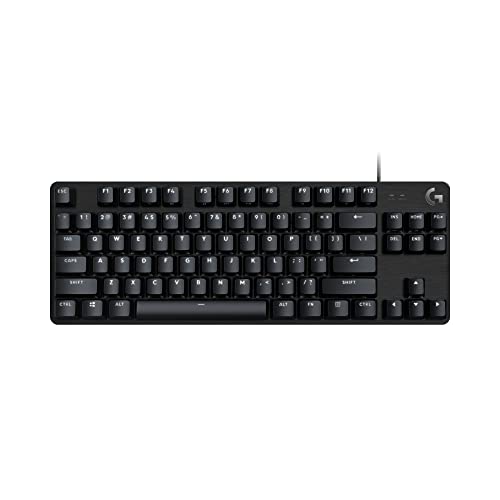 Logitech G413 TKL SE Mechanical Gaming Keyboard
- Product Group: Personal Computer
- Binding: Personal Computers


As an Amazon Associate we earn from qualifying purchases at no extra cost to you. Ratings are shown as listed on Amazon.
⚡ Save on Your Next PC — Amazon Prime
Prime members get fast free shipping on the systems above, plus early access to Prime Day & Black Friday PC deals. New members get a 30-day free trial.
Watch: Full-Size vs TKL Keyboard: 2026 Comparison — Video Review
Quick Verdict
Buy a full-size keyboard if you spend real hours outside of games — spreadsheets, accounting, CAD, data entry, or sim titles that bind commands to the numpad — and your desk is wide enough that your mouse still lands comfortably in front of your shoulder. Buy a TKL if you play mouse-heavy genres at medium-to-low sensitivity, travel to LANs, run a compact or dual-monitor setup, or simply want a cleaner desk without giving up mechanical feel. For the majority of players in 2026, TKL is the better default.
Key Differences
- Footprint: A full-size board typically spans 17–18 inches, while TKL models land around 14 inches — roughly a 20% reduction in width with no loss to the alphanumeric or function rows.
- Mouse ergonomics: TKL lets you centre your keyboard on your body while keeping the mouse close, reducing the shoulder abduction that causes fatigue during long sessions. Full-size forces the mouse further right.
- Number pad access: Full-size wins outright for data entry, spreadsheet work, and flight or space sims that use numpad bindings. TKL requires a separate pad or layer shortcuts.
- Portability: TKL boards fit standard backpacks and hard cases. The Logitech G PRO TKL even uses a detachable cable specifically for transport — a feature almost no full-size design bothers with.
- Price: TKL models frequently undercut their full-size equivalents by $10–$25 simply because there is less plastic, fewer switches, and a smaller PCB involved.
- Media and macro keys: Full-size boards have more real estate for dedicated volume wheels and macro columns, though modern TKLs like the Razer Ornata V3 TKL and Corsair K55 CORE TKL still fit backlit media controls into the top row.
Full-Size Keyboards: Maximum Functionality
The full-size layout exists because the PC ecosystem was built around it. Every numeric shortcut, every Alt code, every accounting workflow assumes a number pad is present. If you finish a raid and immediately open a budget spreadsheet, or you fly in DCS and MSFS where autopilot and radio functions live on the numpad, the extra width earns its place. Full-size boards also tend to offer more generous dedicated media clusters, volume wheels, and macro columns, because there is physical room to include them without compromising the main layout.
The trade-off is spatial. That number pad pushes your mouse several inches to the right, which forces your shoulder outward and your wrist into a slight ulnar deviation. At high sensitivity you will never notice. At 800 DPI with a 30cm/360 setup, you will — usually as a dull ache in the right trapezius after two hours. Full-size is the correct choice when your desk is deep and wide, and the wrong one when it is 100cm of IKEA laminate shared with a monitor arm and a mug.
TKL Keyboards: The Competitive Standard
Tenkeyless has become the default for competitive play for one reason: arm room. Removing the number pad lets you place the WASD cluster directly in front of your left shoulder while the mouse sits centred, and it opens up a huge sweeping area for low-sens flicks. The Logitech G PRO TKL was designed explicitly around this, with a clicky mechanical switch, LIGHTSYNC RGB, and a detachable Micro USB cable for tournament travel. The Logitech G413 TKL SE takes the same footprint in a stripped-back tactile mechanical package with full anti-ghosting and native macOS support.
TKL is also where the value sits. The SteelSeries Apex 3 TKL pairs whisper-quiet gaming switches with 8-zone RGB and IP32 water and dust resistance — genuinely useful if you eat at your desk — and the Renewed version drops the entry price further. The Corsair K55 CORE TKL offers quiet spill-resistant membrane keys with 1000Hz polling for players who want silence over click, while the Razer Ornata V3 TKL splits the difference with low-profile Mecha-Membrane switches, UV-coated keycaps, and a magnetic wrist rest included in the box.
Which Should You Buy?
- For competitive FPS and low sensitivity: Pick TKL — the Logitech G PRO TKL is the tournament-proven option with a detachable cable.
- For spreadsheets, sims, or heavy numpad use: Pick full-size, or pair a TKL with a standalone numeric pad you can move aside.
- For shared rooms, dorms, and late-night sessions: Pick a quiet TKL — the SteelSeries Apex 3 TKL or Corsair K55 CORE TKL keep noise down.
- For LANs and travel: Pick TKL. The smaller footprint and detachable cabling make transport far easier.
- For the tightest budget: Pick the Razer Ornata V3 TKL or a Renewed Apex 3 TKL for RGB and media keys at entry pricing.
Frequently Asked Questions
Do professional gamers use TKL or full-size keyboards?
The overwhelming majority of professional FPS players use TKL or smaller. Tournament desks are shallow, cable management is standardised, and low sensitivity demands mouse room. Full-size boards are rare on stage.
Can I still use a number pad with a TKL keyboard?
Yes. Standalone USB numeric pads cost very little and can be placed on your left side, or stowed entirely when gaming. Most gaming software also lets you bind a function layer for numeric input.
Is a TKL keyboard better for wrist and shoulder pain?
Generally, yes. Bringing the mouse closer to your body’s centreline reduces shoulder abduction, which is a common source of discomfort during long sessions. Adding a wrist rest — included with the Ornata V3 TKL — helps further.
Are TKL keyboards cheaper than full-size?
Usually slightly. Fewer switches and a smaller chassis typically shave $10–$25 off the equivalent full-size model, though flagship TKLs aimed at esports can cost the same or more due to premium switches and detachable cables.
Final Verdict
If your desk does double duty for work that involves numbers, buy full-size and enjoy having every key at hand. For everyone else — and especially for anyone playing at low sensitivity on a compact setup — TKL is the smarter buy in 2026: the Logitech G PRO TKL for competitive mechanical feel, the Logitech G413 TKL SE for a no-nonsense tactile board, the SteelSeries Apex 3 TKL for quiet durability, and the Razer Ornata V3 TKL or Corsair K55 CORE TKL for maximum features per dollar.