Key takeaways
- Confirm it’s truly mechanical: Watch for phrases like “mecha-membrane” or “mechanical feel.” Those are membrane boards with a mechanical-style keycap profile. A real mechanical keyboard names its switch type — red, brown, blue, yellow, or a branded equivalent.
- Pick switches by how you play: Linear switches (red, yellow) are smooth with no bump, which suits fast repeated inputs in shooters. Tactile browns give a noticeable bump for typing accuracy. Clicky blues are loud and best avoided if you share a room or use a microphone.
- Prioritise PBT keycaps: Double-shot PBT keycaps resist the greasy shine that ABS develops within weeks of heavy use, and the legends can’t wear off because they’re moulded in rather than printed. This is the single biggest longevity upgrade at this price.
- Check for hot-swap sockets: A hot-swappable PCB lets you replace switches by hand with no soldering. On a budget board this matters twice over — you can fix a single failed switch instead of binning the keyboard, and you can upgrade the feel later for the price of a switch pack.
- Verify anti-ghosting and rollover: Look for full N-key rollover or at least 26-key rollover. Cheaper boards sometimes only guarantee anti-ghosting on a limited cluster of gaming keys, which becomes a problem the moment you rebind outside WASD.
Shopping for a mechanical keyboard under $50 used to mean accepting a long list of compromises: mushy stabilizers, thin ABS keycaps that shine within weeks, and switches soldered in place forever. In 2026 that has changed. Hot-swap sockets, double-shot PBT caps, and pre-lubed switches have trickled down from enthusiast boards into genuinely budget hardware, and the gap between a $45 keyboard and a $150 one is narrower than it has ever been.
The catch is that the sub-$50 shelf is also where the worst keyboards live. Plenty of listings advertise “mechanical feel” while hiding membrane domes, and others cut corners in places you only notice after a month of daily use. This guide covers what actually matters at this price, then reviews the boards we would genuinely recommend to a friend building a gaming setup on a tight budget — including a few that punch far above their price tag.
Our top picks
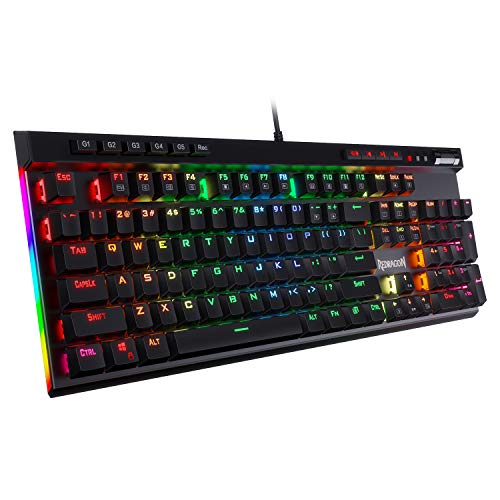
 Redragon Mechanical Gaming Keyboard Wired
- Product Group: Personal Computer
- Binding: Personal Computers

 Logitech G413 SE Full-Size Mechanical Gaming Keyboard
- Product Group: Personal Computer
- Binding: Personal Computers
 Logitech G213 Prodigy Wired RGB Gaming Keyboard
- Product Group: Personal Computer
- Binding: Personal Computers


As an Amazon Associate we earn from qualifying purchases at no extra cost to you. Ratings are shown as listed on Amazon.
⚡ Save on Your Next PC — Amazon Prime
Prime members get fast free shipping on the systems above, plus early access to Prime Day & Black Friday PC deals. New members get a 30-day free trial.
Watch: Best Mechanical Keyboard Under $50 — Video Review
How to Choose Mechanical Keyboard Under $50
- Confirm it’s truly mechanical: Watch for phrases like “mecha-membrane” or “mechanical feel.” Those are membrane boards with a mechanical-style keycap profile. A real mechanical keyboard names its switch type — red, brown, blue, yellow, or a branded equivalent.
- Pick switches by how you play: Linear switches (red, yellow) are smooth with no bump, which suits fast repeated inputs in shooters. Tactile browns give a noticeable bump for typing accuracy. Clicky blues are loud and best avoided if you share a room or use a microphone.
- Prioritise PBT keycaps: Double-shot PBT keycaps resist the greasy shine that ABS develops within weeks of heavy use, and the legends can’t wear off because they’re moulded in rather than printed. This is the single biggest longevity upgrade at this price.
- Check for hot-swap sockets: A hot-swappable PCB lets you replace switches by hand with no soldering. On a budget board this matters twice over — you can fix a single failed switch instead of binning the keyboard, and you can upgrade the feel later for the price of a switch pack.
- Verify anti-ghosting and rollover: Look for full N-key rollover or at least 26-key rollover. Cheaper boards sometimes only guarantee anti-ghosting on a limited cluster of gaming keys, which becomes a problem the moment you rebind outside WASD.
The Best Picks Reviewed
AULA F75 Pro Wireless
This is the most complete keyboard on the list and the closest thing to a custom board at a budget price, with a 75% layout, a volume knob, hot-swap sockets, pre-lubed Reaper switches, and triple connectivity across 2.4GHz, Bluetooth 5.0, and USB-C. Wireless mechanical keyboards this well specified almost never land under $50, so it’s the pick we’d make first unless you specifically need a full-size layout.
Redragon Hot-Swappable Wired
Redragon’s hot-swappable wired board pairs red linear switches with double-shot PBT keycaps and 11 backlight modes, which is an unusually strong spec sheet for the money and means it won’t develop shiny keycaps after a few months. The hot-swap sockets make it the smartest long-term buy for anyone who suspects they’ll want to experiment with different switch feels later.
Razer BlackWidow V4 X
The BlackWidow V4 X brings genuine brand-name build quality to the category, with Razer’s linear yellow switches, a full-size layout with dedicated media controls, and Chroma RGB that integrates cleanly with Synapse. It typically sits at the very top of this budget and occasionally drifts above it, so it’s worth watching the price — at or under $50 it’s excellent value, above that the AULA makes more sense.
Logitech G413 SE
The G413 SE is the sensible, no-drama option: an aluminium top plate, tactile mechanical switches, PBT keycaps, and clean white backlighting instead of RGB. There’s no software bloat and no hot-swap, but the build feels considerably more expensive than it is, and it’s the one we’d recommend to someone who wants a keyboard that simply works for five years.
Redragon K580
The K580 is the value pick for anyone who wants dedicated macro keys and a media wheel without stepping up to a mid-range board, and its per-key RGB is genuinely bright and well-diffused. It’s a chunky full-size design with a wrist rest, so plan for desk space, but the feature-per-dollar ratio is hard to argue with.
Frequently Asked Questions
Can a mechanical keyboard under $50 actually be good for gaming?
Yes. Switch actuation speed, anti-ghosting, and polling rates on budget boards in 2026 are effectively identical to those on keyboards costing three times as much. What you give up is build refinement — case rigidity, stabiliser tuning, sound dampening — rather than raw performance, and none of those affect your in-game inputs.
Are red or brown switches better for gaming?
Red (and yellow) linear switches are marginally better for fast, repeated inputs because there’s no tactile bump to push past, which is why they dominate competitive setups. Browns are the better all-rounder if you type as much as you game, and the real-world difference in performance is small enough that comfort should decide it.
Is hot-swap worth it on a cheap keyboard?
It’s arguably more valuable on a cheap keyboard than an expensive one. Budget boards are more likely to develop a chattering or dead switch, and hot-swap turns that from a replacement purchase into a two-minute fix with a $0.30 part. It also lets you meaningfully upgrade the typing feel later without buying a new board.
Should I buy wired or wireless at this price?
Wired is the safer default under $50, because cheap wireless implementations sometimes cut corners on latency or battery. The exception is a board with a dedicated 2.4GHz dongle rather than Bluetooth alone — that delivers latency low enough that most players won’t detect it, and it’s the reason the AULA F75 Pro stands out here.
Final Thoughts
If you want the most keyboard for your money, the AULA F75 Pro is the standout — wireless, hot-swappable, and pre-lubed at a price that would have bought you a basic wired board two years ago. The Redragon hot-swappable wired board is the best straightforward gaming buy thanks to its PBT caps and upgrade path, while the Logitech G413 SE is the one to choose if you value understated build quality and long-term reliability over features. Any of the three will comfortably outlast the membrane board it replaces.