Key takeaways
- A hub advertising “4K” without stating whether it supports 30Hz or 60Hz.
- Power Delivery claims without a stated wattage, such as simply “fast charging.”
- A dock slot narrower than 0.7 inch when you use a case.
- Only USB 2.0 ports if you plan to use an external SSD or multiple accessories.
- No mention of Gigabit Ethernet when wired network speed matters to you.
- A permanently attached host cable that is extremely short, thin, or poorly reinforced.
- Rear supports that cover the Deck’s intake vents or force the device to sit at an awkward angle.
- A price that excludes the charger when you do not already own a 45W or 65W USB-C PD adapter.
What's inside
A USB-C hub can make a Steam Deck feel like a compact console or desktop PC—but the wrong one creates exactly the problems buyers are trying to avoid: a loose fit, a charger warning, a black TV screen, or ports that are blocked by a protective case.
The most common mistake is buying on port count alone. A “6-in-1” hub may be perfect for a travel setup but frustrating beside a television if it has no Ethernet or if its HDMI output is limited. Another frequent error is assuming that a 100W Power Delivery rating means the Steam Deck will receive 100W. The Deck is designed around 45W charging; the hub needs enough input capacity to power itself and attached accessories while still supplying the Deck reliably.
As an Amazon Associate we earn from qualifying purchases at no extra cost to you. Product prices and availability are accurate as of the date shown and are subject to change.


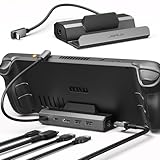

When learning how to choose USB-C hub for Steam Deck, focus on physical fit, charging behavior, display support, and the ports you will genuinely use. In 2026, there are plenty of inexpensive options, but the best value is rarely the hub with the longest feature list. It is the one that suits your room, screen, controller setup, and travel habits without adding clutter.
Decide These 3 Things First
- Will it live by a TV, monitor, or in a travel bag? A living-room setup benefits from HDMI, Gigabit Ethernet, and a weighted dock-style base. For travel, a compact hub under 4 ounces is easier to pack and can work with a separate stand.
- What display are you connecting? For a typical 1080p TV or monitor, HDMI output at 1080p and 60Hz is enough. Choose a hub rated for 4K at 60Hz if you use a newer 4K display, want clearer desktop-mode text, or expect to keep the hub through a future monitor upgrade.
- What accessories need simultaneous power? A controller receiver, keyboard, mouse, external SSD, Ethernet cable, and USB headset quickly use up ports. Count the devices you use at the same time, then add one spare USB port. Most buyers are happiest with three USB-A ports or two USB-A ports plus one USB-C data port.
Size and Desk Footprint
Start with where the hub will sit. Small travel hubs are commonly 4 to 5.5 inches long, 1.5 to 2.5 inches wide, and less than 0.75 inch thick. They usually weigh 2 to 4 ounces. These are easy to put in a case pocket, but they do not hold the Steam Deck upright. You will need a separate stand, which means one more item to carry.
Dock-style hubs combine the ports and stand in one unit. Expect a footprint around 5 to 7 inches wide, 3 to 4.5 inches deep, and 1.5 to 2.5 inches tall, with weights from roughly 7 to 14 ounces. That extra weight matters: it keeps HDMI and Ethernet cables from pulling the dock across a media console.
Check the cradle opening before ordering. A bare Steam Deck is approximately 11.7 inches wide and 1.9 inches thick at its deepest grip area. The key measurement, however, is the slot that supports the center of the device. A dock slot of about 0.55 to 0.7 inch suits a bare Deck and thin skin. A slot around 0.75 to 1 inch is more accommodating for a protective case. Thick rugged cases may still require a dock with a wider adjustable cradle or a separate hub-and-stand arrangement.
Also inspect the attached USB-C cable. A 4- to 6-inch lead works neatly with an uncased Deck in a dock. If you use a bulky case, look for at least 7 inches of cable or a connector with enough clearance to reach the top USB-C port without bending sharply.
Material and Heat Management
Aluminum is the preferred shell material for a hub that will remain connected to a TV or monitor. It generally feels more substantial, resists scuffs, and helps spread the mild heat produced by the hub’s controller and Power Delivery circuitry. Most aluminum hubs weigh between 3 and 10 ounces depending on whether they include a stand.
Plastic hubs can be perfectly practical for occasional travel. They are often lighter and less expensive, commonly $12 to $25, but should have a firm, non-flexing housing and well-finished seams. Avoid ultralight housings that feel hollow or bend when an HDMI cable is inserted. Repeated cable tension is hard on a hub’s internal port mounts.
For a dock-style unit, look for silicone pads on both the bottom and the Deck cradle. Four bottom pads are ideal. The cradle should use a soft liner at least 1 millimeter thick so the shell does not rub against the handheld’s finish. Avoid hard, bare metal contact points.
Do not cover the Steam Deck’s rear intake or top exhaust. A correctly designed dock supports the lower back of the console and leaves the rear vents open. If the cradle presses against the back panel or forces the Deck into an unusually upright angle, choose another model.
Construction and Port Layout
A useful Steam Deck hub needs more than a sturdy exterior. Look closely at where each port sits. HDMI, Ethernet, and power input are easiest to manage along the rear edge, where their heavier cables can route behind a television stand. USB ports work best on the front or side, where controller receivers and flash drives remain accessible.
For wired internet, choose Gigabit Ethernet rated for 10/100/1000 Mbps. It is more than sufficient for game downloads and streaming, while 100 Mbps Ethernet can become a bottleneck on a fast home connection. If you never use wired networking, a smaller hub without Ethernet may be a better buy.
USB-A ports should be at least USB 3.0 or USB 3.2 Gen 1, generally listed as 5Gbps. That is adequate for external SSDs, keyboards, mice, and controller adapters. A 10Gbps USB-C or USB-A port is worthwhile if you regularly move large game files to an external SSD, but it is not essential for a controller-and-TV setup.
Inspect the cable strain relief where the hub’s host cable meets the body. It should be reinforced rather than a thin, sharply bent section of rubber. The USB-C plug should seat firmly without wobbling. Because the Steam Deck has one primary USB-C port, a hub with a damaged host cable can render the whole unit unusable; a model with a replaceable host cable has a long-term advantage when available.
Comfort and Display Performance
“Performance” for a Steam Deck hub is largely about stable charging, dependable display output, and an arrangement that makes gaming comfortable. For power, select a hub with at least 65W Power Delivery pass-through. A 100W PD input rating adds useful headroom if you connect an SSD, Ethernet adapter, keyboard, or other USB-powered gear. The hub will reserve a small amount of power for itself and connected peripherals, so the charger matters as much as the hub.
The Steam Deck’s included 45W charger is suitable for many basic setups. However, if you see a slow-charger message or plan to run several accessories, use a reputable 65W USB-C PD charger. A 65W charger paired with a 100W-rated hub is a sensible sweet spot. There is no need to buy a 140W charger solely for the Steam Deck.
For video, 4K at 60Hz HDMI is the most flexible specification. The Deck can be connected to a 4K television, but demanding games may be more enjoyable at 1080p or 720p with settings adjusted for smoother play. The hub’s 4K/60 rating describes its display connection capability; it does not increase game frame rates.
If you use a monitor for desktop mode, a hub that supports 4K at 60Hz can make text and browser windows look more comfortable than a 4K/30-only connection. For couch gaming, prioritize reliable 1080p at 60Hz, a clean cable route, and enough USB ports for your preferred controller setup.
Price Tiers and Realistic Value
Budget: $12 to $20. Basic hubs in this range commonly offer HDMI, 45W to 100W PD input, and two or three USB ports. A compact gaming hub such as the SABRENT USB-C 3-Port Gaming Hub, listed around $12.99, fits this category. It can be a smart choice for travel or a minimal setup, but confirm whether it includes Ethernet and whether its display specification matches your screen.
Mid-range: $20 to $35. This is the best range for most Steam Deck owners. Expect 4K at 60Hz HDMI, 65W to 100W PD pass-through, three USB ports, and sometimes Gigabit Ethernet. The UGREEN Revodok Pro 6-in-1, around $16.14 when discounted, is an example of a compact hub that may offer more connectivity per dollar. Dock-style options such as the JSAUX 5-in-1 Docking Station, around $27.99, add the convenience of a dedicated stand.
Premium: $35 to $70. Higher-priced hubs and docks should earn their cost with a heavier stand, better cable management, a longer warranty, additional high-speed ports, Ethernet, or stronger fit-and-finish. The Anker Steam Deck Dock, listed around $29.99, can fall near the top of the mid-range depending on current pricing. Do not pay a premium simply for a gaming label if the port selection is identical to a less expensive alternative.
Warranty, Delivery, and Setup
Look for a warranty of at least 12 months. A 18- or 24-month warranty is a meaningful advantage for a dock that will stay plugged in every day. Read the support terms for cable failures, HDMI issues, and Power Delivery problems rather than assuming every part is covered equally.
Delivery is straightforward because most hubs weigh under 1 pound, but inspect the package contents before buying. Some dock-style models include only the hub; the power adapter is often sold separately. Budget an additional $20 to $40 if you need a quality 65W USB-C PD charger.
Setup should take less than 10 minutes. Connect the charger to the hub’s PD input first, connect HDMI to the display, then attach the hub’s USB-C cable to the Steam Deck. Switch the television or monitor to the correct HDMI input. If the display stays black, disconnect and reconnect the hub, check the display’s input setting, and test with another HDMI cable before assuming the hub is defective.
Spec Checklist
| Spec | Budget | Mid | Premium |
|---|---|---|---|
| Typical price | $12–$20 | $20–$35 | $35–$70 |
| Form factor | Compact hub, 2–4 oz | Hub or dock, 3–10 oz | Weighted dock, 8–14 oz |
| Power Delivery input | 45W–65W minimum | 65W–100W | 100W or higher |
| Video output | 1080p/60 or 4K/30 | 4K/60 HDMI | 4K/60 HDMI plus expanded display options |
| USB ports | 2–3 ports, preferably 5Gbps | 3 ports, 5Gbps to 10Gbps | 3–5 ports, including 10Gbps data |
| Ethernet | Optional | Gigabit preferred | Gigabit expected |
| Warranty target | 12 months | 12–18 months | 18–24 months |
Red Flags
- A hub advertising “4K” without stating whether it supports 30Hz or 60Hz.
- Power Delivery claims without a stated wattage, such as simply “fast charging.”
- A dock slot narrower than 0.7 inch when you use a case.
- Only USB 2.0 ports if you plan to use an external SSD or multiple accessories.
- No mention of Gigabit Ethernet when wired network speed matters to you.
- A permanently attached host cable that is extremely short, thin, or poorly reinforced.
- Rear supports that cover the Deck’s intake vents or force the device to sit at an awkward angle.
- A price that excludes the charger when you do not already own a 45W or 65W USB-C PD adapter.
FAQ
Do I need a 100W USB-C hub for Steam Deck?
No. A hub with 65W Power Delivery pass-through is enough for most setups. A 100W-rated hub gives additional overhead for USB accessories and works well with a 65W charger, but the Steam Deck itself is designed around 45W charging.
Can a Steam Deck hub output 4K at 60Hz?
Yes, if both the hub and display support 4K at 60Hz through HDMI. This improves flexibility for a 4K TV or desktop monitor, though it does not mean every game will run well at 4K. Many games are better played at 1080p or lower resolutions.
Will a USB-C hub fit with a Steam Deck case?
It depends on the dock cradle width and host-cable length. For a case, look for a cradle slot around 0.75 to 1 inch wide and a USB-C lead of at least 7 inches. Compact hubs without a built-in stand usually work with any case when paired with a separate stand.
Is Ethernet worth having on a Steam Deck dock?
Gigabit Ethernet is worthwhile for large game downloads, cloud gaming, remote play, and stable online multiplayer. If your Wi-Fi is already reliable and you travel often, skipping Ethernet can save space and money.