Our Top Picks
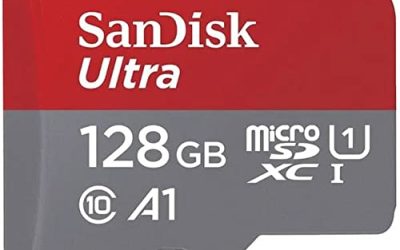
 SANDISK 128GB High Endurance Video microSDXC Card with128 GB0.4 x 0.6 x 0.1 inches0 poundsCheck on Amazon

As an Amazon Associate, we earn from qualifying purchases made through links on this page.

128GB is the capacity most people search for by name, and it is easy to see why. It is large enough to hold a serious game library, months of dash cam footage or a long trip’s worth of 4K video, yet it sits in the mainstream part of every maker’s range, so the choice is wide. The catch is that “128GB SD card” describes dozens of very different products: tiny microSDXC cards for phones and drones, full-size SDXC cards for cameras, fast cards built for 4K recording and slow ones built for cheap storage, and endurance cards designed to be overwritten every day for years.
This roundup fixes the capacity at exactly 128GB and compares cards across those jobs. Every pick below is the 128GB variant of its line, and every link points at that specific variant, because each capacity of a memory card is a separate listing with its own product code. If you need a card for one specific device, the dedicated guides for that device go deeper; here the question is narrower: given 128GB, which card fits the way you record?
What to look for in a 128GB SD card
Form factor comes first. microSDXC cards fit phones, tablets, action cameras, drones, handheld consoles and most dash cams. Full-size SDXC cards fit DSLR and mirrorless cameras, camcorders and laptops with SD slots. A microSD card can work in a full-size slot through the adapter usually bundled in the pack, but the adapter is one more contact point to fail, and camera makers generally recommend a native card for heavy shooting. Four of the five picks here are microSDXC; the fifth is a full-size SDXC card for camera bodies.
At 128GB, everything is SDXC. Cards from 64GB upward use the SDXC standard and ship formatted as exFAT, which removes the old 4GB single-file limit. That matters for long video clips, and it also means very old devices that only understand SDHC cards (32GB and below) cannot use any card on this page.
Speed classes tell you the guaranteed floor, not the headline. The markings that matter are U3 and V30, which both promise a minimum sustained write speed of 30 MB/s. That floor is what keeps 4K video recording from dropping frames. A1 and A2 are application performance classes aimed at phones and handhelds that run apps and games from the card; A2 is the stronger of the two. The big read and write numbers on the packaging are best-case figures measured with specific readers, and some brands reach their headline read speed only through a proprietary mode that needs a matching reader from the same brand. In a typical UHS-I slot, expect transfers to level off near the practical ceiling of that bus.
UHS-I versus UHS-II is a hardware question. UHS-II cards carry a second row of pins and need a UHS-II host to use them. They are the right answer for high-end stills and video work, and this site’s photography roundup covers the 128GB UHS-II field in detail. The cards here are all UHS-I, which every modern slot supports, and which is fast enough for 4K video at the bitrates phones, drones and action cameras use.
Endurance is a separate axis from speed. A dash cam or security camera overwrites its card continuously, and standard cards wear out quickly under that workload. Endurance lines use flash and firmware tuned for constant rewriting, and their makers express the lifespan in hours of Full HD recording rather than in peak speeds. If a card will live in a camera that records whenever it is powered, pick the endurance model even though its headline speeds look modest.
Buy the exact variant, from a seller you trust. Memory cards are among the most counterfeited products in electronics. Check the model code on the listing against the maker’s own page (each pick below names its code), and remember that a 128GB card shows roughly 119GB of usable space on most systems, because operating systems count in binary units while the capacity on the box is decimal. That gap is normal and is not a sign of a fake.
1. SanDisk Extreme 128GB microSDXC — the all-round 4K pick
SanDisk’s Extreme line is the default recommendation for action cameras and drones, and the 128GB card (model code SDSQXAA-128G-GN6MA) shows why. SanDisk rates it at up to 190 MB/s read and up to 90 MB/s write, with Class 10, U3 and V30 markings for 4K video and an A2 application class for phones and handhelds that load games and apps from the card. A full-size adapter is included, and SanDisk backs the card with a lifetime limited warranty in the US.
The 90 MB/s write ceiling is the figure that matters most in use: it is well above the sustained rate any current action camera or drone asks for, so the card never becomes the bottleneck while recording. For a Nintendo Switch, a Steam Deck or an Android phone, the A2 class and fast random performance make it a strong library card as well.
Two limitations follow from the spec sheet. First, this is a UHS-I card, so in a camera body with a UHS-II slot it will behave like a good UHS-I card and nothing more. Second, the headline read speed relies on SanDisk’s proprietary high-speed mode with a compatible SanDisk reader; through an ordinary reader, offloads run at standard UHS-I speeds. It is also a performance card, not an endurance card, so it is not the right choice for a dash cam that records all day.
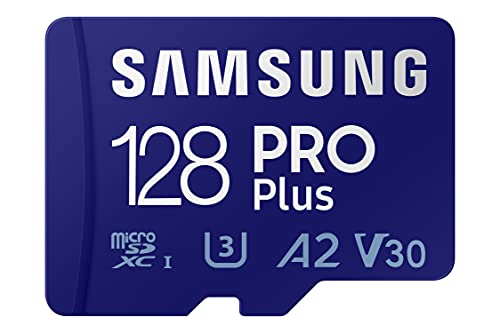
2. Samsung PRO Plus 128GB microSDXC — the fastest writer here
Samsung rates the PRO Plus 128GB (model code MB-MD128KA/AM) at up to 160 MB/s read and up to 120 MB/s write, the highest manufacturer write figure in this roundup. It carries U3, V30 and A2 markings, ships with a full-size adapter, and Samsung covers it with a 10-year limited warranty plus the line’s six-proof protection against water, temperature extremes, X-rays, magnets, drops and wearout.
That write speed is the reason to choose it. Phones that record long 4K clips, drones capturing high-bitrate footage and anyone who regularly empties a full card onto a computer will feel the difference at the margins, and the card has headroom for devices that push UHS-I hard. Samsung publishes its figures for use with its own reader, which is a fair caveat for any brand, but the underlying class guarantees still promise at least 30 MB/s sustained writes in any compliant host.
The limitations are modest. Its read ceiling sits below the SanDisk Extreme’s headline number, even if that number needs special hardware to reach. Samsung does not market this line for continuous surveillance recording, so dash cam duty belongs to the endurance pick below. And because the PRO Plus and the cheaper EVO Select share a spec sheet on paper (both U3, V30, A2), the real difference is the published write speed and the stronger internal flash tier, which only shows up in sustained transfers.
3. Samsung EVO Select 128GB microSDXC — the value expansion card
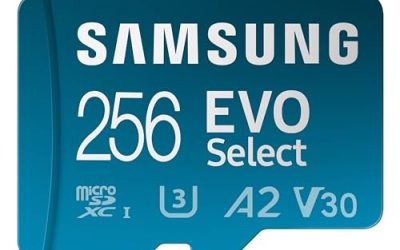
The EVO Select 128GB (model code MB-ME128KA/AM) is Samsung’s mainstream expansion card, sold through Amazon, and it covers the everyday jobs well: more room on an Android phone or tablet, a bigger game library on a Switch or handheld, or storage for a Raspberry Pi project. Samsung rates read speeds at up to 130 MB/s, and the U3, V30 and A2 markings guarantee a minimum sustained write of 30 MB/s, which is enough for 4K video in phones and action cameras as well as for game storage. It includes an adapter and carries Samsung’s 10-year limited warranty.
For library-style use, where the card is written once and read often, this is the sensible tier. Game installs, media folders and photo backups do not stress a card the way continuous recording does, and the EVO Select’s class guarantees match what those devices actually require.
The trade-off is sustained write performance. Samsung does not publish a headline write speed for this card, and in long continuous writes it trails the PRO Plus above; a full 128GB offload-and-refill cycle is where that gap appears. It is also not an endurance product. Buyers comparing across shops should know the EVO Select is the Amazon-channel name for Samsung’s EVO family, so the model code MB-ME128KA/AM is the reliable thing to match when checking a listing.
4. SanDisk High Endurance 128GB microSDXC — built for dash cams and security cameras
The High Endurance 128GB (model code SDSQQNR-128G-GN6IA) is the specialist in this group. SanDisk builds it for devices that record continuously and overwrite old footage in a loop: dash cams, home monitoring systems, doorbell cameras and body cameras. Instead of chasing peak speed, SanDisk rates this line by hours of Full HD recording life, and the card is designed to keep working through the constant write cycles that wear out ordinary cards. Speeds are up to 100 MB/s read and up to 40 MB/s write, with U3 and V30 markings, so it still satisfies the class requirements of 4K dash cams.
For a camera that records whenever the car is running or the house is occupied, this is the correct 128GB card even though it looks slow on the box. A faster card that fails early is worse than a steady card that lasts, and failure in a dash cam usually goes unnoticed until the footage is needed.
The limitations are the mirror image of its strengths. A 40 MB/s write ceiling and no A2 application class make it a poor choice for app-heavy phones or fast game loading, and its read speed is the lowest here for offloading large files. SanDisk’s warranty on this line is also shorter than the flagship cards, at two years, which is worth knowing when comparing it with the 10-year coverage on the Samsung picks.
5. SanDisk Extreme PRO 128GB SDXC UHS-I — the full-size camera card
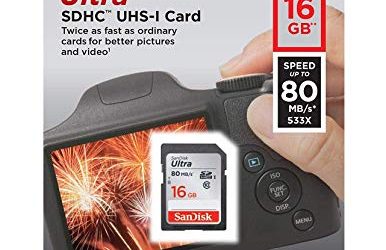
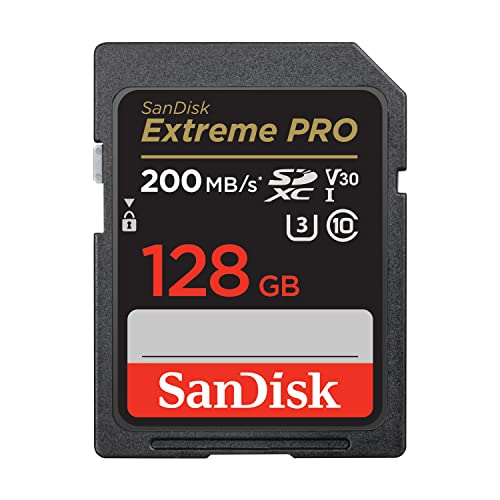
The only full-size card in this roundup, the Extreme PRO SDXC UHS-I 128GB (model code SDSDXXD-128G-GN4IN) is aimed at DSLR and mirrorless cameras and camcorders with SD slots. SanDisk rates read speeds at up to 200 MB/s using its QuickFlow technology with a compatible reader, and the listing gives write speeds of up to 90 MB/s at this 128GB capacity. U3 and V30 markings cover 4K video, and the card carries a lifetime limited warranty in the US.
For stills shooters, the value is in burst depth and offload time: a V30 floor keeps the buffer clearing during continuous shooting at the frame rates most enthusiast bodies manage, and 128GB holds long days of RAW files. For video, it handles the 4K modes of UHS-I camera bodies without the cost step up to UHS-II media.
Be clear about what it is not. It is a UHS-I card, so a camera with a UHS-II slot cannot use its full potential the way it would with a V60 or V90 card; photographers who need that ceiling should look at the UHS-II roundup on this site instead. The 200 MB/s read figure also depends on SanDisk’s reader technology, and the write figure varies by capacity within this line, so the 128GB card should be judged on the 90 MB/s figure quoted for this variant rather than on numbers from larger sizes.
Comparison table
| Card | Format | Bus | Read (up to) | Write (up to) | Classes | Warranty | Best for |
|---|---|---|---|---|---|---|---|
| SanDisk Extreme 128GB | microSDXC | UHS-I | 190 MB/s | 90 MB/s | U3, V30, A2 | Lifetime limited (US) | Action cams, drones, 4K all-round use |
| Samsung PRO Plus 128GB | microSDXC | UHS-I | 160 MB/s | 120 MB/s | U3, V30, A2 | 10-year limited | Fast writes on phones and drones |
| Samsung EVO Select 128GB | microSDXC | UHS-I | 130 MB/s | 30 MB/s class floor | U3, V30, A2 | 10-year limited | Game libraries and phone expansion |
| SanDisk High Endurance 128GB | microSDXC | UHS-I | 100 MB/s | 40 MB/s | U3, V30 | 2-year limited | Dash cams and security cameras |
| SanDisk Extreme PRO 128GB | SDXC (full-size) | UHS-I | 200 MB/s | 90 MB/s | U3, V30 | Lifetime limited (US) | DSLR and mirrorless cameras |
FAQ
Is 128GB enough for a game library?
It depends on the games. Many handheld and Switch titles are only a few gigabytes, so 128GB holds a working library comfortably, but a handful of large releases can fill it quickly. The advantage of fixing on 128GB is that every card here meets the same speed classes, so the choice comes down to the endurance and write-speed differences above rather than to capacity.
Can I use a microSD card in a camera’s full-size SD slot?
Yes, with the adapter included with most of these cards, and the card’s speed classes still apply. For occasional use it is fine. For heavy burst shooting or important work, a native full-size card removes the adapter as a failure point, which is why the Extreme PRO SDXC is included here.
What does V30 actually guarantee?
V30 is a video speed class that guarantees a minimum sustained write speed of 30 MB/s, enough for 4K video at the bitrates most consumer devices use. The U3 marking promises the same floor. Headline speeds on packaging are peak figures; the class marking is the number a device maker designs around.
Why does a 128GB card show less space on my device?
Card makers measure capacity in decimal gigabytes, while most operating systems report in binary units. A 128GB card therefore appears as roughly 119GB. That is expected behaviour for genuine cards from every brand.
Should I pay more for UHS-II at 128GB?
Only if your device has a UHS-II slot and your work needs the sustained write speeds of V60 or V90 media, mainly high-bitrate video and fast burst photography. For phones, drones, action cameras, handhelds and dash cams, all of which use UHS-I slots, a UHS-II card brings no benefit.
Conclusion
At 128GB, the right card depends on the job, not on the capacity. The SanDisk Extreme is the safest all-round microSDXC for 4K recording across action cameras, drones and phones, and the Samsung PRO Plus beats it on published write speed for transfer-heavy use. The Samsung EVO Select covers game libraries and everyday expansion with the same class guarantees for less demanding work. Dash cams and security cameras should skip all three and take the SanDisk High Endurance, which trades speed for a lifespan measured in recording hours. And if your device takes a full-size card, the SanDisk Extreme PRO SDXC brings the same V30 assurances to camera bodies without stepping up to UHS-II. Match the model code to the listing, buy the exact 128GB variant, and any of these five will do its job well.
More from Amazon
Programs that pair well with the guide above. Offers and eligibility are set by Amazon and may change.
Free shipping on eligible items, Prime Video and more. Eligible new members can start with a free trial.
Start a Prime free trialAd-free music streaming. Eligible new subscribers can start with a free trial.
Try Music Unlimited freeA Prime membership for ages 18-24 with a trial period. Eligibility is set by Amazon.
See Prime for Young AdultsAudiobooks and podcasts to listen to on the go. Eligible new members can start with a free trial.
Try Audible freeAs an Amazon Associate we earn from qualifying purchases.