Our Top Picks
 SANSUI 32 Inch Curved 240Hz Gaming Monitor High32 inch24.19 x 8.06 x 17.75 inches9.7 PoundsCheck on Amazon
A 240Hz monitor is smoother and can reduce display-side latency compared with 144Hz, but 144Hz is usually the better value unless your gaming PC or laptop can consistently produce well over 144 frames per second.
240Hz vs 144Hz: The Core Difference
Refresh rate is the number of times a monitor updates its image each second. A 144Hz display refreshes every 6.94 milliseconds, while a 240Hz display refreshes every 4.17 milliseconds.

Z-Edge 24 inch 240Hz 144Hz Gaming Monitor, FHD 1080p, IPS PC Gaming | MPRT 1ms, 350nits, 16.7M Colors, 99% sRGB, UG24PJ Frameless Bezel, DP x1, HDMI x1(Black)
Chosen because it specifies FHD 1080p and IPS PC Gaming.
View on Amazon
Dell 24 240Hz Gaming Monitor - SE2426HG - 23.8-inch FHD (1920x1080) 240Hz Display, in-Plane Switching (IPS) Technology, AMD FreeSync™ Premium, TÜV 3-Star, 2X HDMI, DisplayPort 1.4, Tilt
Chosen because it specifies SE2426HG and 23.8-inch FHD (1920x1080) 240Hz Display.
View on AmazonSANSUI 32 Inch Curved 240Hz Gaming Monitor High Refresh Rate, FHD 1080P | Gaming PC Monitor HDMI DP1.4, 1500R Curvature, 1Ms MPRT, HDR,Metal Stand,VESA Compatible(DP Cable Incl.)
Chosen because it specifies FHD 1080P.
View on Amazon
SANSUI Gaming Monitor 27" 1440p 260hz/240hz WQHD 2K - Fast IPS 1ms FreeSync Premium 丨DCI-P3 98% 丨sRGB130% 丨HDR10 丨2×DisplayPort 1.4丨2×HDMI2.0 PC Gaming Monitor with Crosshair
Picked as a relevant option in this category.
View on Amazon
Dell 24 240Hz Gaming Monitor - SE2426HG - 23.8-inch FHD (1920x1080) 240Hz Display, in-Plane Switching (IPS) Technology, AMD FreeSync™ Premium, TÜV 3-Star, 2X HDMI, DisplayPort 1.4, Tilt
Chosen because it specifies SE2426HG and 23.8-inch FHD (1920x1080) 240Hz Display.
View on AmazonZ-Edge 24 inch 240Hz 144Hz Gaming Monitor, FHD 1080p, IPS PC Gaming | MPRT 1ms, 350nits, 16.7M Colors, 99% sRGB, UG24PJ Frameless Bezel, DP x1, HDMI x1(Black)
Chosen because it specifies FHD 1080p and IPS PC Gaming.
View on Amazon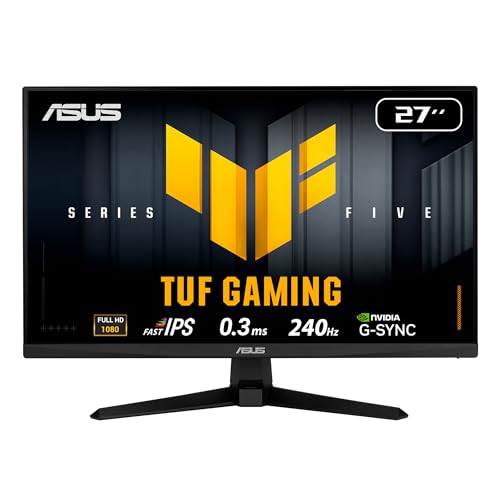
ASUS TUF VG279QM5A 27 Inch 1080p 240Hz Fast IPS G-SYNC Gaming Monitor | ELMB Sync, 0.3ms, FreeSync Premium, Variable Overdrive, 99% sRGB, HDMI, DisplayPort, 3yr warranty
Picked as a relevant option in this category.
View on Amazon| Specification | 144Hz | 240Hz | Practical meaning |
|---|---|---|---|
| Time between refreshes | 6.94 ms | 4.17 ms | 240Hz can show a new frame about 2.78 ms sooner |
| Frames shown per second | 144 | 240 | More updates can make fast movement easier to track |
| Maximum refresh interval improvement | Baseline | 40% shorter | Useful mainly when frame rates are also high |
| Typical sweet-spot resolution | 1080p or 1440p | 1080p, sometimes 1440p | Higher resolution makes 240 frames per second harder to render |
The important point is that 240Hz is not automatically twice as good. The jump from 60Hz to 144Hz is much more obvious because each refresh interval falls by 9.72 ms. The jump from 144Hz to 240Hz saves only 2.78 ms per refresh. That improvement is real, but it is easier to notice in competitive games than in slower single-player games.
Motion Clarity: Which Monitor Looks Smoother?
At the same frame rate, a 240Hz monitor can present motion with less visible stepping and less sample-and-hold blur than a 144Hz monitor. When you quickly turn in a first-person shooter, targets and map details remain easier to follow because the display updates more frequently.
However, refresh rate is only one part of motion clarity. Pixel response time matters too. A slow panel can leave behind ghosting even if it runs at 240Hz. Conversely, a well-tuned 144Hz monitor with a fast response time can look cleaner than a poorly tuned 240Hz model.
Overdrive settings also affect the result. Excessive overdrive may create bright inverse trails around moving objects, while an overly weak setting causes ordinary smearing. Use the monitor’s middle or “Fast” response mode first, then compare it with the faster mode in a moving test. Choose the setting with the least trailing rather than the one with the most aggressive name.
Variable refresh rate technologies such as Adaptive-Sync, FreeSync, or G-SYNC-compatible operation can improve smoothness when the frame rate fluctuates. A 240Hz screen running between 170 and 220 fps may feel smoother than a 144Hz screen frequently dropping below 100 fps, but stable frame delivery remains more important than the maximum number printed on the box.
Input Latency: How Much Faster Is 240Hz?
A higher refresh rate reduces the waiting time before the monitor can display a newly rendered frame. The average scanout-related difference between 144Hz and 240Hz is roughly 1.39 ms, while the maximum interval difference is 2.78 ms. That is a small but measurable advantage.
It does not mean your entire gaming system becomes 2.78 ms faster. Total input latency also includes mouse or controller processing, game-engine latency, CPU simulation, GPU rendering, the monitor’s internal processing, and pixel response. A weak processor, inconsistent frame pacing, wireless interference, or excessive graphics settings can erase the practical benefit.
For the lowest latency, use a wired or reliable low-latency mouse, enable the monitor’s gaming mode if it bypasses unnecessary processing, and avoid letting the GPU remain permanently maxed out. In games that support it, a latency-reduction feature can help. A frame-rate cap just below the monitor’s variable-refresh ceiling can also prevent GPU saturation and reduce latency spikes.
GPU Requirements and a Worked Calculation
The main cost of 240Hz is not the monitor alone; it is producing enough frames to use it. At 1080p, rendering 240 fps requires 1.67 times as many frames per second as 144 fps. If each frame takes the same GPU work, the graphics card must deliver about 67% more throughput.
Here is a simple example. Suppose a game runs at 180 fps at a particular quality setting. Each frame takes:
1,000 ÷ 180 = 5.56 ms
That is fast enough to benefit from a 240Hz panel, but it cannot fully use the monitor’s 4.17 ms refresh interval. To reach 240 fps, the frame time must fall to:
1,000 ÷ 240 = 4.17 ms
Reducing frame time from 5.56 ms to 4.17 ms requires approximately 25% more frame-processing speed, calculated as 5.56 ÷ 4.17. In other words, a system that produces 180 fps does not necessarily need 67% more performance to reach 240 fps; the exact upgrade depends on the starting point. Compared with 144 fps, however, 240 fps is 66.7% more frames.
At 1440p, the GPU must shade 1.78 times as many pixels as at 1080p. Combining 1440p with 240Hz is therefore demanding: compared with 1080p at 144Hz, it requires approximately 1.78 × 1.67 = 2.97 times the pixel throughput, before accounting for quality settings, ray tracing, or upscaling. This is why 240Hz is most common at 1080p and why 1440p 240Hz is generally aimed at powerful desktop systems.
Competitive Gaming Benefits
Competitive shooters, arena games, racing games, and rhythm games gain the most from 240Hz. The benefits include:
- Smoother panning when checking corners or tracking a moving opponent.
- A more current image during rapid camera movement.
- Slightly lower display-side latency for clicks, flicks, and directional changes.
- More useful visual information when the game consistently runs above 144 fps.
These advantages improve consistency rather than guaranteeing better aim. Network latency, server tick behavior, audio cues, mouse control, practice, and game performance still matter far more than a 96Hz numerical difference. A player whose system fluctuates between 100 and 160 fps may gain more from a stable frame-rate configuration than from buying a 240Hz panel.
When 144Hz Is the Better Choice
Choose 144Hz when you play mostly story-driven games, strategy games, simulation games, or visually demanding titles where frame rates commonly sit between 70 and 140 fps. It is also the sensible option when the price difference could fund a better GPU, more memory, a larger SSD, or a higher-quality panel with better contrast and ergonomics.
For gaming laptops, 144Hz can be especially practical. A display running at 240Hz may draw more power, although the exact difference depends on panel size, brightness, resolution, and the laptop’s display design. If a laptop battery lasts four hours during gaming at an average 20-watt display-and-system overhead, a 10-watt increase would change the simplified calculation from 240 watt-hours of use to 280 watt-hours over four hours. Real battery behavior is more complicated, but the example shows why maximum refresh rate can matter away from a wall outlet.
Decision Matrix: Which Refresh Rate Fits You?
| Your situation | Recommended choice | Reason |
|---|---|---|
| Esports titles at 200–300 fps, 1080p | 240Hz | You can regularly use the extra refresh headroom |
| Most games at 100–180 fps | 144Hz or 165Hz | A 240Hz panel will often run below its useful range |
| Powerful PC, competitive priority, budget available | 240Hz | The small latency and clarity gains align with the use case |
| 1440p gaming with demanding graphics | 144Hz or 165Hz | Higher image quality is usually easier to sustain than 240 fps |
| Gaming laptop used on battery | 144Hz | It may reduce display power and avoids paying for unused refresh rate |
| Mixed work, movies, and occasional gaming | 144Hz | Better value unless smooth competitive play is a priority |
How to Configure Either Monitor Properly
- Use the correct cable and port: check that the monitor’s DisplayPort or HDMI input supports the desired resolution and refresh rate. A cable or port limited to 144Hz can make a 240Hz purchase irrelevant.
- Select the refresh rate in the operating system: open the display settings and manually choose 144Hz or 240Hz. Some systems default to 60Hz after installation or a driver reset.
- Enable variable refresh rate: turn on Adaptive-Sync in the monitor menu and the relevant graphics settings. This helps prevent tearing when frame rates move around.
- Set a sensible frame cap: for a 240Hz display, try 237 fps; for a 144Hz display, try 141 fps when using variable refresh. The small margin helps keep the GPU from hitting the ceiling.
- Adjust game settings for consistency: lower shadows, reflections, volumetric effects, and post-processing before lowering texture quality. Textures often affect VRAM more than frame rate, while these effects commonly have a larger GPU cost.
- Check response-time modes: use the fastest mode that does not create obvious inverse ghosting. Refresh rate cannot correct poor pixel tuning.
Final Verdict on Monitor 240Hz vs 144Hz
The monitor 240Hz vs 144Hz decision comes down to sustained frame rate and priorities. A 240Hz display offers clearer high-speed motion and a modest latency improvement, making it worthwhile for competitive players who can maintain roughly 200–240 fps, especially at 1080p. For most gamers, 144Hz remains the more balanced choice: it is smooth, easier to drive, often less demanding on a laptop, and leaves more budget for image quality or system performance.