Our Top Picks
 Acer 27in FHD 1920x1080 IPS 120Hz Gaming Monitor27-inch8.27 x 24.07 x 17.44 Inches11 poundsCheck on Amazon
The best gaming monitors under $200 for portable and battery-powered setups are 24-inch 1080p IPS models with 100Hz to 180Hz refresh rates, 15W to 25W typical power draw, and either USB-C with DisplayPort Alt-Mode or HDMI 1.4/2.0 — they give you the best balance of low battery drain, broad compatibility with laptops, handhelds and consoles, and smooth gameplay without needing a large power station.
At this price you are not getting 1440p 240Hz or OLED, but you can get a panel that runs for hours on a 60Wh to 100Wh battery pack and is light enough to fit in a backpack. The trick is picking the right combination of power input, refresh rate, and size for how you actually play portably.

Sceptre New 22-Inch Gaming Monitor, FHD 1080p, Up to 144Hz, HDMI, DisplayPort, Built-in Speakers, Machine Black (E225W-FW144 Series, 2026)
Chosen because it specifies FHD 1080p and Up to 144Hz.
View on AmazonAcer 27in FHD 1920x1080 IPS 120Hz Gaming Monitor | Office KB272 G0bi | 1ms, AdaptiveSync, sRGB 99%, HDMI, VGA, VESA Mountable, Bluelight Filter
Chosen because it specifies Office KB272 G0bi.
View on Amazon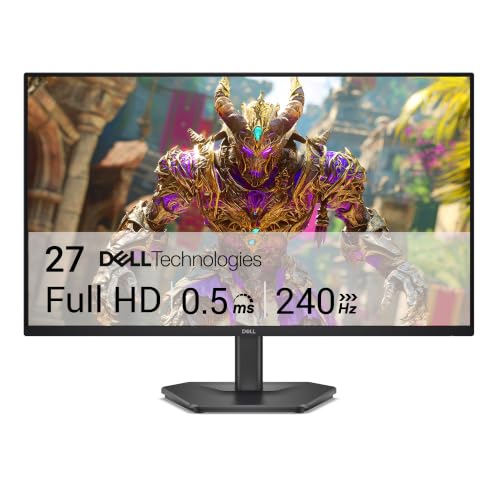
Dell 27 240Hz Gaming Monitor - SE2726HG - 27-inch FHD (1920x1080) Display, in-Plane Switching (IPS) Technology, AMD FreeSync Premium, TÜV 3-Star, 2X HDMI, DisplayPort 1.4, Tilt
Chosen because it specifies SE2726HG and 27-inch FHD (1920x1080) Display.
View on AmazonWhat Actually Matters for a Battery-Powered Gaming Monitor
For a desk setup you optimize for image quality first. For portable and battery-powered use, you optimize for power, input flexibility, and weight in that order.
1. Real Power Draw, Not Just the Adapter Rating
The brick might say 36W or 65W, but typical draw at 120-150 nits brightness is much lower on modern IPS panels. This is what determines battery runtime.
- 24-inch 1080p 100Hz IPS (e.g. class like AOC 24G2SP, ViewSonic VX2418-P-MHD, Acer Nitro KG241Y): usually 14W to 18W at 120 nits, 22W to 28W peak
- 27-inch 1080p 165Hz/180Hz IPS (e.g. class like MSI G272QPF E2 budget variants, ASUS TUF Gaming VG279Q1A, LG 27GQ50F): usually 18W to 24W at 120 nits, 28W to 35W peak
- 15.6-inch portable USB-C monitors (1080p 60Hz IPS): usually 8W to 12W, but often limited to 60Hz and 250 nits
A monitor with USB-C power delivery that can run directly off 15W to 20W is ideal for a single-battery setup with a laptop or Steam Deck. Models that require a separate 19V DC barrel jack need an AC inverter on your power station, which wastes 10-15% efficiency.
2. Input Compatibility
USB-C with DP Alt-Mode carries video, audio and power over one cable — perfect for laptops, tablets, Steam Deck, ROG Ally, and phones with desktop modes. HDMI is still mandatory for Nintendo Switch (via dock), PlayStation, Xbox, and most mini PCs. The most flexible budget monitors under $200 offer both: one USB-C and one or two HDMI ports.
Check these specifics before buying:
- USB-C DP Alt-Mode: does the monitor accept video over USB-C, or is the port power-only? The spec sheet must list “DP Alt Mode” or “USB-C Display Input”
- Power over USB-C: does it run on 65W PD input, or does it still need its DC adapter even when using USB-C video?
- HDMI version: HDMI 1.4 is enough for 1080p 144Hz, HDMI 2.0 is needed for 1080p 165Hz+ on many budget scalers
3. Refresh Rate vs. Battery Trade-off
Above 100Hz the benefit for portable play is less about competitive advantage and more about smoothness when you are not pushing high frame rates constantly. A 180Hz panel does not draw much more than a 100Hz panel at the same brightness, but driving it at 180 fps over HDMI/DP does increase GPU power draw on your source device.
Worked Calculation: Battery Runtime and Power Budget
Use this formula to estimate real-world runtime before you buy. It accounts for inverter loss if you use an AC-powered monitor on a power station.
Runtime (hours) = Battery Capacity (Wh) x 0.85 (efficiency) / Monitor Average Draw (W)
For a DC-powered portable monitor over USB-C, use 0.95 efficiency. For an AC-powered desktop monitor via a power station inverter, use 0.80 to 0.85.
| Battery Source | Capacity | Monitor Type (at 120 nits) | Avg Draw | Estimated Runtime |
|---|---|---|---|---|
| Small power bank (PD) | 38Wh (10,000mAh @ 3.8V) | 15.6″ Portable 1080p 60Hz | 9W | 4.0 hours (38 x 0.95 / 9) |
| Large power bank | 72Wh | 24″ Desktop 1080p 100Hz via USB-C | 16W | 4.3 hours (72 x 0.95 / 16) |
| Portable power station | 99Wh (airline limit) | 24″ Desktop 1080p 165Hz via AC inverter | 22W | 3.8 hours (99 x 0.85 / 22) |
| Portable power station | 256Wh | 27″ Desktop 1080p 165Hz via AC inverter | 24W | 9.1 hours (256 x 0.85 / 24) |
Bandwidth calculation for reference: 1920×1080 at 144Hz with 8-bit color requires about 8.0 Gbit/s with CVT-RB v2 timing. This fits within HDMI 1.4 (10.2 Gbit/s) and well within HDMI 2.0 (18 Gbit/s) or DP 1.2 over USB-C (21.6 Gbit/s). You do not need HDMI 2.1 for any 1080p monitor under $200.
Practical takeaway: If you want a full day of on-and-off gaming away from outlets, a 24-inch 100Hz model paired with a 99Wh station gives you roughly 3.5 to 4.5 hours of continuous play. A 15.6-inch portable panel almost doubles that runtime on the same battery because it draws half the power.
Decision Matrix: Which Class Fits Your Portable Setup
| Your Setup | Best Fit Under $200 | Why | What to Prioritize |
|---|---|---|---|
| Laptop / Steam Deck / ROG Ally as source, one battery | 24″ 1080p 100-120Hz with USB-C DP Alt-Mode + PD | Single USB-C cable for video + power, lowest conversion loss | USB-C that supports both video and 65W PD passthrough, built-in speakers |
| Nintendo Switch, PS5, Xbox with power station | 24″ 1080p 120-165Hz with HDMI + DC adapter + speakers/headphone jack | Consoles need HDMI; you already need AC for the console | Low input lag, HDMI CEC, 3.5mm audio out, VESA mount for stand |
| Ultra-compact backpack / van / train use | 15.6″ – 16.1″ portable 1080p 60-144Hz USB-C | Weighs 700g to 900g vs 3.5kg to 5kg for desktop models, draws under 12W | Weight, built-in cover/stand, brightness at least 300 nits |
| Competitive FPS on battery, want 165Hz+ | 27″ 1080p 165-180Hz IPS via HDMI 2.0 | Larger screen and overdrive options, still usually $150-$190 | 1ms MPRT / Adaptive Sync (FreeSync compatible), matte coating |
What to Expect in 2026 Under $200
Prices in this bracket usually fall into two ranges: 15.6-inch portable IPS panels generally $90 to $150, and 24 to 27-inch desktop gaming IPS panels generally $110 to $190. Anything marketed as 180Hz in this range is almost always a 165Hz native panel with a factory overclock.
Real models that consistently appear in this price class in 2026 include the AOC 24G2 series, Acer Nitro KG241Y and VG240Y series, ViewSonic VX2418 and VX2718 series, ASUS TUF Gaming VG249Q1A / VG279Q1A, MSI Optix G2412 and G2722, and LG UltraGear 24GN600. Availability rotates, but the underlying spec class — 1080p IPS, 100Hz to 180Hz, FreeSync Compatible — is stable.
What you typically give up under $200:
- No true HDR: peak brightness is usually 250 to 300 nits, with HDR400 modes that do not add local dimming
- Basic stands: tilt-only, no height adjustment unless you add a $25 to $40 VESA arm
- USB-C is not universal: many 27-inch budget models still have no USB-C at all
Settings for Battery-Powered Use
Default out-of-box settings are tuned for a bright showroom, not for battery life. Change these first:
- Brightness: 30 to 45 out of 100 (roughly 120 to 160 nits). On most budget IPS monitors this cuts draw by 6W to 10W vs 100% brightness with minimal visible loss indoors.
- Refresh rate: set to 100Hz or 120Hz in Windows/SteamOS if you are battery limited. You save 2W to 4W on the monitor scaler and more on the GPU vs 165Hz.
- Adaptive Sync: enable FreeSync / Adaptive-Sync in the monitor OSD and in your GPU settings. This prevents tearing when your source drops below max refresh without the power cost of V-Sync.
- Overdrive: use Medium or Normal. Max/Extreme overdrive on budget panels causes inverse ghosting and uses slightly more processing power.
- Volume / RGB: mute speakers if using headphones and disable any LED accent lighting to save 1W to 2W.
For portable power stations, use the DC barrel output or USB-C PD output directly if the monitor supports it. Avoid the AC outlet if you can — the DC-AC-DC conversion step wastes energy as heat and adds fan noise.
Weight and Portability Considerations
A 24-inch desktop monitor without its stand weighs about 2.9kg to 3.4kg and with the stand 4.0kg to 5.2kg. The stand itself often accounts for 25% of the weight. For a portable station, removing the factory stand and using a compact VESA 75×75 or 100×100 stand or a lightweight monitor arm saves space and makes packing flat possible. A 15.6-inch portable monitor with its cover weighs under 1kg and slips into a laptop sleeve.
If you need to fly, remember most airlines cap lithium batteries at 100Wh without approval. A 15.6-inch portable monitor at 9W paired with a 72Wh power bank is the only setup that realistically stays under that limit while powering both the display and a handheld source for more than two hours.
FAQ
Can I run a 27-inch gaming monitor directly from a USB power bank?
No, unless it is a dedicated portable monitor. Most 24-inch and 27-inch desktop gaming monitors require 19V DC at 2A or more and cannot run from 5V or even 20V USB PD. They need their included AC adapter or a power station with an AC inverter or 12V DC output that matches the monitor input.
Is 1080p enough at 27 inches for portable gaming?
For battery-powered use, 1080p is the right choice under $200. It keeps GPU load and power draw low, allows higher refresh rates over limited bandwidth, and budget 1440p panels in this price range are typically lower-quality VA panels with higher power consumption and no USB-C.
Do I need FreeSync or G-Sync for a portable setup?
FreeSync (Adaptive Sync) is highly recommended. Almost all monitors under $200 that support 100Hz+ include FreeSync Compatible support at no extra power cost, and it smooths gameplay when your laptop or handheld cannot hold a locked frame rate, which is common on battery power when performance is limited.