Key takeaways
- Protects against everyday scratches. A Deck often travels in a backpack, tote, or carrying case where dust and grit can rub against the display. A protector provides a replaceable barrier.
- Low cost compared with screen repair. Spending about $10 to $20 is an inexpensive form of protection for a console that costs several hundred dollars.
- Easy to replace. If the glass becomes scratched or develops a crack after a drop, you can remove it without replacing the entire display assembly.
- Preserves touch functionality. A properly fitted protector should still allow taps, swipes, and on-screen keyboard input to work normally.
- Useful resale protection. A clean, scratch-free display can make a used Steam Deck easier to sell and help it retain a more presentable condition.
- A spare can save time. Two-packs are convenient if the first installation attracts dust or the protector gets damaged later.
- Minimal effect on handling. Tempered glass is thin, and the added weight is insignificant during handheld play.
The Short Answer
Yes—if you carry your Steam Deck OLED outside the house or store it in a bag with other items. If your Deck stays on a clean desk and goes straight into a padded case when you move it, a screen protector is optional rather than essential.
The Steam Deck OLED has a 7.4-inch, 1280-by-800 display, and replacing that display is far more expensive and inconvenient than replacing a sheet of tempered glass. A protector will not make the console indestructible, but it can absorb scratches from zippers, dust, grit, and everyday handling. For most owners in 2026, it is a sensible $10-to-$20 precaution.
Our top picks
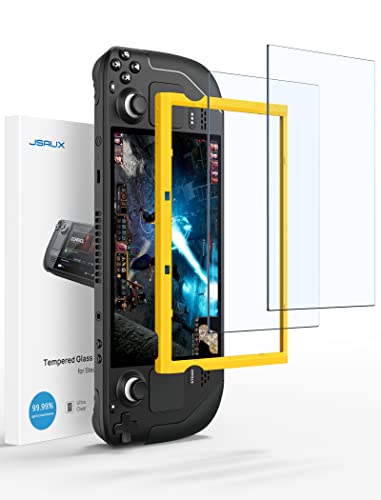 JSAUX 2-Pack Ultra HD Screen Protector for
- Product Group: Video Games
- Binding: Electronics
 Spigen GlasTR EZ FIT Screen Protector for
- Product Group: Video Games
- Binding: Electronics
As an Amazon Associate we earn from qualifying purchases at no extra cost to you. Ratings are shown as listed on Amazon.
What You Actually Get
A screen protector is a thin layer of glass or film cut to fit the Steam Deck’s display. Most popular options are tempered glass, which usually measures around 0.3 millimeters thick. You apply it directly to the screen after cleaning away dust and fingerprints.
In practical terms, you get a sacrificial surface. If a key, zipper pull, or piece of grit scratches the display, the protector may take the damage instead of the original screen. When the protector becomes marked, you peel it off and install another one. That is the main benefit—not better graphics, higher frame rates, or longer battery life.
Most glass protectors preserve the Deck OLED’s touch controls and do not affect its 90Hz refresh rate. They also generally add only a small amount of weight, often roughly 10 to 20 grams including packaging residue and any alignment accessories. On a console that weighs about 640 grams, or 1.41 pounds, the added weight is barely noticeable.
Fit matters more on the OLED model than the product name might suggest. The Steam Deck OLED and LCD models have the same basic exterior dimensions—approximately 11.7 inches wide, 4.6 inches tall, and 0.8 inches thick—so many protectors are labeled for both versions. Still, check the packaging before buying, especially if the protector includes a frame or installation tray.
Two common choices illustrate the price range. The JSAUX 2-Pack Ultra HD Screen Protector for Steam Deck OLED/LCD is listed at about $9.49 and includes a spare. The Spigen GlasTR EZ FIT Screen Protector for Steam Deck OLED/LCD costs about $17.99 and emphasizes easier alignment. Prices can change, but roughly $9 to $18 is a normal range for a basic glass protector.
Pros
- Protects against everyday scratches. A Deck often travels in a backpack, tote, or carrying case where dust and grit can rub against the display. A protector provides a replaceable barrier.
- Low cost compared with screen repair. Spending about $10 to $20 is an inexpensive form of protection for a console that costs several hundred dollars.
- Easy to replace. If the glass becomes scratched or develops a crack after a drop, you can remove it without replacing the entire display assembly.
- Preserves touch functionality. A properly fitted protector should still allow taps, swipes, and on-screen keyboard input to work normally.
- Useful resale protection. A clean, scratch-free display can make a used Steam Deck easier to sell and help it retain a more presentable condition.
- A spare can save time. Two-packs are convenient if the first installation attracts dust or the protector gets damaged later.
- Minimal effect on handling. Tempered glass is thin, and the added weight is insignificant during handheld play.
Cons
- Installation can be frustrating. One dust particle trapped underneath creates a visible bubble or speck. Applying the protector in a clean, well-lit room gives you the best chance of a smooth result.
- It can add glare. Clear glass may reflect lamps and windows more noticeably than the bare screen. This matters particularly if you play outdoors or near bright lights.
- Edges may collect dust. A protector that is slightly misaligned can leave a narrow lip around the display. Dust may gather there over time.
- Some protectors alter the feel of the screen. The surface can feel different from the original glass, and inexpensive models may have more friction or fingerprints.
- It is not drop protection for the whole console. A screen protector may prevent scratches, but it will not protect the joysticks, buttons, rear shell, or internal components from a hard fall.
- It may complicate accessory fit. Most carrying cases have enough clearance, but an unusually tight case or a screen cover designed for a bare display could press against the protector.
- It can reduce the benefit of certain display finishes. If you own a model or replacement screen with a special anti-glare surface, a glossy glass protector may change how reflections look.
Who Should Buy It
Buy a screen protector if your Steam Deck OLED regularly leaves your home. Commuters, travelers, students, and anyone who carries the console in a backpack face more opportunities for accidental scratches than someone who plays only beside a sofa.
It is also a good purchase for households with children, pets, or crowded spaces. A controller, toy, charging plug, or set of keys can contact the display surprisingly easily. The same applies if you play in bed, on a plane, or outdoors, where the Deck is more likely to be placed on unfamiliar surfaces.
Choose a two-pack if you want the best value or are installing glass for the first time. The JSAUX option at about $9.49 gives you a spare for a low upfront cost. Choose a product such as the Spigen GlasTR EZ FIT at about $17.99 if a guided alignment system is worth paying extra for. Installation convenience can matter more than a small difference in glass specifications.
Who Should Skip It
You can skip a protector if the Steam Deck OLED stays at home, is handled carefully, and is always stored in a padded case with an empty screen area. Owners who dislike added glare or prefer the exact texture of the original display may reasonably go without one.
Skipping is also defensible if you already use a rigid case with a built-in screen cover and never place the Deck face-down. Just remember that a case protects primarily during storage and transport. It cannot prevent a scratch while you are playing or carrying the console without its case.
Cheaper Alternatives
| Option | Cost | Trade-off |
|---|---|---|
| Use a padded carrying case | $15–$40 | Protects the whole console during travel, but the screen is exposed whenever the Deck is outside the case. |
| Soft screen film | $5–$12 | Usually cheaper and lighter than glass, but it is harder to apply perfectly and offers less resistance to sharp impacts. |
| Two-pack tempered glass protector | About $9–$12 | Excellent value, though budget glass may have less consistent alignment, coating, or edge fit. |
| Screen-cover case | $20–$45 | Combines protection and storage, but adds bulk and may be inconvenient to remove during play. |
| No protector | $0 | Preserves the original screen feel and clarity, but every scratch reaches the display itself. |
FAQ
Does the Steam Deck OLED need a screen protector?
It does not need one to operate safely, but it benefits from one if you travel with it. The OLED display is not automatically protected from scratches just because it is newer. A protector is optional for careful home use and recommended for frequent transport.
Will a screen protector affect touch sensitivity?
A correctly installed, compatible protector should not meaningfully interfere with touch input. If taps fail to register, the protector may be too thick, poorly fitted, dirty underneath, or damaged. Confirm that the product specifically supports the Steam Deck OLED or both OLED and LCD models.
Can a screen protector prevent a cracked Steam Deck screen?
It may reduce the chance of scratches and can absorb some minor contact, but it is not a guarantee against cracks. A hard drop can damage the screen beneath the protector or the console’s frame. Use a padded case for impact protection and a screen protector for surface protection.
Is an expensive Steam Deck OLED screen protector worth it?
Usually, the main advantage of paying more is easier installation, better alignment, or a smoother fingerprint-resistant coating—not dramatically stronger protection. A $9-to-$12 two-pack is a strong value for most buyers. Spending around $18 can make sense if an alignment tray lowers your risk of a crooked or dusty installation.