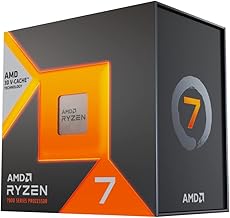
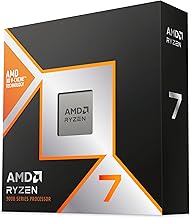
Key takeaways
- Cores and threads: The 9950X3D offers 16 cores and 32 threads across two CCDs, while the 9800X3D provides 8 cores and 16 threads on a single die.
- Cache layout: The 9800X3D carries 96MB of total L3 on one cache-stacked die. The 9950X3D has 128MB total, but the stacked cache sits on only one of its two CCDs, so scheduling matters.
- Gaming performance: Across large test suites the two land within roughly 1 to 3 percent of each other at 1440p and are effectively identical at 4K, where the GPU sets the ceiling.
- Productivity: This is not close. The 9950X3D roughly doubles the 9800X3D in Blender, Handbrake, code compilation, and other all-core workloads.
- Power and thermals: 170W TDP versus 120W. The 9950X3D wants a 360mm AIO or a top-tier air cooler under sustained load; the 9800X3D is happy on a good dual-tower.
- Cost of entry: The 9800X3D pairs sensibly with a mid-range B850 board, while 9950X3D buyers typically step up to X870E for better VRMs and connectivity.
Two years after Zen 5’s launch, AMD’s 3D V-Cache lineup has settled into a clear split, and in 2026 the decision most enthusiasts face comes down to two chips: the 16-core Ryzen 9 9950X3D and the 8-core Ryzen 7 9800X3D. Both sit on the same AM5 socket, both use the same second-generation stacked cache technology, and both will comfortably feed anything from an RTX 5080 to a Radeon RX 9070 XT. The difference is what happens outside of games, and how much you are willing to pay for headroom you may never touch.
That question matters more now than it did at launch. AM5 support runs through 2027 and beyond, DDR5 kits have matured to the point where 6000 MT/s CL28 is routine, and GPUs have become the dominant cost in most builds. Choosing between these two processors is really a choice about where your budget belongs: in a CPU that doubles as a workstation, or in a CPU that does one job exceptionally well and leaves money for the graphics card.
Our top picks
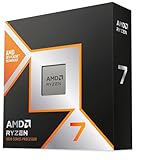
 AMD Ryzen 9 9950X3D 16-Core Processor
- AMD Ryzen 9 9950X3D Gaming and Content Creation…
- Max
- Form Factor: Desktops , Boxed Processor
 AMD Ryzen™ 9 9950X 16-Core
- The best for creators meets the best for…
- 16 Cores and 32 processing threads, based on…
- 5.7 GHz Max Boost, unlocked for overclocking, 80…
| Product | Key specs | |
|---|---|---|
| AMD Ryzen 9 9950X3D 16-Core Processor | AMD Ryzen 9 9950X3D Gaming and Content Creation… Max Form Factor: Desktops , Boxed Processor | Check price |
 AMD Ryzen™ 9 9950X3D2 Dual Edition AMD Ryzen™ 9 9950X3D2 Dual Edition | AMD Ryzen 9 9950X3D2 Dual Edition | Check price |
| AMD Ryzen™ 9 9950X 16-Core | The best for creators meets the best for… 16 Cores and 32 processing threads, based on… 5.7 GHz Max Boost, unlocked for overclocking, 80… | Check price |
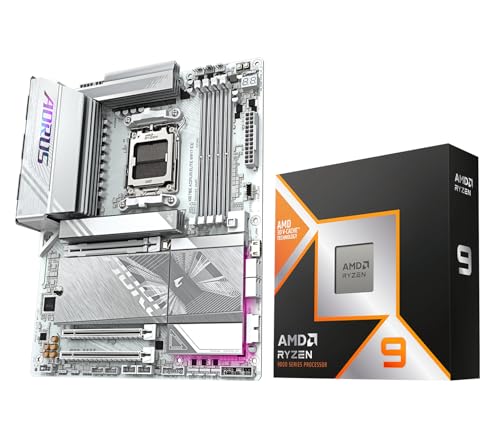 AMD 9950X3D Processor with GIGABYTE X870E AORUS AMD 9950X3D Processor with GIGABYTE X870E AORUS | AMD Ryzen 9 9950X3D Desktop Processor, 16-Core, 32-Thread,… For the state-of-the-art Socket AM5 platform, can support… GIGABYTE X870E AORUS Elite WIFI7 ICE Motherboard, ATX… | Check price |
 Panorama XL RTX 5080 16GB Panorama XL RTX 5080 16GB | [CPU] AMD Ryzen 9 9950X3D Processor (16 Cores,… [GPU] NVD Geforce RTX 5080 (16GB GDDR7 dedicated… [FANS] 10 ARGB PWM Fans for Powerful Air… | Check price |
 Micro Center AMD Ryzen 9 9950X3D Processor Micro Center AMD Ryzen 9 9950X3D Processor | AMD Ryzen 9 9950X3D Desktop Processor, 16-Core, 32-Thread,… For the state-of-the-art Socket AM5 platform, can support… P WiFi Motherboard, ATX Form Factor, Socket AM5,… | Check price |
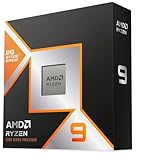
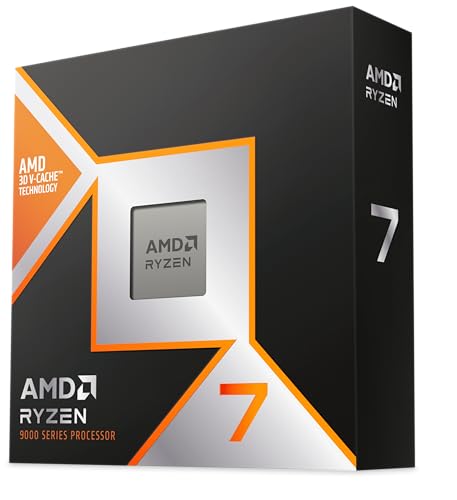 AMD RYZEN 7 9800X3D 8-Core AMD RYZEN 7 9800X3D 8-Core | The world’s fastest gaming processor, built on AMD… 8 cores and 16 threads, delivering +~16% IPC… 96MB L3 cache with better thermal performance vs | Check price |
 AMD Ryzen 9 9900X3D 12-Core Processor AMD Ryzen 9 9900X3D 12-Core Processor | AMD Ryzen 9 9900X3D Gaming and Content Creation… | Check price |
As an Amazon Associate we earn from qualifying purchases at no extra cost to you.
⚡ Save on Your Next PC — Amazon Prime
Prime members get fast free shipping on the systems above, plus early access to Prime Day & Black Friday PC deals. New members get a 30-day free trial.
Watch: Ryzen 9 9950X3D vs 9800X3D: 2026 Showdown — Video Review
Quick Verdict
The Ryzen 7 9800X3D remains the smartest buy for pure gaming builds. It delivers the same class-leading frame rates as its bigger sibling in the overwhelming majority of titles, runs cooler, and costs meaningfully less. The Ryzen 9 9950X3D is the better processor overall, and the right pick if you stream, render, compile, or run heavy simulation work alongside gaming, where sixteen cores turn a two-hour job into a one-hour one.
Key Differences
- Cores and threads: The 9950X3D offers 16 cores and 32 threads across two CCDs, while the 9800X3D provides 8 cores and 16 threads on a single die.
- Cache layout: The 9800X3D carries 96MB of total L3 on one cache-stacked die. The 9950X3D has 128MB total, but the stacked cache sits on only one of its two CCDs, so scheduling matters.
- Gaming performance: Across large test suites the two land within roughly 1 to 3 percent of each other at 1440p and are effectively identical at 4K, where the GPU sets the ceiling.
- Productivity: This is not close. The 9950X3D roughly doubles the 9800X3D in Blender, Handbrake, code compilation, and other all-core workloads.
- Power and thermals: 170W TDP versus 120W. The 9950X3D wants a 360mm AIO or a top-tier air cooler under sustained load; the 9800X3D is happy on a good dual-tower.
- Cost of entry: The 9800X3D pairs sensibly with a mid-range B850 board, while 9950X3D buyers typically step up to X870E for better VRMs and connectivity.
AMD Ryzen 9 9950X3D
The 9950X3D is AMD’s do-everything flagship. Its cache-equipped CCD handles games while the frequency-optimized second CCD takes on background and multithreaded tasks, coordinated by AMD’s driver and the Windows scheduler. That arrangement has grown considerably more reliable since 2025; provided your chipset drivers and BIOS are current, cross-CCD misassignment is now rare rather than routine. Boost clocks reach into the high 5GHz range, so lightly threaded applications also feel quicker than on the 9800X3D.
If you would rather not source parts individually, bundles simplify the build. The 9950X3D with the GIGABYTE X870E AORUS Elite WIFI7 ICE combo covers PCIe 5.0, quad M.2, USB4, and Wi-Fi 7 in one purchase, and the Micro Center 9950X3D with MSI PRO X870E-P bundle is a similarly complete AM5 foundation. Prebuilt shoppers can skip assembly entirely with something like the Panorama XL, which pairs the 9950X3D with an RTX 5080, 32GB of DDR5, and a 2TB Gen4 NVMe drive.
AMD Ryzen 7 9800X3D
The 9800X3D earned its reputation by being boring in the best way. One CCD, one pool of stacked cache, no scheduling to think about. Every core has full access to that 96MB, which is exactly what cache-sensitive engines want: simulation-heavy strategy titles, large-map shooters, MMOs, and CPU-bound sims like flight and racing all respond dramatically to it. Minimum frame rates and frame-time consistency, not average FPS, are where the difference shows.
It is also the easier chip to live with. Lower power draw means a quieter system, a smaller cooler, and a cheaper power supply. Unlike earlier X3D parts it is fully unlocked for overclocking, and Precision Boost Overdrive with Curve Optimizer typically finds a few extra percent for free. For a gaming-first build in 2026, the money saved against the 9950X3D is better spent on a faster GPU almost every time.
Which Should You Buy?
- For pure gaming at 1440p or 4K: pick the 9800X3D and put the savings toward your graphics card.
- For gaming plus streaming, editing, or rendering: pick the 9950X3D; the second CCD absorbs encoding and export work without touching frame rates.
- For developers and engineers who also game: pick the 9950X3D, where compile and simulation times justify the premium outright.
- For maximum multithreaded value with no gaming priority: consider the standard Ryzen 9 9950X, which matches the core count without paying for stacked cache.
- For a no-compromise halo build: the Ryzen 9 9950X3D2 Dual Edition extends V-Cache across both CCDs, at a price only enthusiasts will entertain.
Frequently Asked Questions
Is the 9950X3D actually faster in games?
Marginally, and inconsistently. Some titles favor its higher boost clocks, others prefer the 9800X3D’s simpler single-die layout. Averaged across a broad suite the gap is within a few percent, and at 4K it usually disappears entirely.
Do I need a specific motherboard or BIOS?
Any AM5 board with a current BIOS will run either chip. For the 9950X3D, prioritize strong VRM cooling; X870E and better B850 boards are the safe choices. Always flash to the latest firmware before first boot.
How does the 9950X3D2 Dual Edition compare?
It places stacked cache on both CCDs, eliminating the split-die scheduling question and helping workloads that spill past eight cores. Availability is limited and pricing is steep, so it is a niche upgrade rather than a mainstream recommendation.
Is the 9800X3D still worth buying in 2026?
Yes. It continues to trade blows with far more expensive processors in gaming benchmarks, and AM5’s long support window means you can drop in a newer X3D part later without replacing the board or memory.
Final Verdict
Buy the Ryzen 7 9800X3D if you game and little else; it captures nearly all of the performance for noticeably less money and less he