Key takeaways
- Memory: The 9070 XT ships with 16GB of GDDR6 on a 256-bit bus; the RTX 5070 has 12GB of faster GDDR7 on a narrower 192-bit bus. Effective bandwidth is close, but capacity is not.
- Rasterization: In traditional rendering the 9070 XT is typically the faster card at 1440p and 4K, often by a meaningful double-digit margin, and it trades blows with cards a tier above it.
- Ray tracing: RDNA 4 dramatically narrowed AMD’s RT deficit, and the 9070 XT is competitive in most hybrid-RT games. In fully path-traced showcases, NVIDIA still holds the advantage.
- Upscaling and frame generation: FSR 4 is a genuine machine-learning upscaler and looks excellent, but DLSS 4 remains slightly ahead on image stability and is supported in a larger back catalogue, with Multi Frame Generation as a bonus.
- Power and thermals: The 9070 XT draws roughly 300W under load versus around 250W for the RTX 5070, so it demands a beefier PSU and better case airflow.
- Creative and AI work: NVENC, CUDA, and broad AI-framework support still make the RTX 5070 the safer pick for editors, streamers, and hobbyist ML users.
The mid-range graphics card fight has rarely been this close. AMD’s Radeon RX 9070 XT and NVIDIA’s GeForce RTX 5070 launched into the same price bracket, target the same buyer, and promise the same thing: no-compromise 1440p gaming with enough headroom to flirt with 4K. Two years on, both are mature, widely stocked, and heavily discounted by board partners — which makes the decision harder, not easier.
In 2026 the choice matters more than a simple frames-per-second chart suggests. Game texture budgets have ballooned, ray tracing is increasingly non-optional rather than a toggle, and upscaling quality now shapes the experience as much as raw silicon does. One of these cards gives you more memory and more raster throughput; the other gives you the most polished feature stack in the industry. Here’s how they actually compare.
Our top picks


 ASUS Prime AMD Radeon RX 9070 XT
- Product Group: Personal Computer
- Binding: Personal Computers


As an Amazon Associate we earn from qualifying purchases at no extra cost to you. Ratings are shown as listed on Amazon.
⚡ Save on Your Next PC — Amazon Prime
Prime members get fast free shipping on the systems above, plus early access to Prime Day & Black Friday PC deals. New members get a 30-day free trial.
Watch: RX 9070 XT vs RTX 5070: 2026 Comparison — Video Review
Quick Verdict
The RX 9070 XT is the better buy for most 1440p and 1440p ultrawide gamers who want maximum frames per dollar and 16GB of VRAM to future-proof against rising texture demands. The RTX 5070 makes more sense if you lean heavily on path-traced titles, stream or edit video, use CUDA-accelerated creative apps, or want DLSS 4 Multi Frame Generation in the widest possible library of games.
Key Differences
- Memory: The 9070 XT ships with 16GB of GDDR6 on a 256-bit bus; the RTX 5070 has 12GB of faster GDDR7 on a narrower 192-bit bus. Effective bandwidth is close, but capacity is not.
- Rasterization: In traditional rendering the 9070 XT is typically the faster card at 1440p and 4K, often by a meaningful double-digit margin, and it trades blows with cards a tier above it.
- Ray tracing: RDNA 4 dramatically narrowed AMD’s RT deficit, and the 9070 XT is competitive in most hybrid-RT games. In fully path-traced showcases, NVIDIA still holds the advantage.
- Upscaling and frame generation: FSR 4 is a genuine machine-learning upscaler and looks excellent, but DLSS 4 remains slightly ahead on image stability and is supported in a larger back catalogue, with Multi Frame Generation as a bonus.
- Power and thermals: The 9070 XT draws roughly 300W under load versus around 250W for the RTX 5070, so it demands a beefier PSU and better case airflow.
- Creative and AI work: NVENC, CUDA, and broad AI-framework support still make the RTX 5070 the safer pick for editors, streamers, and hobbyist ML users.
AMD Radeon RX 9070 XT: Raster Muscle and 16GB of Headroom
The 9070 XT is the value play, and its trump card is memory. Sixteen gigabytes means you can run ultra textures, high-resolution shadow maps, and heavy mod loads without the stutter and texture pop-in that 12GB cards increasingly exhibit at 1440p and above. Combine that with class-leading raster performance and you get a card that ages gracefully rather than falling off a cliff.
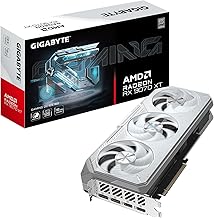
Board partner choice matters here because this is a warm chip. The GIGABYTE RX 9070 XT Gaming OC 16G and its white Gaming OC ICE sibling use a 2.7-slot cooler with server-grade thermal gel and hold clocks impressively well. The ASUS Prime RX 9070 XT OC Edition is the pick for compact builds thanks to its 2.5-slot design, dual BIOS, and ball-bearing Axial-tech fans, while the ASRock Challenger 16GB OC pushes a 2970 MHz boost clock with triple-fan cooling. The XFX Swift and PowerColor Reaper are the sensible, quieter budget options — the Reaper in particular fits cases where a chunky triple-slot card simply won’t. All support PCIe 5.0, DisplayPort 2.1a, and HDMI 2.1b.
NVIDIA GeForce RTX 5070: DLSS 4 and Efficiency
The RTX 5070’s argument is polish. DLSS 4’s transformer model produces the cleanest upscaled image available, Multi Frame Generation can multiply on-screen smoothness in supported titles, and Reflex keeps latency in check. If you play a lot of ray-traced or path-traced games — the kind where the lighting is the point — the 5070 delivers a more consistent experience than its raw specification suggests.
It’s also the easier card to live with. Lower power draw means a smaller PSU, less heat dumped into your case, and quieter operation under sustained load, which is a real advantage in small form factor builds. The catch is that 12GB frame buffer. It’s adequate at 1440p today, but it’s the specification most likely to force settings compromises before the card’s raw performance does, particularly if you enable ray tracing and frame generation together.
Which Should You Buy?
- For 1440p high-refresh gaming: Pick the RX 9070 XT. It delivers more frames per dollar and won’t run short on VRAM.
- For path-traced showcase titles: Pick the RTX 5070 for stronger heavy-RT performance and DLSS 4 Multi Frame Generation.
- For streaming and content creation: Pick the RTX 5070 — NVENC and CUDA support remain the industry default.
- For small form factor or low-wattage builds: Pick the RTX 5070, or the compact ASUS Prime or PowerColor Reaper versions of the 9070 XT if you have the power headroom.
- For longevity on a fixed budget: Pick the RX 9070 XT. The extra 4GB of VRAM is the single best hedge against 2027’s game requirements.
Frequently Asked Questions
Is 12GB of VRAM still enough in 2026?
At 1080p and most 1440p settings, yes. In the most demanding recent releases with ultra textures and ray tracing enabled, 12GB is where you’ll start dropping a setting or two. 16GB removes that concern entirely.
What power supply does the RX 9070 XT need?
Plan on a quality 750W to 850W unit depending on your CPU and how heavily overclocked your card is. The RTX 5070 is comfortable on a good 650W supply.
Is FSR 4 finally comparable to DLSS 4?
It’s much closer than FSR 3 ever was. In quality mode at 1440p most players won’t notice a difference in motion. DLSS 4 retains a small edge in fine detail stability and is supported in more older games.
Can either card handle 4K gaming?
Both can with upscaling enabled. The 9070