Ultrawide monitors have quietly become the enthusiast’s default for immersive single-player worlds and productivity-heavy setups alike. That extra horizontal real estate wraps racing sims, open-world RPGs, and flight simulators around your peripheral vision in a way a standard 16:9 panel simply cannot match, and the wide desktop pays dividends the moment you alt-tab into a spreadsheet.
The catch is that “ultrawide” spans a huge range of prices, panel types, and refresh rates, so buying blind is a genuine risk. Below we break down the panels worth your money in 2026, along with the specs that actually move the needle for gaming.
Our top picks
 Samsung 34' Odyssey G5 Ultra-Wide Gaming Monitor
- OPTIMAL CURVE, TRUE IMMERSION: The all-encompassing 1000R display…
- The ultrawide WQHD monitor provides a seamless dual-monitor…
- This gaming monitor features a 165Hz refresh rate…
 Sceptre 34-Inch Curved Ultrawide WQHD Monitor
- 1ms MPRT: Colors fade and illuminate instantly with…
- Luminous Backcover Lights: A colorful LED light illuminates…
- WQHD Resolution: At 5 million pixels, Wide Quad…
| Product | Key specs | |
|---|---|---|
| Samsung 34' Odyssey G5 Ultra-Wide Gaming Monitor | OPTIMAL CURVE, TRUE IMMERSION: The all-encompassing 1000R display… The ultrawide WQHD monitor provides a seamless dual-monitor… This gaming monitor features a 165Hz refresh rate… | Check price |
| Sceptre 34-Inch Curved Ultrawide WQHD Monitor | 1ms MPRT: Colors fade and illuminate instantly with… Luminous Backcover Lights: A colorful LED light illuminates… WQHD Resolution: At 5 million pixels, Wide Quad… | Check price |
 CRUA 34" WQHD 165Hz IPS Ultrawide Gaming CRUA 34" WQHD 165Hz IPS Ultrawide Gaming | Check price | |
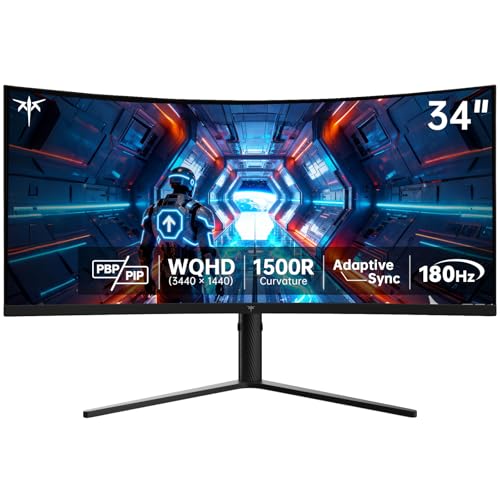 KTC 34 Inch Ultrawide Curved Gaming Monitor KTC 34 Inch Ultrawide Curved Gaming Monitor | 34 Inch Ultrawide Monitor: This ktc 34 curved… Smooth Gaming Experience: 180Hz refresh rate and adaptive… Vibrant and Vivid Colors: Enjoy true-to-life colors with… | Check price |
 LG 34G630A-B 34-Inch Ultragear WQHD LG 34G630A-B 34-Inch Ultragear WQHD | UltraGear: More Screen 21:9 Widescreen Gaming - The 21:9 UltraGear WQHD… 240Hz Refresh Rate for the Win - React… | Check price |
 Gawfolk 34 Inch Ultrawide Gaming Monitor Gawfolk 34 Inch Ultrawide Gaming Monitor | 165Hz + FreeSync: Seamless, Tear-Free Gaming More Pixels, More Space: UWQHD (3440x1440) delivers more… Brilliant Picture Quality: The IPS panel delivers sharper… | Check price |
 INNOCN 49" Curved Gaming Monitor 144Hz Ultrawide INNOCN 49" Curved Gaming Monitor 144Hz Ultrawide | 【Curved Ultrawide Monitor 49" & VA】 Premium VA… 【USB Type C, DP and HDMI Ports】49C1G widescreen… 【Adaptive-Sync & HDR 400 Technology】 INNOCN 49C1G ultrawide… | Check price |
 ASUS TUF Gaming 34” Ultra-Wide Curved Monitor ASUS TUF Gaming 34” Ultra-Wide Curved Monitor | Ultra-Wide QHD Curved Display: 34-inch QHD (3440x1440) 1500R… Fast Response Time and Motion Blur Reduction: 1ms… FreeSync Premium Technology: Delivers a seamless, tear-free gaming… | Check price |
As an Amazon Associate we earn from qualifying purchases at no extra cost to you.
🎮 Get More From Your Setup — Free
Prime Gaming gives you free PC games every month, in-game loot, and a free Twitch channel sub — plus fast free shipping on all the gear above. New members get a 30-day free trial.
Watch: Best Ultrawide Monitors For Gaming — Video Review
How to Choose an Ultrawide Gaming Monitor
- Resolution and aspect ratio: 3440×1440 (21:9) is the sweet spot for most GPUs; 5120×1440 (32:9) is stunning but demands a top-tier graphics card to drive it comfortably.
- Refresh rate: 144Hz is the practical floor for fast games; 165Hz to 240Hz rewards competitive players, while 100Hz is fine for slower, story-driven titles.
- Panel technology: IPS delivers the best color and viewing angles, VA offers deeper contrast on a budget, and QD-OLED gives near-perfect blacks at a premium.
- Curvature: A 1000R or 1500R curve reduces edge distortion on wide screens and keeps the far corners at a consistent viewing distance.
- Adaptive sync: FreeSync Premium or G-Sync compatibility eliminates tearing and should be considered non-negotiable at this size.
The Best Ultrawide Gaming Monitors Reviewed
Samsung Odyssey G5 34″
Samsung’s 34-inch Odyssey G5 nails the fundamentals with a 1000R curve, 165Hz refresh, and WQHD sharpness. It is the easiest recommendation for anyone stepping into ultrawide for the first time without overspending.
Sceptre 34″ Curved WQHD
The Sceptre C345B pushes up to 180Hz and covers 99% sRGB with dual DisplayPort inputs, making it a remarkably well-equipped budget pick. Built-in speakers are a convenient bonus for casual setups.
Samsung Odyssey G93SC 49″
This 49-inch QD-OLED super-ultrawide is the showpiece of the group, with 240Hz, near-instant 0.03ms response, and inky OLED blacks. It replaces a dual-monitor setup entirely and is glorious for sim racing.
LG UltraGear 34G630A
LG’s 34-inch UltraGear hits a blistering 240Hz with DisplayHDR 400 and USB Type-C connectivity. It is the pick for competitive players who still want the ultrawide field of view without sacrificing speed.
CRUA 34″ WQHD IPS
The CRUA 34-inch IPS panel delivers 165Hz and 120% sRGB coverage in a clean white chassis. Its wide 178-degree viewing angles and VESA mount support make it a versatile choice for hybrid work-and-play desks.
Frequently Asked Questions
Do all games support ultrawide resolutions?
Most modern AAA titles support 21:9 natively, and community fixes cover many that do not. A small number of competitive shooters cap the field of view to keep play fair.
Is 3440×1440 harder to run than 1440p?
Yes. It carries roughly 34% more pixels than standard 2560×1440, so plan for a capable mid-range or better GPU to maintain high frame rates.
Curved or flat for an ultrawide?
Curved is strongly preferred at 34 inches and above. The curve keeps the screen edges equidistant from your eyes and reduces the head-turning fatigue of a flat wide panel.
Will an ultrawide work with my console?
Consoles output 16:9, so you will see black bars on the sides. Ultrawide monitors are primarily a PC advantage.
Final Thoughts
For most players, the Samsung Odyssey G5 34″ offers the best balance of price and immersion, while the LG UltraGear 34G630A is the choice for speed-focused competitors. If budget is no object, the Samsung Odyssey G93SC 49″ QD-OLED is a category-defining experience worth every penny.