Key takeaways
- 60Hz is the old baseline, fine for casual and slower-paced games but visibly less smooth in fast action.
- 144Hz is the mainstream sweet spot, and monitors like the LG UltraGear 144Hz or ASUS TUF Gaming VG249QE5A deliver a huge, immediately noticeable jump over 60Hz.
- 165Hz and beyond, seen on displays like the Sceptre 165Hz, offer a further edge for dedicated competitive players, though the gains get smaller past 144Hz.
If you have ever wondered why some games feel buttery smooth while others look faintly choppy even at the same frame rate, the answer often comes down to refresh rate, the most overlooked specification on any gaming monitor. It is the quiet difference between a display that makes fast motion feel fluid and responsive and one that leaves it looking slightly stuttery. In competitive games especially, a higher refresh rate is one of the most immediately noticeable upgrades you can make.
This guide explains what refresh rate actually is, how it works hand in hand with your frame rate, and why technologies like adaptive sync keep everything looking clean. You will learn what the Hz numbers mean in practice, how high you really need to go, and how refresh rate fits alongside resolution when choosing a monitor. The high-refresh gaming monitors below are the displays we recommend for smooth, responsive play in 2026.
Our top picks
 Sceptre New 22-Inch Gaming Monitor
- Product Group: Personal Computer
- Binding: Personal Computers
 LG 27G414B-B 27-inch Ultragear Full HD
- Product Group: Personal Computer
- Binding: Personal Computers




As an Amazon Associate we earn from qualifying purchases at no extra cost to you. Ratings are shown as listed on Amazon.
⚡ Save on Your Next PC — Amazon Prime
Prime members get fast free shipping on the systems above, plus early access to Prime Day & Black Friday PC deals. New members get a 30-day free trial.
Watch: What Is Refresh Rate? Gaming Monitors Explained — Video Review
What Refresh Rate Really Means
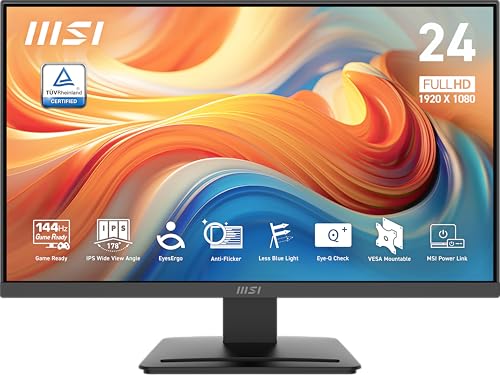
Refresh rate, measured in hertz (Hz), is how many times per second your monitor redraws the image on screen. A 60Hz display refreshes 60 times a second, while a 144Hz monitor like the Sceptre 144Hz or msi PRO MP243L does it 144 times, showing you more than twice as many updates in the same second. More refreshes mean motion appears smoother and more continuous, which makes aiming feel more precise and fast-scrolling scenes far easier on the eyes. It is the frequency of updates, not the resolution, that governs this smoothness.
Refresh Rate vs Frame Rate
These two numbers are easy to confuse but they describe different things. Frame rate (frames per second) is how many images your graphics card produces, while refresh rate is how many your monitor can display. They work as a team: a 144Hz monitor only shows its full benefit if your GPU is also pushing frames near 144, and conversely a powerful GPU is wasted on a 60Hz screen that cannot keep up. The goal is to pair a monitor and graphics card so their capabilities roughly match.
How High Should You Go?
- 60Hz is the old baseline, fine for casual and slower-paced games but visibly less smooth in fast action.
- 144Hz is the mainstream sweet spot, and monitors like the LG UltraGear 144Hz or ASUS TUF Gaming VG249QE5A deliver a huge, immediately noticeable jump over 60Hz.
- 165Hz and beyond, seen on displays like the Sceptre 165Hz, offer a further edge for dedicated competitive players, though the gains get smaller past 144Hz.
Why Adaptive Sync Matters
When your frame rate and refresh rate fall out of step, you can get screen tearing, where the image looks split, or stutter. Adaptive sync technologies, marketed as FreeSync or G-Sync, solve this by letting the monitor vary its refresh rate on the fly to match whatever your GPU is producing. Many high-refresh monitors, including the Sceptre FreeSync models, build this in. The result is tear-free, smooth motion even when your frame rate fluctuates, which it always does. It is a feature well worth having on any gaming display.
Balancing Refresh Rate With Resolution
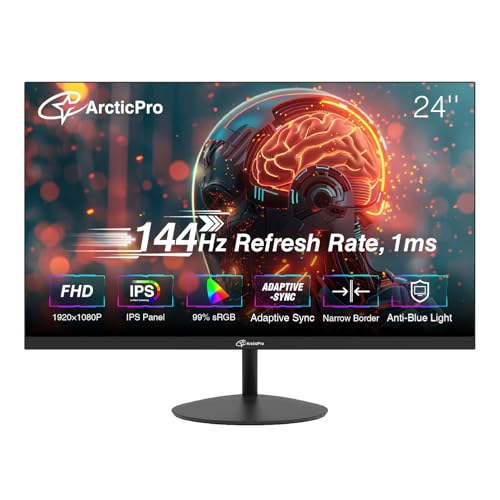
Refresh rate does not exist in a vacuum; it trades off against resolution and your GPU’s power. Pushing very high frame rates at high resolution demands a strong graphics card, so many gamers pair a fast 144Hz panel with a sensible 1080p resolution, as with the ArcticPro 24 or LG 24-inch UltraGear, to keep frames high without an expensive GPU. Decide what matters most for the games you play, raw smoothness or sharpness, then choose a monitor whose refresh rate and resolution your hardware can actually feed.
Tips
- Treat 144Hz as your target; the jump from 60Hz is the single most noticeable monitor upgrade for most gamers.
- Make sure your GPU can push frame rates near your monitor’s refresh rate, or you will not see the full benefit.
- Choose a monitor with FreeSync or G-Sync so fluctuating frame rates stay tear-free and smooth.
- For fast competitive games on a tighter budget, pair a high-refresh panel with 1080p rather than chasing higher resolution.
Frequently Asked Questions
Is 144Hz noticeably better than 60Hz?
Absolutely. Moving from 60Hz to a 144Hz monitor like the LG UltraGear or msi PRO is one of the most immediately obvious upgrades in gaming, making motion smoother and aiming feel far more responsive.
Do I need a strong GPU to benefit from a high refresh rate?
To see the full benefit, your graphics card should push frame rates near the monitor’s refresh rate. Pairing a 144Hz panel with a 1080p resolution, as on the ArcticPro 24, keeps frames high without needing a top-tier GPU.
What is the difference between FreeSync and G-Sync?
Both are adaptive sync technologies that match the monitor’s refresh rate to your GPU’s output to eliminate tearing and stutter. FreeSync is more common and widely supported; functionally, for most gamers, they achieve the same smooth result.
Is going above 144Hz worth it?
For dedicated competitive players, 165Hz and higher offer a small additional edge, and displays like the Sceptre 165Hz provide it affordably. For most people, though, the gains past 144Hz are subtle compared to the leap from 60Hz.
Conclusion
Refresh rate is the specification that decides how smooth and responsive your games feel, and in 2026 a 144Hz monitor is the sweet spot for the vast majority of players. Pair that refresh rate with a graphics card capable of feeding it, enable adaptive sync to stay tear-free, and balance the number against resolution for your hardware. Get it right and every fast-moving moment on screen will feel noticeably crisper and more in your control.