Key takeaways
- Pixel density: 1440p delivers roughly 109 PPI at 27 inches — crisp, but text and distant object detail soften. 4K hits about 163 PPI at 27 inches and 138 PPI at 32 inches, which is where fine detail genuinely pops.
- GPU load: 4K renders 2.25× the pixels of 1440p. A card that comfortably pushes 144fps at 1440p will typically land somewhere around 60–80fps at native 4K in demanding titles.
- Refresh rate ceiling: 1440p panels routinely reach 180Hz and beyond at low cost. High-refresh 4K exists — 160Hz on the Acer Nitro and CRUA 32″, 165Hz on the Samsung Odyssey G7 (G75F), 240Hz on the PG32UCDMR — but you pay a premium for it.
- Ideal screen size: 1440p looks best at 27 inches; stretch it to 32 and pixels become visible. 4K is what makes 32-inch and 37-inch panels like the Odyssey G7 usable at a normal desk distance.
- Console compatibility: Current consoles target 4K output. A 4K display with HDMI 2.1 accepts native 2160p at up to 120Hz; a 1440p monitor will downscale, and some titles handle that less gracefully.
- Cost of the whole system: The monitor is only part of the bill. 4K realistically asks for a stronger GPU, which often adds more to the total than the panel upgrade itself.
Choosing between 1440p and 4K used to be a simple budget decision. In 2026 it is genuinely a strategic one. Panel prices have fallen hard, 4K monitors now ship with 160Hz, 165Hz and even 240Hz refresh rates, and upscaling tech like DLSS 4 and FSR 4 has quietly erased much of the frame rate penalty that once made 2160p a compromise. Meanwhile, 1440p has not stood still — it has become the value sweet spot, with 180Hz+ panels, low latency and excellent motion clarity available for the price of a mid-range GPU cooler.
The right answer depends on three things: the size of the screen, the graphics card driving it, and whether you prioritise competitive frame rates or cinematic detail. A 27-inch 1440p panel and a 32-inch 4K panel are aimed at very different players. Below we break down the real-world differences in sharpness, performance cost, and value, then match each option to the kind of gamer it actually suits.
Our top picks
 Acer Nitro 27in 4K 3840x2160 IPS 160Hz
- Quality Visuals: The VG270K 27" IPS monitor with…
- AMD FreeSync Premium Technology: Say “goodbye” to stuttering…
- Quick Refresh Rate: Different content has different refresh…
 ASUS ROG PG32UCDMR 32 Inch 4K 240Hz
- Immersive 4K Gaming Display: 32-inch 4K (3840 x…
- Advanced OLED Care Technology: New ASUS OLED Care…
- Professional Color Accuracy: VESA DisplayHDR 400 True Black…
 ASUS TUF Gaming 27” 4K HDR Monitor
- 27-inch 4K Ultra HD Display: Features 3840 x…
- ASUS Extreme Low Motion Blur Sync Technology: ELMB…
- Advanced Synchronization Technologies: NVIDIA G-SYNC Compatible, AMD FreeSync…
| Product | Key specs | |
|---|---|---|
| Acer Nitro 27in 4K 3840x2160 IPS 160Hz | Quality Visuals: The VG270K 27" IPS monitor with… AMD FreeSync Premium Technology: Say “goodbye” to stuttering… Quick Refresh Rate: Different content has different refresh… | Check price |
| ASUS ROG PG32UCDMR 32 Inch 4K 240Hz | Immersive 4K Gaming Display: 32-inch 4K (3840 x… Advanced OLED Care Technology: New ASUS OLED Care… Professional Color Accuracy: VESA DisplayHDR 400 True Black… | Check price |
| ASUS TUF Gaming 27” 4K HDR Monitor | 27-inch 4K Ultra HD Display: Features 3840 x… ASUS Extreme Low Motion Blur Sync Technology: ELMB… Advanced Synchronization Technologies: NVIDIA G-SYNC Compatible, AMD FreeSync… | Check price |
 CRUA 32" 4K UHD 160Hz Curved Gaming CRUA 32" 4K UHD 160Hz Curved Gaming | 32inch 4K Curved Display: Enjoy breathtaking clarity and… 160Hz Refresh Rate + AMD FreeSync: Dominate every… 120% sRGB Color Accuracy & Built-in Speakers: Featuring… | Check price |
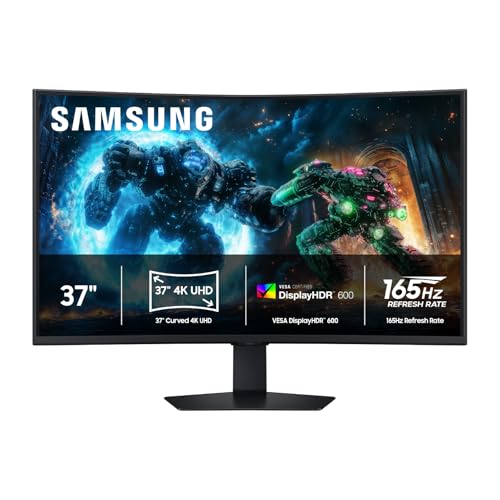 Samsung 37” Odyssey G7 Samsung 37” Odyssey G7 | Samsung’s 37” 4K UHD Odyssey G7 Curved Gaming… 37” 1000R curved display with 4K UHD resolution… VESA DisplayHDR 600 delivers more contrast, with deeper… | Check price |
 Samsung 27" Odyssey G5 Samsung 27" Odyssey G5 | QHD Resolution (2560 x 1440) has 1.7 times… HDR10 provides brighter highlights and nuanced shadow for… The 180Hz refresh rate minimizes lag for gameplay… | Check price |
 Samsung 32" Odyssey Samsung 32" Odyssey | Your gaming world, more lifelike than ever Experience the exhilaration of gameplay as you speed… Experience the next level of heart-pounding gaming | Check price |
 LG 27G810A-B 27-inch Ultragear 4K UHD LG 27G810A-B 27-inch Ultragear 4K UHD | 27” 4K Gaming—Speed Meets Clarity - UltraGear's 27-inch… Breathtaking UHD Clarity, Bold Colors, and DisplayHDR 400… Dual Mode: 4K UHD 180Hz or Full HD… | Check price |
As an Amazon Associate we earn from qualifying purchases at no extra cost to you.
⚡ Save on Your Next PC — Amazon Prime
Prime members get fast free shipping on the systems above, plus early access to Prime Day & Black Friday PC deals. New members get a 30-day free trial.
Watch: 1440p vs 4K Gaming Monitor: 2026 Guide — Video Review
Quick Verdict
Pick 1440p if you play competitive shooters, own a mid-range GPU, or want the highest frame rate per dollar — the Samsung Odyssey G5 (G51F) at 27 inches and 180Hz is the archetype of that value. Pick 4K if you game at 32 inches or larger, play visually rich single-player titles, use the monitor for creative or productivity work, or own a PS5 Pro or Xbox Series X. Options like the Acer Nitro VG270K V4 and ASUS TUF VG27UQ1A make 4K affordable, while the ASUS ROG PG32UCDMR represents the current high-water mark.
Key Differences
- Pixel density: 1440p delivers roughly 109 PPI at 27 inches — crisp, but text and distant object detail soften. 4K hits about 163 PPI at 27 inches and 138 PPI at 32 inches, which is where fine detail genuinely pops.
- GPU load: 4K renders 2.25× the pixels of 1440p. A card that comfortably pushes 144fps at 1440p will typically land somewhere around 60–80fps at native 4K in demanding titles.
- Refresh rate ceiling: 1440p panels routinely reach 180Hz and beyond at low cost. High-refresh 4K exists — 160Hz on the Acer Nitro and CRUA 32″, 165Hz on the Samsung Odyssey G7 (G75F), 240Hz on the PG32UCDMR — but you pay a premium for it.
- Ideal screen size: 1440p looks best at 27 inches; stretch it to 32 and pixels become visible. 4K is what makes 32-inch and 37-inch panels like the Odyssey G7 usable at a normal desk distance.
- Console compatibility: Current consoles target 4K output. A 4K display with HDMI 2.1 accepts native 2160p at up to 120Hz; a 1440p monitor will downscale, and some titles handle that less gracefully.
- Cost of the whole system: The monitor is only part of the bill. 4K realistically asks for a stronger GPU, which often adds more to the total than the panel upgrade itself.
1440p: The Frame Rate Sweet Spot
QHD remains the most sensible resolution for the majority of PC gamers, and the Samsung Odyssey G5 (G51F) shows why. At 27 inches, 180Hz and 1ms response, it delivers the fluid motion that matters in Valorant, CS2, Apex and Marvel Rivals, with AMD FreeSync to keep tearing away and a Black Equalizer plus Virtual Aim Point for competitive visibility. Crucially, a mainstream GPU can actually saturate that refresh rate in most esports and many AAA titles.
The trade-off is detail. Text is noticeably less sharp than on a 4K panel of the same size, foliage and hair shimmer more, and if you also edit photos or work in spreadsheets all day, you will feel the missing desktop real estate. 1440p is not a downgrade — it is a deliberate allocation of your budget toward frames rather than pixels.
4K: Detail, Immersion and Big-Screen Gaming
4K has become far more attainable. The ASUS TUF VG27UQ1A and Acer Nitro VG270K V4 both pair 27-inch 4K panels with 160Hz refresh rates, G-SYNC and FreeSync support, and fast response times; the Acer even adds a Dual Frame Rate mode that drops to 1080p at 320Hz when you want maximum speed in competitive sessions. For larger, more immersive setups, the CRUA 32-inch 1500R curved VA and the Samsung Odyssey G7 (G75F) at 37 inches with DisplayHDR 600 turn 4K into a genuine cockpit experience for racing, flight and open-world games.
At the top end, the ASUS ROG PG32UCDMR combines 4K, 240Hz and QD-OLED into a panel with near-instant 0.03ms response, 99% DCI-P3 coverage, true 10-bit colour and 90W USB-C — effectively removing the old “sharp or fast, pick one” compromise. It is the enthusiast choice, and it expects an enthusiast GPU to match.
Which Should You Buy?
- For competitive esports: pick 1440p — the Samsung Odyssey G5 (G51F) at 180Hz gives you the frames without demanding a flagship GPU.
- For a mid-range GPU: pick 1440p, or a 27-inch 4K panel like the ASUS TUF VG27UQ1A if you are happy leaning on DLSS and FSR upscaling.
- For 32 inches or larger: pick 4K — the CRUA 32″ curved or Samsung Odyssey G7 (G75F) keep the image sharp at sizes where 1440p falls apart.
- For PS5 and Xbox Series X: pick 4K with HDMI 2.1; the Acer Nitro VG270K V4 handles native 2160p console output cleanly.
- For no-compromise enthusiasts: pick the ASUS ROG PG32UCDMR — 4K, 240Hz and QD-OLED in one panel.
Frequently Asked Questions
Is 4K worth it at 27 inches?
Yes, if you sit close and value sharpness. At 27 inches 4K delivers roughly 163 PPI, which makes text and fine texture detail dramatically cleaner. You will likely need upscaling to hit high frame rates, but panels like the Acer Nitro VG270K V4 make it affordable to try.
Can I run 4K at 160Hz or 240Hz?
Only with a strong GPU and modern upscaling. Native 4K at 240Hz is realistic in esports titles; in demanding AAA games, expect to use DLSS 4 or FSR 4 with frame generation to approach those numbers. High refresh still helps by reducing latency and smoothing motion even below the cap.
Does 1440p look bad on a 32-inch monitor?
It looks noticeably softer. Pixel density drops to about 92 PPI, so individual pixels become visible at typical desk distance. At 32 inches and above, 4K is the better match — which is why panels like the CRUA 32″ and Odyssey G7 use it.
Which is better for mixed work and gaming?
4K, comfortably. The extra desktop space, sharper text and wider colour coverage matter for editing, coding and multitasking. The ASUS ROG PG32UCDMR’s 90W USB-C and 99% DCI-P3 coverage make it especially strong as a single laptop-and-console hub.
Final Verdict
If your budget is finite and your GPU is mid-range, 1440p at 27 inches remains the smartest buy in 2026 — the Samsung Odyssey G5 (G51F) delivers high refresh gaming without forcing a graphics card upgrade. If you are building around a larger screen, playing on console, or want the best-looking image money can buy, 4K has matured to the point where there is no real reason to hold back: the Acer Nitro VG270K V4 and ASUS TUF VG27UQ1A cover the value end, while the ASUS ROG PG32UCDMR is the panel to beat.