Key takeaways
- Resolution and size: At this budget, 27-inch QHD (2560×1440) is the clear value winner. It delivers roughly 109 pixels per inch — noticeably sharper than 1080p at the same size — without demanding the GPU horsepower that 4K gaming requires.
- Panel type: Fast IPS gives you accurate colour, wide viewing angles and strong brightness for well-lit rooms. VA offers deeper blacks and is common on curved models. QD-OLED delivers the best contrast and pixel response by a wide margin, but costs more and needs a darker room to shine.
- Refresh rate and response: 144Hz is the practical minimum for competitive play; 165–180Hz is the current sweet spot and costs very little extra. Treat “1ms” claims with scepticism — real-world grey-to-grey performance and overdrive tuning matter far more than the marketed figure.
- Adaptive sync: Make sure the monitor supports FreeSync Premium and is G-SYNC Compatible certified. This eliminates tearing and stutter across a variable frame rate range, and at this price there’s no reason to accept a panel without it.
- Connectivity: Check for DisplayPort 1.4 (needed to hit full refresh rate at 1440p) plus at least two HDMI 2.0 ports for consoles. USB-C with power delivery is a genuine bonus if you dock a laptop, and built-in speakers save desk space even if they won’t replace headphones.
Shopping for a gaming monitor under $500 is harder than it should be. Spec sheets are crowded with acronyms, refresh rates get quoted in “overclocked” numbers that panels can’t sustain cleanly, and two monitors with identical 1440p/180Hz listings can look and feel completely different in a real game. Add in the fact that OLED has finally drifted into this price bracket, and the choice between a bright, reliable IPS panel and a contrast-rich QD-OLED becomes genuinely difficult.
This guide cuts through that. We’ve focused on 27-inch 1440p displays, which remain the sweet spot for value in 2026 — high enough resolution to look sharp, easy enough to drive that a mid-range GPU can push high frame rates. Below you’ll find our top picks, a short buying checklist covering the specs that actually matter, and answers to the questions readers ask most often. Every recommendation here sits realistically within a $500 budget.
Our top picks


 ASUS TUF Gaming 27” 1440P HDR Monitor
- Product Group: Personal Computer
- Binding: Personal Computers
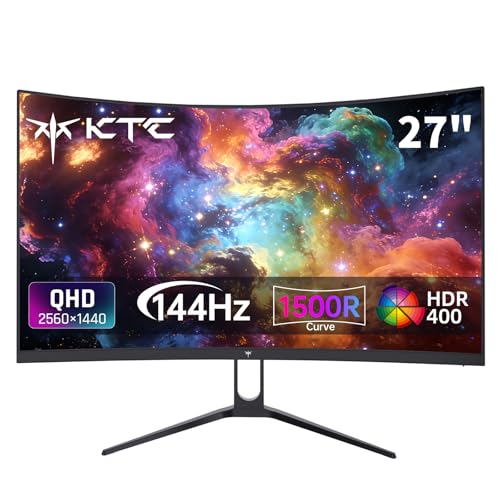 KTC H27S5C 27 Inch Curved Gaming Monitor
- Product Group: Personal Computer
- Binding: Electronics



As an Amazon Associate we earn from qualifying purchases at no extra cost to you. Ratings are shown as listed on Amazon.
⚡ Save on Your Next PC — Amazon Prime
Prime members get fast free shipping on the systems above, plus early access to Prime Day & Black Friday PC deals. New members get a 30-day free trial.
Watch: Best Gaming Monitor Under $500 — Video Review
How to Choose Gaming Monitor Under $500
- Resolution and size: At this budget, 27-inch QHD (2560×1440) is the clear value winner. It delivers roughly 109 pixels per inch — noticeably sharper than 1080p at the same size — without demanding the GPU horsepower that 4K gaming requires.
- Panel type: Fast IPS gives you accurate colour, wide viewing angles and strong brightness for well-lit rooms. VA offers deeper blacks and is common on curved models. QD-OLED delivers the best contrast and pixel response by a wide margin, but costs more and needs a darker room to shine.
- Refresh rate and response: 144Hz is the practical minimum for competitive play; 165–180Hz is the current sweet spot and costs very little extra. Treat “1ms” claims with scepticism — real-world grey-to-grey performance and overdrive tuning matter far more than the marketed figure.
- Adaptive sync: Make sure the monitor supports FreeSync Premium and is G-SYNC Compatible certified. This eliminates tearing and stutter across a variable frame rate range, and at this price there’s no reason to accept a panel without it.
- Connectivity: Check for DisplayPort 1.4 (needed to hit full refresh rate at 1440p) plus at least two HDMI 2.0 ports for consoles. USB-C with power delivery is a genuine bonus if you dock a laptop, and built-in speakers save desk space even if they won’t replace headphones.
The Best Picks Reviewed
ASUS TUF Gaming VG27AQ3A
This is the best all-round choice under $500 for most gamers: a 180Hz Fast IPS panel with 130% sRGB coverage, Extreme Low Motion Blur Sync, and both FreeSync Premium and G-SYNC compatibility. Motion clarity is excellent for an IPS display, and the inclusion of speakers and a fully adjustable stand makes it feel more premium than its price suggests.
Samsung Odyssey OLED G6 (G61SH)
If you can stretch to the top of the budget, this QD-OLED delivers per-pixel contrast and near-instant response times that no IPS panel can match — dark scenes and fast motion are transformative. Just be aware it performs best in a room with controlled lighting, and you should use Samsung’s built-in burn-in protection features.
ASUS ROG XG27ACS
The standout pick for anyone splitting time between a desktop and a laptop, thanks to USB-C connectivity alongside its 180Hz 1440p panel and G-SYNC support. Colour accuracy out of the box is strong, and ASUS’s overdrive tuning keeps overshoot artefacts under control at high refresh rates.
Acer Nitro KG271U N3bmiipx
A no-nonsense budget champion that hits 180Hz on an IPS panel for meaningfully less than the competition. The stand is basic and HDR support is nominal rather than impactful, but the core gaming experience — sharp, fast and tear-free — is genuinely hard to beat at this price.
Samsung Odyssey G5 (G51F)
Samsung’s G5 leans on strong native contrast and a well-tuned QHD panel to deliver punchy, saturated visuals that suit single-player and cinematic games particularly well. It’s a sensible pick if you value image depth over the last few frames of motion clarity.
Frequently Asked Questions
Is 1440p worth it over 1080p for gaming?
Yes, for the vast majority of players. At 27 inches, 1080p looks noticeably soft, while 1440p offers a clear jump in detail without the heavy GPU cost of 4K. A modern mid-range card can comfortably drive 1440p at high frame rates in most titles.
Do I need more than 144Hz?
The jump from 60Hz to 144Hz is dramatic; the jump from 144Hz to 180Hz is subtle and mostly relevant to competitive shooters. Since 180Hz panels now cost roughly the same as 144Hz ones, it’s worth having — but don’t pay a large premium for it.
Should I buy an OLED at this budget?
Only if image quality is your top priority and you game in a dimmer room. QD-OLED contrast is outstanding, but IPS panels are brighter, cheaper and carry no burn-in considerations, which makes them the safer choice for mixed desktop and gaming use.
Does a curved monitor help in games?
At 27 inches the effect is mild — curvature becomes genuinely immersive at 32 inches and above, or on ultrawides. Choose curved if you like the aesthetic and sit close, but don’t treat it as a deciding factor at this size.
Final Thoughts
For most buyers, the ASUS TUF Gaming VG27AQ3A is the smartest use of a $500 budget, combining 180Hz Fast IPS performance with a genuinely complete feature set. Those chasing the best possible image quality should stretch to the Samsung Odyssey OLED G6, while anyone who wants maximum performance per dollar will find the Acer Nitro KG271U almost impossible to beat.